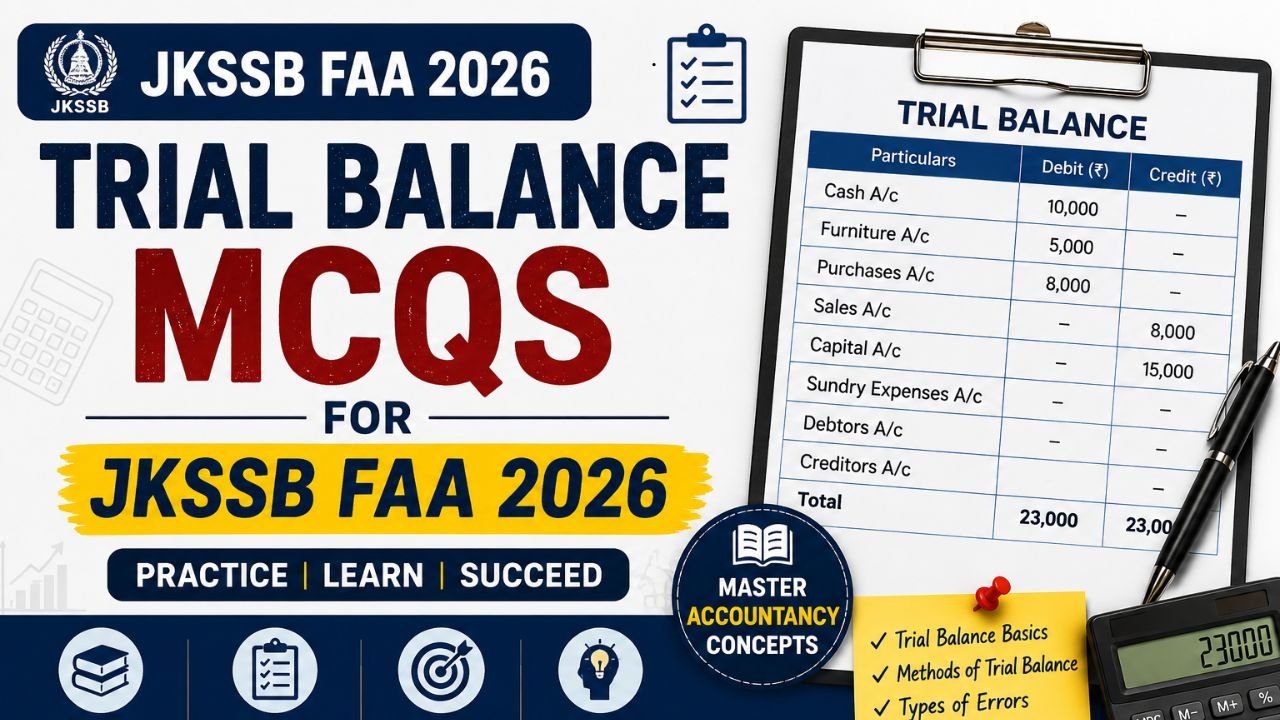
Dear aspirants, strengthen your JKSSB FAA 2026 preparation with these important Trial Balance MCQs by Exam Waves. Practice questions on Trial Balance, types of errors, debit-credit balances, and Suspense Account to improve your Accountancy concepts and exam readiness.
Q1. Which of the following statements correctly describe a Trial Balance?
- It is a statement and not an account.
- It acts as an arithmetical check under the Double Entry System.
- It verifies whether both aspects of every transaction have been recorded accurately or not.
- It is prepared for a particular date.
A) 1 and 2 only
B) 1, 2 and 3 only
C) 2, 3 and 4 only
D) 1, 2, 3 and 4
Answer: D
Q2. Consider the following statements regarding the preparation and purpose of a Trial Balance:
- It is normally prepared at the end of every accounting year.
- It can also be prepared monthly or quarterly.
- It helps in locating errors.
- It helps in the preparation of final accounts.
- It checks the equality of debits and credits.
Which of the statements given above are correct?
A) 1, 2 and 3 only
B) 1, 3, 4 and 5 only
C) 2, 3, 4 and 5 only
D) 1, 2, 3, 4 and 5
Answer: D
Q3. A Trial Balance contains the following balances: Cash ₹10,000, Furniture ₹5,000, Purchases ₹8,000, Capital ₹15,000 and Sales ₹8,000. Which of the following correctly represents its totals?
A) Debit ₹15,000 and Credit ₹15,000
B) Debit ₹23,000 and Credit ₹23,000
C) Debit ₹18,000 and Credit ₹23,000
D) Debit ₹23,000 and Credit ₹15,000
Answer: B
Q4. Match List I with List II and select the correct answer:
| List I | List II |
|---|---|
| A. Total Method | 1. Balances of Debit and Credit accounts are taken |
| B. Balance Method | 2. Transaction completely or partially omitted |
| C. Error of Omission | 3. Totals of both Debit and Credit sides of all ledger accounts are taken |
| D. Error of Commission | 4. Correct class of account but wrong person’s account |
A) A-3, B-1, C-2, D-4
B) A-1, B-3, C-4, D-2
C) A-3, B-2, C-1, D-4
D) A-4, B-1, C-2, D-3
Answer: A
Q5. Which of the following statements correctly distinguish the Total Method from the Balance Method of preparing a Trial Balance?
- Under the Total Method, totals of both Debit and Credit sides of all ledger accounts are taken.
- Under the Balance Method, balances of Debit and Credit accounts are taken.
- Under the Balance Method, accounts with nil balances are not included.
- Both methods require only the credit balances of ledger accounts.
A) 1 and 2 only
B) 1, 2 and 3 only
C) 2, 3 and 4 only
D) 1, 2, 3 and 4
Answer: B
Download Our Accountancy Master Guide 2026
Q6. Which of the following groups contains only the items shown on the Debit side of a Trial Balance?
A) Assets, Debit Balance, Expenses, Losses and Opening Stock
B) Assets, Capital, Expenses, Losses and Opening Stock
C) Assets, Debit Balance, Income, Gains and Opening Stock
D) Credit Balance, Expenses, Losses, Capital and Purchases Return
Answer: A
Q7. Which of the following groups contains only the items shown on the Credit side of a Trial Balance?
A) Credit Balance, Opening Stock, Capital, Income and Gains
B) Credit Balance, Capital, Income and Gains, Purchase Return
C) Assets, Capital, Income and Gains, Purchase Return
D) Credit Balance, Capital, Expenses, Gains and Opening Stock
Answer: B
Q8. Assertion (A): An Error of Omission occurs when a transaction is completely or partially omitted from the books.
Reason (R): An error of complete omission is included among the errors that do not affect the agreement of the Trial Balance.
Choose the correct answer:
A) Both A and R are true, and R is the correct explanation of A
B) Both A and R are true, but R is not the correct explanation of A
C) A is true, but R is false
D) A is false, but R is true
Answer: B
Q9. Consider the following descriptions of different types of errors:
- Omission — A transaction is completely or partially omitted from the books.
- Commission — A transaction is recorded in the correct class of account but in the wrong person’s account.
- Principle — A transaction violates accounting principles.
- Compensating Error — Two or more errors cancel each other out.
Which of the above are correctly matched?
A) 1 and 2 only
B) 1, 2 and 3 only
C) 2, 3 and 4 only
D) 1, 2, 3 and 4
Answer: D
Q10. Which of the following errors are shown as affecting the Trial Balance?
- Wrong casting
- Posting to the wrong side
- Posting the wrong amount
- Double posting in one account
- One-sided posting omission
- Totalling errors in Ledger
A) 1, 2 and 3 only
B) 1, 2, 3 and 4 only
C) 2, 3, 4, 5 and 6 only
D) 1, 2, 3, 4, 5 and 6
Answer: D
Q11. Consider the following errors:
- Error of Omission
- Error of Commission
- Compensating Error
- Error of Principle
- Posting in wrong account
Which of the following correctly describes their effect on the Trial Balance?
A) All five are errors not affecting the Trial Balance.
B) Only 1, 2 and 3 do not affect the Trial Balance.
C) Only 3, 4 and 5 do not affect the Trial Balance.
D) All five necessarily cause disagreement of the Trial Balance.
Answer: A
Q12. Match the following items with the side of the Trial Balance on which they normally appear:
| List I | List II |
|---|---|
| A. Assets | 1. Credit Side |
| B. Expenses | 2. Debit Side |
| C. Capital | 3. Credit Side |
| D. Purchase Return | 4. Credit Side |
| E. Losses | 5. Debit Side |
Which of the following is correctly matched?
A) A-2, B-5, C-3, D-4, E-1
B) A-2, B-5, C-3, D-4, E-5
C) A-1, B-2, C-3, D-5, E-4
D) A-2, B-3, C-1, D-4, E-5
Answer: B
Q13. Assertion (A): A Suspense Account is opened when the Trial Balance does not balance and the error cannot immediately be found.
Reason (R): A Suspense Account is a temporary account for transactions that are unclear or need verification and is closed after rectification.
Choose the correct answer:
A) Both A and R are true, and R is the correct explanation of A
B) Both A and R are true, but R is not the correct explanation of A
C) A is true, but R is false
D) A is false, but R is true
Answer: A
Q14. Which of the following statements correctly describe a Suspense Account?
- It is a temporary account.
- It is used for transactions that are unclear or need verification.
- It may be opened when the Trial Balance is not balanced.
- If the error is not found, the Trial Balance difference is inserted in the Suspense Account to balance the Trial Balance.
- It is closed after rectification.
A) 1, 2 and 3 only
B) 1, 2, 3 and 4 only
C) 2, 3, 4 and 5 only
D) 1, 2, 3, 4 and 5
Answer: D
Q15. Consider the following statements about Trial Balance, errors and Suspense Account:
- Agreement of the Debit and Credit totals provides an arithmetical check.
- Wrong casting and posting to the wrong side are errors affecting the Trial Balance.
- Errors of Commission, Principle and Compensating Errors are shown as errors not affecting the Trial Balance.
- Accounts with zero balances need not necessarily be recorded in the Trial Balance.
- A Suspense Account is temporary and is closed after rectification.
- The Trial Balance can be prepared monthly, quarterly or at the end of an accounting year.
Which of the statements given above are correct?
A) 1, 2, 3 and 4 only
B) 1, 2, 4, 5 and 6 only
C) 2, 3, 4, 5 and 6 only
D) 1, 2, 3, 4, 5 and 6
Answer: D