Dear aspirants, if you are preparing for any JKSSB exams, the Soils of Jammu and Kashmir is an important topic in J&K Geography.
In this article, Exam Waves Coaching Academy provides simple and exam-focused notes on the major soil types of Jammu and Kashmir, including Hilly Soil, Alluvial Soil and Karewa Soil, along with the important classification of soils found in Kashmir.
Soils of Jammu and Kashmir
The physical diversity of Jammu and Kashmir has resulted in the formation of different types of soils. Their characteristics vary according to relief, river deposits, location and local environmental conditions.
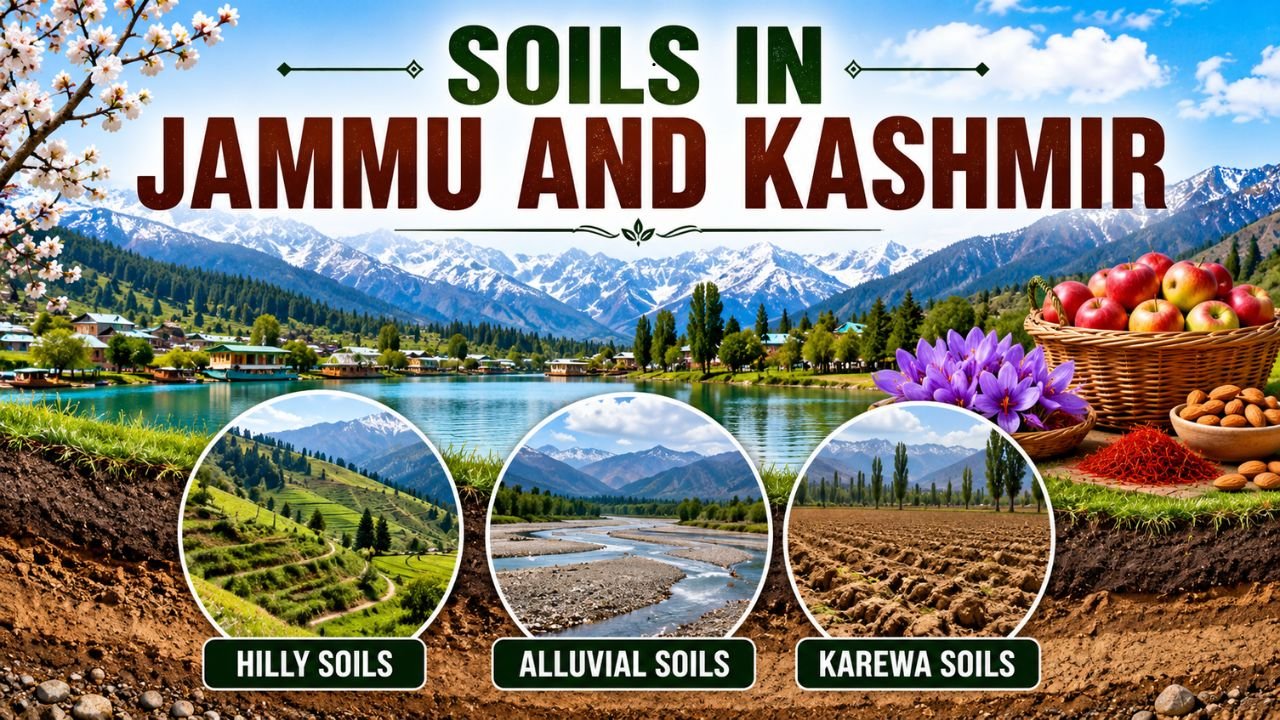
The three important soil groups are:
- Hilly Soils
- Alluvial Soils
- Karewa Soil
1. Hilly Soils
Hilly soils are found in the hilly and mountainous areas of Jammu and Kashmir.
Important Characteristics
- They are generally acidic in character.
- They are deficient in:
- Potash
- Lime
- Phosphorus
- These soils require regular manuring and fertilizers to maintain fertility.
Major Crops
Important crops and fruits associated with hilly soils include:
- Maize
- Pulses
- Apples
- Pears
Quick Fact
Hilly Soil → Acidic → Deficient in Potash, Lime and Phosphorus
2. Alluvial Soils
Alluvial soils are formed by the deposition of material carried by rivers.
Distribution
These soils are deposited by various rivers flowing through Jammu and Kashmir.
They are particularly found along the banks of rivers such as:
- Jhelum
- Chenab
Formation
Rivers carry materials such as:
- Sand
- Silt
- Mud
These materials are deposited over land and gradually form alluvial soil.
Characteristics
- It is considered the most productive soil.
- It is suitable for agricultural activities.
Major Crops
Alluvial soil is particularly good for crops such as:
- Paddy
- Barley
Remember
Alluvial Soil → River deposits → Sand + Silt + Mud → Highly productive
3. Karewa Soil
Karewa Soil is one of the most important soil types from the examination point of view.
Distribution
Deposits of Karewa soil are found in low mounds in:
- Kashmir Valley
- Kishtwar
- Bhaderwah
Characteristics
- Karewa soil is lacustrine soil.
- It is particularly important for the cultivation of high-value crops and fruits.
Major Crops
Important crops grown in Karewa soil include:
- Saffron
- Almond
- Apple
Important Points to Remember
Karewa Soil → Lacustrine → Saffron → Almond → Apple
Classification of Soils in Kashmir
Different local names are used for various soils found in Kashmir. These local soil types and their characteristics are particularly important for JKSSB examinations.
1. Gruti
Gruti is a clayey soil.
Remember:
Gruti → Clayey Soil
2. Behil
Behil is a loamy soil.
- It is considered ideal for paddy cultivation.
- This is because of its high humus content.
Remember:
Behil → Loamy → High Humus → Paddy
3. Sekil
Sekil is a sandy soil.
4. Dazanlad
Dazanlad is also a sandy soil.
- It is generally found near swamps.
Important Difference
Sekil → Sandy Soil
Dazanlad → Sandy Soil near Swamps
5. Nambal
Nambal is a peaty soil.
- It is generally found near the banks of rivers.
- It is considered suitable for rape seed and mustard.
Remember:
Nambal → Peaty → River Banks → Rape Seed & Mustard
6. Tand
Tand is a mountain soil.
7. Zabal Zamin
Zabal Zamin is an alkaline soil.
- It is considered unproductive.
Quick Fact
Zabal Zamin → Alkaline → Unproductive
8. Surzamin
Surzamin is associated with vegetable cultivation.
Remember:
Surzamin → Vegetable Soil
9. Radh
Radh is known as floating garden soil.
Important Exam Fact
Radh → Floating Garden Soil
Classification of Kashmir Soils at a Glance
| Local Soil Name | Type / Important Characteristic |
|---|---|
| Gruti | Clayey soil |
| Behil | Loamy soil; suitable for paddy |
| Sekil | Sandy soil |
| Dazanlad | Sandy soil found near swamps |
| Nambal | Peaty soil near river banks |
| Tand | Mountain soil |
| Zabal Zamin | Alkaline and unproductive |
| Surzamin | Vegetable soil |
| Radh | Floating garden soil |
Important Soil–Crop Combinations
For competitive examinations, students should remember the following combinations:
| Soil | Important Crops / Products |
|---|---|
| Hilly Soil | Maize, pulses, apples, pears |
| Alluvial Soil | Paddy, barley |
| Karewa Soil | Saffron, almond, apple |
| Behil | Paddy |
| Nambal | Rape seed and mustard |
| Surzamin | Vegetables |
Important Facts for JKSSB Exams
- Hilly soils are acidic in character.
- Hilly soils are deficient in potash, lime and phosphorus.
- Alluvial soil is formed by river deposits.
- Alluvial soil is considered the most productive soil.
- Karewa soil is lacustrine in origin.
- Karewa deposits occur in the Kashmir Valley, Kishtwar and Bhaderwah.
- Saffron is an important crop of Karewa soil.
- Gruti is clayey soil.
- Behil is loamy soil with high humus content.
- Dazanlad is sandy soil found near swamps.
- Nambal is peaty soil.
- Tand is mountain soil.
- Zabal Zamin is alkaline and unproductive.
- Radh is floating garden soil.
Quick Revision Table
| Question Point | Answer |
|---|---|
| Acidic soil | Hilly Soil |
| Most productive soil | Alluvial Soil |
| Lacustrine soil | Karewa Soil |
| Important crop of Karewas | Saffron |
| Clayey soil | Gruti |
| Loamy soil | Behil |
| Soil ideal for paddy | Behil |
| Sandy soil | Sekil |
| Sandy soil near swamps | Dazanlad |
| Peaty soil | Nambal |
| Mountain soil | Tand |
| Alkaline soil | Zabal Zamin |
| Unproductive soil | Zabal Zamin |
| Vegetable soil | Surzamin |
| Floating garden soil | Radh |
| Rape seed and mustard | Nambal |
Important MCQ’s on Soils in Jammu and Kashmir for all Competitive Exams
Q1. Consider the following statements regarding Hilly Soils of Jammu and Kashmir:
- Hilly soils are generally acidic in character.
- They are deficient in potash, lime and phosphorus.
- They require regular application of manure and fertilizers.
- They are naturally alkaline and therefore require no additional nutrients.
Which of the statements given above are correct?
A) 1, 2 and 4 only
B) 1, 2 and 3 only
C) 1, 3 and 4 only
D) 2, 3 and 4 only
Answer: B
Q2. Which of the following crops and fruits are associated with Hilly Soils?
- Maize
- Pulses
- Apples
- Pears
Select the correct answer:
A) 1 and 2 only
B) 2, 3 and 4 only
C) 1, 3 and 4 only
D) 1, 2, 3 and 4
Answer: D
Q3. Consider the following statements regarding Alluvial Soils:
- They are deposited by various rivers in Jammu and Kashmir.
- They are found along the banks of rivers, especially the Jhelum and Chenab.
- Sand, silt and mud carried by rivers contribute to their formation.
- They are considered the least productive soils of the region.
Which of the statements given above are correct?
A) 1, 2 and 3 only
B) 1, 2 and 4 only
C) 1, 3 and 4 only
D) 2, 3 and 4 only
Answer: A
Q4. Match the following soil types with their correct characteristics:
| List-I | List-II |
|---|---|
| A. Hilly Soil | 1. Lacustrine soil |
| B. Alluvial Soil | 2. Acidic in character |
| C. Karewa Soil | 3. Most productive soil |
| D. Zabal Zamin | 4. Alkaline and unproductive |
Select the correct answer:
A) A-3, B-2, C-4, D-1
B) A-1, B-4, C-2, D-3
C) A-2, B-3, C-1, D-4
D) A-4, B-1, C-3, D-2
Answer: C
Q5. Consider the following statements regarding Karewa Soil:
- Karewa deposits are found in low mounds in the Kashmir Valley, Kishtwar and Bhaderwah.
- Karewa is a lacustrine soil.
- Saffron, almond and apple are associated with this soil.
- Karewa soil is formed exclusively by the recent deposition of the Jhelum River.
Which of the statements given above are correct?
A) 1, 2 and 4 only
B) 1, 2 and 3 only
C) 1, 3 and 4 only
D) 2, 3 and 4 only
Answer: B
Q6. Match the following local soil names of Kashmir with their correct types:
| List-I | List-II |
|---|---|
| A. Gruti | 1. Peaty soil |
| B. Behil | 2. Sandy soil |
| C. Sekil | 3. Clayey soil |
| D. Nambal | 4. Loamy soil |
Select the correct answer:
A) A-4, B-3, C-1, D-2
B) A-3, B-4, C-2, D-1
C) A-2, B-1, C-4, D-3
D) A-1, B-2, C-3, D-4
Answer: B
Q7. Which of the following statements correctly describe Behil Soil?
- It is a loamy soil.
- It has a high humus content.
- It is considered ideal for paddy cultivation.
- It is primarily an alkaline and unproductive soil.
Select the correct answer:
A) 1, 2 and 3 only
B) 1, 2 and 4 only
C) 1, 3 and 4 only
D) 2, 3 and 4 only
Answer: A
Q8. Consider the following pairs:
- Gruti — Clayey soil
- Sekil — Sandy soil
- Dazanlad — Sandy soil found near swamps
- Tand — Peaty soil found near river banks
Which of the pairs given above are correctly matched?
A) 1, 2 and 4 only
B) 1, 3 and 4 only
C) 2, 3 and 4 only
D) 1, 2 and 3 only
Answer: D
Q9. Consider the following statements regarding Nambal Soil:
- It is classified as a peaty soil.
- It is generally found near the banks of rivers.
- It is considered suitable for rape seed and mustard.
- It is another name for the floating garden soil of Kashmir.
Which of the statements given above are correct?
A) 1, 2 and 3 only
B) 1, 2 and 4 only
C) 1, 3 and 4 only
D) 2, 3 and 4 only
Answer: A
Q10. Match the following soils with their important agricultural associations:
| List-I | List-II |
|---|---|
| A. Karewa | 1. Rape seed and mustard |
| B. Behil | 2. Vegetables |
| C. Nambal | 3. Saffron |
| D. Surzamin | 4. Paddy |
Select the correct answer:
A) A-4, B-3, C-2, D-1
B) A-3, B-4, C-1, D-2
C) A-1, B-2, C-4, D-3
D) A-2, B-1, C-3, D-4
Answer: B
Q11. Consider the following statements about Zabal Zamin:
- It is an alkaline soil.
- It is considered unproductive.
- It is classified as the most suitable soil for paddy cultivation.
- It forms part of the local classification of soils in Kashmir.
Which of the statements given above are correct?
A) 1, 2 and 4 only
B) 1, 2 and 3 only
C) 1, 3 and 4 only
D) 2, 3 and 4 only
Answer: A
Q12. Which of the following soil–characteristic combinations are correctly matched?
- Tand — Mountain soil
- Surzamin — Vegetable soil
- Radh — Floating garden soil
- Dazanlad — Clayey soil
Select the correct answer:
A) 1, 2 and 4 only
B) 1, 3 and 4 only
C) 1, 2 and 3 only
D) 2, 3 and 4 only
Answer: C
Q13. A farmer wants to select soils particularly associated with paddy cultivation and rape seed/mustard cultivation. Which combination correctly identifies these soils?
A) Gruti for paddy and Tand for mustard
B) Behil for paddy and Nambal for rape seed/mustard
C) Sekil for paddy and Radh for mustard
D) Zabal Zamin for paddy and Dazanlad for mustard
Answer: B
Q14. Match the following local soil names with their distinguishing features:
| List-I | List-II |
|---|---|
| A. Dazanlad | 1. Floating gardens |
| B. Tand | 2. Sandy soil near swamps |
| C. Zabal Zamin | 3. Mountain soil |
| D. Radh | 4. Alkaline and unproductive |
Select the correct answer:
A) A-2, B-3, C-4, D-1
B) A-3, B-4, C-1, D-2
C) A-4, B-1, C-2, D-3
D) A-1, B-2, C-3, D-4
Answer: A
Q15. Consider the following statements regarding the major soils and their agricultural importance:
- Hilly soils support crops and fruits such as maize, pulses, apples and pears.
- Alluvial soils are productive and suitable for crops such as paddy and barley.
- Karewa soils are particularly associated with saffron, almond and apple cultivation.
- Radh soil is an alkaline and unproductive soil.
Which of the statements given above are correct?
A) 1, 2 and 4 only
B) 1, 3 and 4 only
C) 2, 3 and 4 only
D) 1, 2 and 3 only
Answer: D