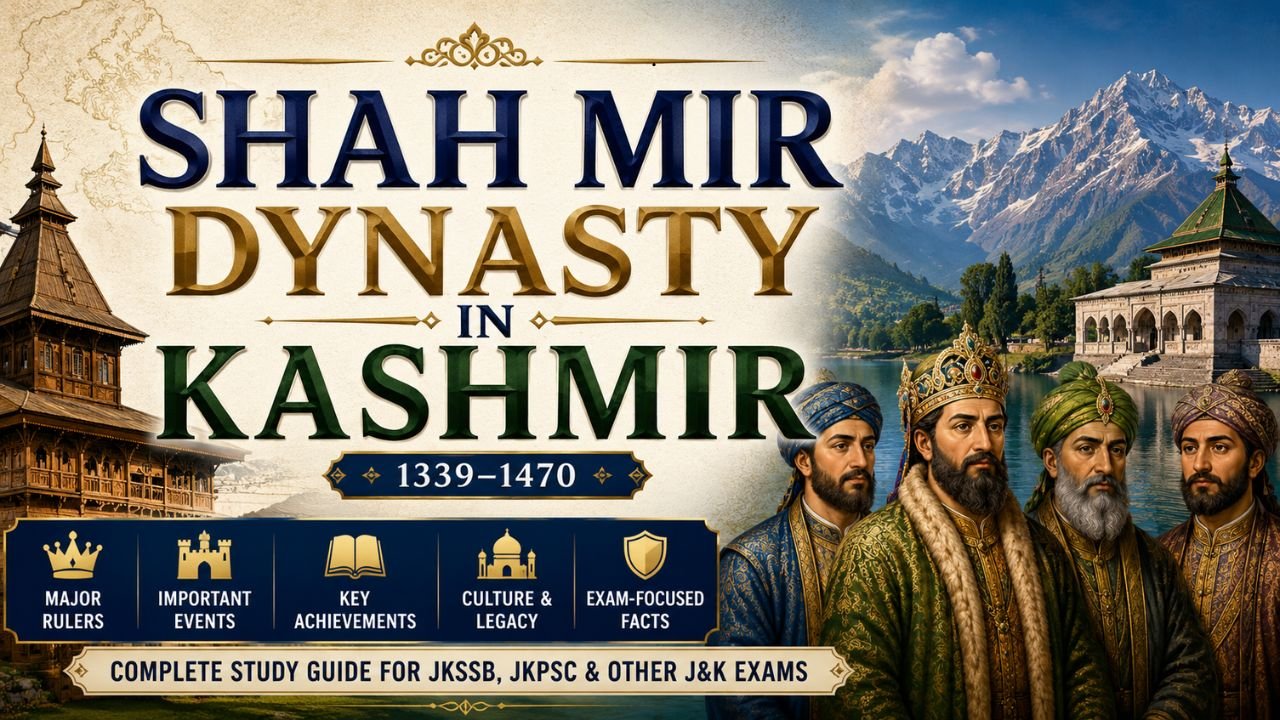
Dear aspirants, if you are preparing for JKSSB, JKPSC or any other competitive exam, the Shah Mir Dynasty is one of the most important topics in the Medieval History of Kashmir.
In this article, Exam Waves Academy provides simple and exam-focused notes on the Shah Mir Dynasty, its important rulers, major events, monuments and historical personalities. Special attention has been given to Shah Mir, Shihab-ud-din, Qutb-ud-din, Sultan Sikandar and Zain-ul-Abidin, as facts related to these rulers are important from an examination point of view.
Shah Mir Dynasty (1339–1470)
The Shah Mir Dynasty ruled Kashmir from 1339 to 1470.
According to the given notes, the actual founder of Muslim rule in Kashmir was Shah Mir.
Shah Mir Dynasty – Important Facts
- Founder: Shah Mir
- Shah Mir adopted the title Sultan Shams-ud-din.
- His period was 1339–1342 AD.
- He was the first Muslim ruler of Kashmir.
- The first Kashmiri ruler to embrace Islam was Rinchin.
- Shah Mir’s coronation took place at Indrakot.
- His commander-in-chief was Lankar Chak.
- Shah Mir had two sons:
- Jamshid
- Ali Sher
- According to the notes, Shah Mir divided the throne between his two sons.
Ala-ud-din (1343–1354)
Ala-ud-din was another important ruler of the Shah Mir Dynasty.
Important Facts about Ala-ud-din
- His reign extended from 1343 to 1354.
- He built a new town in Srinagar called Alauddinpur.
- He transferred his capital from Andarkot to Alauddinpur.
These facts are particularly important for questions based on ruler–place associations.
Sultan Shihab-ud-din (1354–1373)
Sultan Shihab-ud-din was the son of Ala-ud-din.
His reign lasted from 1354 to 1373.
Important Facts about Shihab-ud-din
- He was known as Shirashamak.
- His commander was Laddar Khan, who was associated with Medieval Kashmir.
- He founded Shihab-ud-din Pura, also known as Shadipora.
- He defeated the ruler of Kangra (Central Asia).
- He also constructed the first Hindu temple during the period of the Shah Mir Dynasty, according to the supplied notes.
- Kota-Bhatt and Udayashri served as his ministers.
Mir Syed Ali Hamdani’s Arrival
An important development during the reign of Shihab-ud-din was the arrival of Mir Syed Ali Hamdani (RA).
- Mir Syed Ali Hamdani arrived in the Kashmir Valley during Shihab-ud-din’s reign.
- He came with 700 Syeds.
Qutb-ud-din or Hindal (1373–89)
Qutb-ud-din, also mentioned as Hindal in the notes, ruled from 1373 to 1389.
Important Facts
- During his reign, Shah Hamdan paid his second visit to Kashmir.
- This provides another important link between the Shah Mir rulers and the religious history of medieval Kashmir.
Sultan Sikandar or But Shikan (1389–1413)
Sultan Sikandar ruled Kashmir from 1389 to 1413.
Early Rule
- Sikandar was the son of Qutb-ud-din.
- He came to the throne at the age of eight years.
- His mother Sura acted as Regent.
- Rai Magre was the second adviser during his period.
Important Developments During Sikandar’s Reign
Several important developments are mentioned in the notes for the reign of Sultan Sikandar.
- He introduced the Pashmina shawl.
- He introduced wooden architecture.
- He introduced the Persian language as a new official language.
- During his period, Jana Raja wrote the second part of Rajatarangini.
Administration Under Sultan Sikandar
The notes mention the following important administrative personalities:
- Tashibhatta — Translated texts
- Janaya — Appointed as a physician
These personalities should be remembered along with Sikandar for matching-type questions.
Places and Buildings Associated with Sultan Sikandar
Sultan Sikandar is associated in the notes with several important places and structures.
Nowshahar
- He founded a new city called Nowshahar.
Zainakot
- He also founded Zainakot.
Jamia Masjid Srinagar
- He built the first wooden bridge at Srinagar at Zainakadal.
- He built the first Jamia Masjid in Srinagar.
Download Our Complete J&K GK Book

Religious Policies During Sikandar’s Period
The notes also associate Sikandar’s reign with several religious policies.
- He introduced Jizya.
- He prohibited Sati.
- He stopped the Persian poem Shikayat.
- The Persian language was made an official language.
Ali Shah (1413–1420)
Ali Shah succeeded Sultan Sikandar.
- His reign lasted from 1413 to 1420.
- According to the notes, he was defeated by Zain-ul-Abidin at Thanna with the help of Jasrath Khokhar.
This development prepared the way for the rule of one of the most important rulers of medieval Kashmir—Zain-ul-Abidin.
Zain-ul-Abidin or Shahi Khan or Budshah
Zain-ul-Abidin was one of the most important rulers of the Shah Mir Dynasty.
He was also known as:
- Shahi Khan
- Budshah
His reign is given in the notes as 1420–1470 AD.
Golden Age of Kashmir
The reign of Zain-ul-Abidin is described as the:
Important Reforms and Contributions of Zain-ul-Abidin
According to the supplied notes, Zain-ul-Abidin introduced or encouraged several important crafts and developments.
Crafts
He introduced:
- Pashmina shawl
- Wooden architecture
- Persian as a new official language
Rajatarangini
- During his period, Jana Raja wrote the second part of Rajatarangini.
Administrative Personalities Under Zain-ul-Abidin
Tashibhatta
- Tashibhatta was associated with the translation of texts.
Janaya
- Janaya was appointed as a physician.
Cities and Places Associated with Zain-ul-Abidin
Zain-ul-Abidin is associated with the foundation and development of several places.
Nowshahar
- He founded the new city of Nowshahar.
Zainakot
- He founded Zainakot.
Zainapur
- He founded Zainapur.
Zainagir
- He founded Zainagir.
Zainakadal
One of the important constructions associated with Zain-ul-Abidin was Zainakadal.
- He built the first wooden bridge at Srinagar.
- The bridge was known as Zainakadal.
Jamia Masjid Srinagar
According to the notes:
- Zain-ul-Abidin built the first Jamia Masjid in Srinagar.
Important Religious and Social Policies
The notes associate Zain-ul-Abidin with important policies such as:
- Jizya was abolished.
- Sati was prohibited.
- The Persian poem Shikayat is mentioned in connection with his period.
- Persian was made the official language.
End of the Shah Mir Dynasty
The last ruler of the Shah Mir Dynasty mentioned in the notes was Habib Shah.
Habib Shah
- Habib Shah was the last ruler of the Shah Mir Dynasty.
- He was overthrown by the military commander Ghazi Chak.
- During his tenure, Akbar attempted to invade Kashmir under Qara Bahadur, but according to the notes, he was defeated by Ghazi Chak at Rajouri.
The fall of Habib Shah eventually opened the way for the rise of the Chak Dynasty in Kashmir.
Quick Revision Table
| Topic | Important Fact |
|---|---|
| Shah Mir Dynasty | 1339–1470 |
| Founder | Shah Mir |
| Shah Mir’s title | Sultan Shams-ud-din |
| Shah Mir’s reign | 1339–1342 AD |
| First Muslim ruler of Kashmir | Shah Mir |
| First Kashmiri ruler to embrace Islam | Rinchin |
| Shah Mir’s coronation | Indrakot |
| Shah Mir’s commander | Lankar Chak |
| Shah Mir’s sons | Jamshid and Ali Sher |
| Ala-ud-din | 1343–1354 |
| Alauddinpur | Built by Ala-ud-din |
| Shihab-ud-din | 1354–1373 |
| Shihab-ud-din Pura | Shadipora |
| Mir Syed Ali Hamdani | Arrived with 700 Syeds |
| Qutb-ud-din | 1373–1389 |
| Sikandar | 1389–1413 |
| Sikandar’s mother | Sura |
| Ali Shah | 1413–1420 |
| Zain-ul-Abidin | 1420–1470 |
| Zain-ul-Abidin’s title | Budshah |
| His period | Golden Age of Kashmir |
| Zainakadal | First wooden bridge at Srinagar |
| Last Shah Mir ruler | Habib Shah |
| Habib Shah overthrown by | Ghazi Chak |
Important Facts for JKSSB & JKPSC Exams
- The Shah Mir Dynasty began in 1339.
- Shah Mir was its founder.
- Shah Mir adopted the title Sultan Shams-ud-din.
- He was the first Muslim ruler of Kashmir.
- Rinchin was the first Kashmiri ruler to embrace Islam, according to the notes.
- Shah Mir’s coronation took place at Indrakot.
- Ala-ud-din built Alauddinpur.
- Shihab-ud-din founded Shadipora.
- Mir Syed Ali Hamdani arrived with 700 Syeds during the reign of Shihab-ud-din.
- Shah Hamdan made his second visit during Qutb-ud-din’s reign.
- Sikandar came to the throne at the age of eight.
- His mother Sura acted as Regent.
- Ali Shah ruled from 1413 to 1420.
- Zain-ul-Abidin was also known as Shahi Khan/Budshah.
- His period is called the Golden Age of Kashmir.
- Zainakadal was the first wooden bridge at Srinagar mentioned in the notes.
- Habib Shah was the last ruler of the Shah Mir Dynasty.
- Ghazi Chak overthrew Habib Shah.
Important MCQ’s on Shah Mir Dynasty in Kashmir for all Competitive Exams
Q1. Consider the following statements regarding the establishment of the Shah Mir Dynasty in Kashmir:
- Shah Mir was the founder of the Shah Mir Dynasty in Kashmir.
- He assumed the title Sultan Shams-ud-din after becoming ruler.
- His reign extended from 1339 to 1342 AD.
- Shah Mir was the first Kashmiri ruler to embrace Islam.
Which of the statements given above are correct?
A) 1, 2 and 3 only
B) 1, 2 and 4 only
C) 1, 3 and 4 only
D) 2, 3 and 4 only
Answer: A
Q2. Match the following personalities associated with the early Shah Mir period with the facts related to them:
| List-I | List-II |
|---|---|
| A. Shah Mir | 1. First Kashmiri ruler to embrace Islam |
| B. Rinchin | 2. Commander-in-Chief of Shah Mir |
| C. Lankar Chak | 3. Founder of the Shah Mir Dynasty |
| D. Ali Sher | 4. Son of Shah Mir |
Select the correct answer:
A) A-1, B-3, C-4, D-2
B) A-3, B-1, C-2, D-4
C) A-2, B-4, C-1, D-3
D) A-4, B-2, C-3, D-1
Answer: B
Q3. Arrange the following rulers of the Shah Mir Dynasty in their correct chronological order:
- Shihab-ud-din
- Shah Mir
- Ala-ud-din
- Qutb-ud-din
Which of the following represents the correct sequence?
A) 3 → 2 → 1 → 4
B) 2 → 1 → 3 → 4
C) 2 → 3 → 1 → 4
D) 1 → 3 → 2 → 4
Answer: C
Q4. Consider the following pairs regarding Shah Mir and the establishment of his rule in Kashmir:
- Coronation — Indrakot
- Commander-in-Chief — Lankar Chak
- Sons — Jamshid and Ali Sher
- Capital transferred to Alauddinpur — Shah Mir
Which of the pairs given above are correctly matched?
A) 1, 2 and 4 only
B) 1, 3 and 4 only
C) 2, 3 and 4 only
D) 1, 2 and 3 only
Answer: D
Q5. Consider the following statements regarding Ala-ud-din and his contribution to the Shah Mir Dynasty:
- Ala-ud-din ruled from 1343 to 1354.
- He built a new town in Srinagar called Alauddinpur.
- He transferred the capital from Andarkot to Alauddinpur.
- He founded the city of Zainapur and named it after himself.
Which of the statements given above are correct?
A) 1, 2 and 3 only
B) 1, 2 and 4 only
C) 1, 3 and 4 only
D) 2, 3 and 4 only
Answer: A
Q6. Match the following rulers with the places or developments associated with them :
| List-I | List-II |
|---|---|
| A. Ala-ud-din | 1. Shadipora |
| B. Shihab-ud-din | 2. Golden Age of Kashmir |
| C. Sikandar | 3. Alauddinpur |
| D. Zain-ul-Abidin | 4. Came to throne at the age of eight |
Select the correct answer:
A) A-1, B-3, C-2, D-4
B) A-3, B-1, C-4, D-2
C) A-4, B-2, C-3, D-1
D) A-2, B-4, C-1, D-3
Answer: B
Q7. Consider the following statements regarding Sultan Shihab-ud-din:
- Shihab-ud-din was the son of Ala-ud-din.
- His reign extended from 1354 to 1373.
- He founded Shihab-ud-din Pura, also known as Shadipora.
- He was the last ruler of the Shah Mir Dynasty.
Which of the statements given above are correct?
A) 1, 2 and 4 only
B) 1, 3 and 4 only
C) 1, 2 and 3 only
D) 2, 3 and 4 only
Answer: C
Q8. Consider the following pairs relating to the reign of Sultan Shihab-ud-din:
- Laddar Khan — Commander
- Kota-Bhatt — Minister
- Udayashri — Minister
- Sura — Commander-in-Chief
Which of the pairs given above are correctly matched?
A) 1, 2 and 4 only
B) 2, 3 and 4 only
C) 1, 3 and 4 only
D) 1, 2 and 3 only
Answer: D
Q9. Consider the following statements regarding Mir Syed Ali Hamdani and his association with Medieval Kashmir:
- Mir Syed Ali Hamdani arrived in Kashmir during the reign of Shihab-ud-din.
- According to the notes, he arrived with 700 Syeds.
- His arrival is associated with the period of the Shah Mir Dynasty.
- He arrived for the first time during the reign of Zain-ul-Abidin.
Which of the statements given above are correct?
A) 1, 2 and 3 only
B) 1, 2 and 4 only
C) 1, 3 and 4 only
D) 2, 3 and 4 only
Answer: A
Q10. Arrange the following rulers in the correct chronological sequence:
- Zain-ul-Abidin
- Qutb-ud-din
- Sikandar
- Ali Shah
Which of the following is the correct order?
A) 3 → 2 → 4 → 1
B) 2 → 3 → 4 → 1
C) 2 → 4 → 3 → 1
D) 4 → 2 → 3 → 1
Answer: B
Q11. Consider the following statements regarding Sultan Sikandar:
- Sultan Sikandar was the son of Qutb-ud-din.
- He came to the throne at the age of eight years.
- His mother Sura acted as Regent during his early reign.
- His reign is described in the notes as the Golden Age of Kashmir.
Which of the statements given above are correct?
A) 1, 2 and 4 only
B) 1, 3 and 4 only
C) 1, 2 and 3 only
D) 2, 3 and 4 only
Answer: C
Q12. Match the following personalities with the roles or activities associated with them:
| List-I | List-II |
|---|---|
| A. Sura | 1. Physician |
| B. Rai Magre | 2. Regent |
| C. Tashibhatta | 3. Second adviser |
| D. Janaya | 4. Translation of texts |
Select the correct answer:
A) A-3, B-2, C-1, D-4
B) A-2, B-4, C-3, D-1
C) A-4, B-1, C-2, D-3
D) A-2, B-3, C-4, D-1
Answer: D
Q13. Consider the following statements regarding the developments associated with Sultan Sikandar.
- He introduced the Pashmina shawl.
- He introduced wooden architecture.
- Persian was introduced as a new official language.
- He was overthrown by the military commander Ghazi Chak.
Which of the statements given above are correct?
A) 1, 2 and 3 only
B) 1, 2 and 4 only
C) 1, 3 and 4 only
D) 2, 3 and 4 only
Answer: A
Q14. Consider the following pairs regarding Ali Shah and the rise of Zain-ul-Abidin:
- Ali Shah — Reigned from 1413 to 1420
- Zain-ul-Abidin — Also known as Shahi Khan
- Zain-ul-Abidin — Also known as Budshah
- Ali Shah — Founder of the Chak Dynasty
Which of the pairs given above are correctly matched?
A) 1, 2 and 4 only
B) 1, 2 and 3 only
C) 1, 3 and 4 only
D) 2, 3 and 4 only
Answer: B
Q15. Consider the following statements regarding Zain-ul-Abidin and his reign:
- His reign extended from 1420 to 1470 AD.
- His period is described as the Golden Age of Kashmir.
- He was popularly known as Budshah.
- His mother Sura acted as Regent because he became ruler at the age of eight.
Which of the statements given above are correct?
A) 1, 2 and 4 only
B) 1, 3 and 4 only
C) 1, 2 and 3 only
D) 2, 3 and 4 only
Answer: C
Q16. Match the following places and developments associated with Zain-ul-Abidin :
| List-I | List-II |
|---|---|
| A. Nowshahar | 1. First wooden bridge at Srinagar |
| B. Zainakadal | 2. New city |
| C. Zainapur | 3. Place founded during his reign |
| D. Zainagir | 4. Place founded during his reign |
Which of the following gives the correct matching?
A) A-1, B-2, C-4, D-3
B) A-3, B-4, C-1, D-2
C) A-4, B-3, C-2, D-1
D) A-2, B-1, C-3, D-4
Answer: D
Q17. Consider the following statements regarding the religious and social policies associated with Zain-ul-Abidin:
- Jizya was abolished during his period.
- Sati was prohibited.
- His reign is associated with important cultural and administrative developments.
- He introduced Jizya and made its payment compulsory for the first time.
Which of the statements given above are correct?
A) 1, 2 and 3 only
B) 1, 2 and 4 only
C) 1, 3 and 4 only
D) 2, 3 and 4 only
Answer: A
Q18. Arrange the following developments in their correct chronological sequence according to the Shah Mir period :
- Reign of Zain-ul-Abidin
- Foundation of Alauddinpur
- Reign of Sultan Sikandar
- Foundation of Shadipora under Shihab-ud-din
Which of the following represents the correct order?
A) 4 → 2 → 3 → 1
B) 2 → 4 → 3 → 1
C) 2 → 3 → 4 → 1
D) 3 → 2 → 4 → 1
Answer: B
Q19. Consider the following pairs regarding the final phase of the Shah Mir Dynasty:
- Habib Shah — Last ruler of the Shah Mir Dynasty
- Ghazi Chak — Military commander who overthrew Habib Shah
- Qara Bahadur — Associated with Akbar’s attempt to invade Kashmir
- Rajouri — Place where Habib Shah defeated Zain-ul-Abidin
Which of the pairs given above are correctly matched?
A) 1, 2 and 4 only
B) 1, 3 and 4 only
C) 1, 2 and 3 only
D) 2, 3 and 4 only
Answer: C
Q20. Arrange the following major rulers of the Shah Mir Dynasty in their correct chronological order:
- Ali Shah
- Ala-ud-din
- Zain-ul-Abidin
- Shihab-ud-din
- Sikandar
- Qutb-ud-din
Which of the following represents the correct chronological sequence?
A) 2 → 6 → 4 → 5 → 1 → 3
B) 4 → 2 → 6 → 5 → 3 → 1
C) 2 → 4 → 5 → 6 → 1 → 3
D) 2 → 4 → 6 → 5 → 1 → 3
Answer: D