Dear aspirants, if you are preparing for JKSSB, JKPSC or any other Jammu and Kashmir competitive exam, Mughal Rule in Kashmir is an important topic in Medieval History.
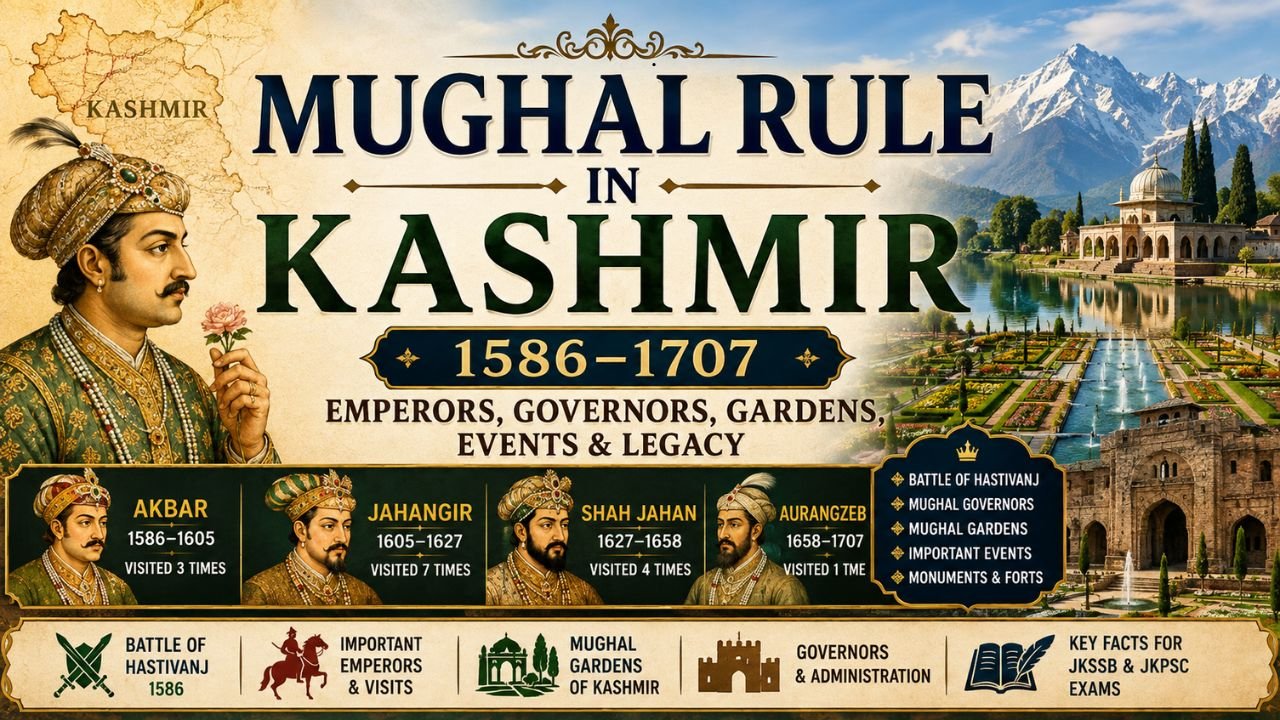
In this article, Exam Waves Academy provides simple and exam-focused notes on the Battle of Hastivanj, Akbar, Jahangir, Shah Jahan and Aurangzeb. We will also cover important Mughal governors, gardens, forts, buildings and other facts that are useful for J&K competitive examinations.
Mughal Rule in Kashmir
The establishment of Mughal authority in Kashmir was an important turning point in its medieval history.
The Battle of Hastivanj played a major role in bringing Kashmir under Mughal control.
Battle of Hastivanj
The Battle of Hastivanj is one of the most important events connected with the beginning of Mughal rule in Kashmir.
Important Facts
- It was fought on 10 October 1586.
- The battle took place near Pir Ki Gali.
- It was fought between the Mughal Governor Qasim Khan and the Chak leader Shamas Chak.
- The battle was won by the Mughals.
- It laid the foundation of Mughal rule in Kashmir.
- The Fall of Srinagar took place on 14 October 1586.
Quick Exam Fact
Battle of Hastivanj → 10 October 1586 → Near Pir Ki Gali → Mughal victory
Akbar’s Period (1586–1605)
The Mughal period in Kashmir is closely associated with Emperor Akbar.
During his reign, Kashmir was administered through four Subedars.
Four Subedars During Akbar’s Reign
- Mirza Qasim
- Mirza Yusuf Khan
- Mirza Qulich Khan
- Mirza Ali
Akbar’s Visits to Kashmir
According to the supplied notes, Akbar visited Kashmir three times.
First Visit – 1589
Akbar’s first visit to Kashmir took place in 1589.
He was accompanied by:
- Faizi
- Finance Minister Raja Todar Mal
- Nizam-ud-din, author of Tabaqat-i-Akbari
Raja Todar Mal and Kashmir
During Akbar’s first visit:
- Raja Todar Mal recognised the revenue assessment of Kashmir.
This is an important ruler–personality–administration combination.
Second Visit of Akbar
During Akbar’s second visit, he was accompanied by:
- Jerome Xavier
- Banjoust De Goe
Third Visit of Akbar
During his third visit:
- Akbar visited Ladakh and Baltistan.
- These areas were annexed under Mughal rule.
Kashmir and the Mughal Court
- Akbar’s Harem once entered the Kashmir Valley through Pakhil.
- They spent a few days in Baramulla.
- The city was decorated like a bride.
Yadgar Revolt
Another event associated with Akbar’s period was the Yadgar revolt.
- The Yadgar revolt of Mansabdars took place under Mirza Yadgar.
- It happened during the reign of Akbar.
Construction During Akbar’s Period
Several important constructions are associated with Akbar’s period.
Hari Parbat
- The first fortification of the Hari Parbat site took place in 1590.
Nagar Nagar
- Akbar built a new capital called Nagar Nagar inside the fort.
Naseem Bagh
- Naseem Bagh was built during Akbar’s reign.
Jahangir’s Period (1605–1627)
After Akbar, Jahangir became an important Mughal emperor associated with Kashmir.
His reign lasted from 1605 to 1627.
Jahangir had a particularly strong association with Kashmir.
Jahangir’s Visits to Kashmir
According to the supplied notes:
- Jahangir visited Kashmir seven times.
This is one of the most important facts to remember about Jahangir and Kashmir.
Quick Revision
Akbar → 3 visits
Jahangir → 7 visits
Conquest of Kishtwar
During Jahangir’s reign:
- Kishtwar was conquered in 1622.
- The conquest was carried out by Dilawar Khan.
- Dilawar Khan was the son of Gauhar Sen.
Gujjar Sen Poonch
- After the release of Gujjar Sen Poonch, he was given the mansab of 1000 Zat and 500 Sawar in 1624.
Siraj-ud-din and Poonch
Jahangir also:
- Nominated Siraj-ud-din of village Kathua as the Raja of Poonch in 1596, as stated in the supplied notes.
Governors During Jahangir’s Period
The notes list the following governors during Jahangir’s period:
- Hashim Khan
- Sardar Khan
- Ahad Beg
- Dilawar Khan
- Irsadat Khan
- Itqad Khan
Gardens and Architecture During Jahangir’s Period
The Mughal period is famous for its gardens, and several important developments are mentioned during Jahangir’s reign.
Shalimar Garden
- Jahangir built Shalimar Garden.
Nishat Garden
- Asif Khan laid the foundation of Nishat Garden.
Achabal Garden
- The beautiful garden at Achabal was built by Noor Jahan.
Octagonal Tank of Sculpture Stones
- An octagonal tank of sculpture stones was located at Verinag Spring.
Chingus Sarai
During the last visit of Jahangir:
- His fourth governorship of Itqad Khan had ended.
- Jahangir died at Chingus Sarai.
According to the notes:
- Chingus Sarai was used by the Mughals as a transit camp in Rajouri.
- The intestines of Jahangir were buried at Chingus.
This is an important location–personality association.
Important Notes from Jahangir’s Period
- Kishtwar supported Chak nobles.
- Raja Gunwar Sen gave his full assistance to Iba Chak and Lohar Chak.
Shah Jahan’s Period (1627–1658)
After Jahangir, Kashmir remained under Mughal rule during the reign of Shah Jahan.
His period lasted from 1627 to 1658.
Administration Under Shah Jahan
- Kashmir was governed by nine governors during Shah Jahan’s reign.
- Shah Jahan visited Kashmir four times.
- Until Kashmir was made a separate Subah, it was added to Kabul Subah in 1586.
- He abolished taxes.
- The Begar system was abolished.
Governors During Shah Jahan
Important governors mentioned in the notes include:
- Zafar Khan
- Ali Mardan Khan
- Lashkar Khan
Chashma Shahi
One of the most famous Mughal gardens of Kashmir is Chashma Shahi.
- Chashma Shahi was built by Ali Mardan Khan in 1632.
- It was built during the reign of Shah Jahan.
- Its design is associated with Dara Shikoh in the supplied notes.
Important Combination
Chashma Shahi → Ali Mardan Khan → 1632 → Shah Jahan’s period
Pari Mahal
According to the notes:
- Dara Shikoh built Pari Mahal.
Gardens During Shah Jahan’s Period
The notes associate Zafar Khan with the construction of:
- Gulshan Bagh
- Hassan Abad Garden
These were situated on the banks of the Dal Canal.
Aurangzeb’s Period (1658–1707)
Aurangzeb ruled from 1658 to 1707.
His period also contains several important facts connected with Kashmir.
Aurangzeb’s Visit to Kashmir
According to the notes:
- Aurangzeb visited Kashmir once in 1665.
- During his first visit, he was accompanied by:
- His daughter Roshan Ara
- Francois Bernier
Quick Exam Fact
Aurangzeb → One visit to Kashmir → 1665 → Roshan Ara and Francois Bernier
Administration During Aurangzeb’s Reign
- Kashmir was governed by 14 governors during Aurangzeb’s reign.
This provides an important comparison:
| Mughal Emperor | Visits / Administration Fact |
|---|---|
| Akbar | Visited Kashmir 3 times |
| Jahangir | Visited Kashmir 7 times |
| Shah Jahan | Visited Kashmir 4 times |
| Aurangzeb | Visited Kashmir once |
Chaudri Mahesh and Ishbar
During Aurangzeb’s reign:
- Chaudri Mahesh laid a garden at Ishbar.
Abdul Qasim
Aurangzeb appointed:
- Abdul Qasim as Qazi of Kishtwar.
Saif Khan and Jama Masjid Srinagar
- Saif Khan built Safa Kadal in Srinagar.
- Aurangzeb renovated Jama Masjid Srinagar.
Mughal Route Between Kashmir and Poonch
- The Mughals used to travel from Kashmir to Poonch via Tosamaidan (Budgam).
Dam-Dam at Tosamaidan
- The Mughals constructed seven-storeyed buildings called Dam-Dam at Tosamaidan.
Quick Revision Table
| Topic | Important Fact |
|---|---|
| Battle of Hastivanj | 10 October 1586 |
| Location | Near Pir Ki Gali |
| Mughal commander | Qasim Khan |
| Chak leader | Shamas Chak |
| Fall of Srinagar | 14 October 1586 |
| Akbar | 1586–1605 |
| Akbar’s visits to Kashmir | 3 |
| First visit | 1589 |
| Raja Todar Mal | Revenue assessment |
| Hari Parbat fortification | 1590 |
| New capital inside fort | Nagar Nagar |
| Jahangir | 1605–1627 |
| Jahangir’s visits | 7 |
| Kishtwar conquered | 1622 |
| Conqueror of Kishtwar | Dilawar Khan |
| Shalimar Garden | Jahangir |
| Nishat Garden | Asif Khan |
| Achabal Garden | Noor Jahan |
| Chingus Sarai | Rajouri |
| Shah Jahan | 1627–1658 |
| Shah Jahan’s visits | 4 |
| Governors under Shah Jahan | 9 |
| Chashma Shahi | Ali Mardan Khan, 1632 |
| Pari Mahal | Dara Shikoh |
| Aurangzeb | 1658–1707 |
| Aurangzeb’s Kashmir visit | 1665 |
| Aurangzeb’s visits | 1 |
| Governors under Aurangzeb | 14 |
| Qazi of Kishtwar | Abdul Qasim |
| Safa Kadal | Saif Khan |
| Jama Masjid Srinagar | Renovated by Aurangzeb |
| Mughal travel route | Kashmir–Poonch via Tosamaidan |
| Dam-Dam | Seven-storeyed buildings at Tosamaidan |
Important Facts for JKSSB & JKPSC Exams
- The Battle of Hastivanj was fought on 10 October 1586 near Pir Ki Gali.
- It was fought between Qasim Khan and Shamas Chak.
- The Mughals won the battle.
- Srinagar fell on 14 October 1586.
- Akbar visited Kashmir three times.
- His first visit took place in 1589.
- Raja Todar Mal is associated with the revenue assessment of Kashmir.
- The first fortification of Hari Parbat took place in 1590.
- Nagar Nagar was built inside the fort.
- Jahangir visited Kashmir seven times.
- Kishtwar was conquered by Dilawar Khan in 1622.
- Shalimar Garden is associated with Jahangir.
- Nishat Garden is associated with Asif Khan.
- Achabal Garden is associated with Noor Jahan.
- Chingus Sarai was a Mughal transit camp in Rajouri.
- Shah Jahan visited Kashmir four times.
- Kashmir was governed by nine governors during his reign.
- Chashma Shahi was built by Ali Mardan Khan in 1632, according to the notes.
- Dara Shikoh built Pari Mahal.
- Aurangzeb visited Kashmir once in 1665.
- He was accompanied by Roshan Ara and Francois Bernier.
- Kashmir was governed by 14 governors during Aurangzeb’s reign.
- Abdul Qasim was appointed Qazi of Kishtwar.
- Saif Khan built Safa Kadal.
- Aurangzeb renovated Jama Masjid Srinagar.
- The Mughals used the Tosamaidan route between Kashmir and Poonch.
- Seven-storeyed buildings called Dam-Dam were constructed at Tosamaidan.
Important MCQ’s on Mughal Rule in Kashmir for all Competitive Exams
Q1. Consider the following statements regarding the Battle of Hastivanj and the establishment of Mughal rule in Kashmir:
- The Battle of Hastivanj was fought on 10 October 1586.
- It was fought near Pir Ki Gali.
- The Mughal forces were led by Qasim Khan, while the Chak side was led by Shamas Chak.
- The battle resulted in the restoration of independent Chak rule in Kashmir.
Which of the statements given above are correct?
A) 1, 2 and 3 only
B) 1, 2 and 4 only
C) 1, 3 and 4 only
D) 2, 3 and 4 only
Answer: A
Q2. Match the following events and personalities associated with the beginning of Mughal rule in Kashmir:
| List-I | List-II |
|---|---|
| A. Qasim Khan | 1. Chak leader at Hastivanj |
| B. Shamas Chak | 2. Mughal commander |
| C. Shaykh Yaqoob Sarfi | 3. Fall of Srinagar |
| D. 14 October 1586 | 4. Helped the Mughals |
Select the correct answer:
A) A-1, B-2, C-3, D-4
B) A-2, B-1, C-4, D-3
C) A-3, B-4, C-1, D-2
D) A-4, B-3, C-2, D-1
Answer: B
Q3. Arrange the following events associated with Mughal Kashmir in the correct chronological order:
- Aurangzeb’s visit to Kashmir
- Akbar’s first visit to Kashmir
- Conquest of Kishtwar during Jahangir’s reign
- Construction of Chashma Shahi during Shah Jahan’s period
Which of the following represents the correct sequence?
A) 2 → 4 → 3 → 1
B) 3 → 2 → 4 → 1
C) 2 → 3 → 4 → 1
D) 2 → 3 → 1 → 4
Answer: C
Q4. Consider the following pairs regarding Akbar’s association with Kashmir:
- First visit to Kashmir — 1589
- Number of visits — Three
- Hari Parbat fortification — 1590
- Conquest of Kishtwar — 1622
Which of the pairs given above are correctly matched with Akbar’s period?
A) 1, 2 and 4 only
B) 1, 3 and 4 only
C) 2, 3 and 4 only
D) 1, 2 and 3 only
Answer: D
Q5. Consider the following statements regarding Akbar’s first visit to Kashmir:
- Akbar visited Kashmir for the first time in 1589.
- Faizi accompanied him during this visit.
- Finance Minister Raja Todar Mal also accompanied him.
- Francois Bernier accompanied Akbar during his first visit to Kashmir.
Which of the statements given above are correct?
A) 1, 2 and 3 only
B) 1, 2 and 4 only
C) 1, 3 and 4 only
D) 2, 3 and 4 only
Answer: A
Q6. Match the following personalities with their correct associations during Akbar’s period:
| List-I | List-II |
|---|---|
| A. Raja Todar Mal | 1. Author of Tabaqat-i-Akbari |
| B. Nizam-ud-din | 2. Revenue assessment of Kashmir |
| C. Jerome Xavier | 3. Associated with Akbar’s second visit |
| D. Mirza Yadgar | 4. Revolt of Mansabdars |
Select the correct answer:
A) A-1, B-2, C-4, D-3
B) A-2, B-1, C-3, D-4
C) A-3, B-4, C-2, D-1
D) A-4, B-3, C-1, D-2
Answer: B
Q7. Consider the following statements regarding Jahangir’s association with Kashmir:
- Jahangir visited Kashmir seven times.
- Kishtwar was conquered in 1622 during his reign.
- Dilawar Khan, son of Gauhar Sen, was associated with the conquest of Kishtwar.
- Jahangir visited Kashmir only once, accompanied by Roshan Ara and Francois Bernier.
Which of the statements given above are correct?
A) 1, 2 and 4 only
B) 1, 3 and 4 only
C) 1, 2 and 3 only
D) 2, 3 and 4 only
Answer: C
Q8. Consider the following pairs relating to Mughal gardens and their associated personalities as given in the notes:
- Shalimar Garden — Jahangir
- Nishat Garden — Asif Khan
- Achabal Garden — Noor Jahan
- Pari Mahal — Aurangzeb
Which of the pairs given above are correctly matched?
A) 1, 2 and 4 only
B) 1, 3 and 4 only
C) 2, 3 and 4 only
D) 1, 2 and 3 only
Answer: D
Q9. Match the following governors associated with Jahangir’s period with the appropriate category:
| List-I | List-II |
|---|---|
| A. Hashim Khan | 1. Governor under Jahangir |
| B. Dilawar Khan | 2. Governor under Jahangir |
| C. Itqad Khan | 3. Governor under Jahangir |
| D. Asif Khan | 4. Associated with Nishat Garden |
Select the correct answer:
A) A-1, B-2, C-3, D-4
B) A-2, B-4, C-1, D-3
C) A-3, B-1, C-4, D-2
D) A-4, B-3, C-2, D-1
Answer: A
Q10. Consider the following statements regarding Chingus Sarai and Jahangir:
- Chingus Sarai is associated with Rajouri.
- It was used by the Mughals as a transit camp.
- The notes state that Jahangir’s intestines were buried at Chingus.
- Chingus Sarai was constructed as Akbar’s new capital inside Hari Parbat Fort.
Which of the statements given above are correct?
A) 1, 2 and 4 only
B) 1, 2 and 3 only
C) 1, 3 and 4 only
D) 2, 3 and 4 only
Answer: B
Q11. Arrange the following Mughal emperors according to the number of visits to Kashmir mentioned in the notes, from the highest to the lowest:
- Aurangzeb
- Shah Jahan
- Akbar
- Jahangir
Which of the following is the correct order?
A) 2 → 4 → 3 → 1
B) 4 → 3 → 2 → 1
C) 4 → 2 → 3 → 1
D) 3 → 4 → 2 → 1
Answer: C
Q12. Consider the following statements regarding Shah Jahan’s period in Kashmir:
- Kashmir was governed by nine governors during his reign.
- Shah Jahan visited Kashmir four times.
- Ali Mardan Khan is associated with Chashma Shahi in 1632 according to the notes.
- Kashmir was governed by fourteen governors during Shah Jahan’s reign.
Which of the statements given above are correct?
A) 1, 2 and 4 only
B) 1, 3 and 4 only
C) 2, 3 and 4 only
D) 1, 2 and 3 only
Answer: D
Q13. Match the following monuments, gardens and places with the personalities associated with them in the supplied material:
| List-I | List-II |
|---|---|
| A. Chashma Shahi | 1. Dara Shikoh |
| B. Pari Mahal | 2. Ali Mardan Khan |
| C. Achabal Garden | 3. Noor Jahan |
| D. Safa Kadal | 4. Saif Khan |
Select the correct answer:
A) A-2, B-1, C-3, D-4
B) A-1, B-2, C-4, D-3
C) A-3, B-4, C-2, D-1
D) A-4, B-3, C-1, D-2
Answer: A
Q14. Consider the following statements regarding Aurangzeb’s period and his association with Kashmir:
- Aurangzeb visited Kashmir in 1665.
- He was accompanied by his daughter Roshan Ara and Francois Bernier.
- Kashmir was governed by 14 governors during his reign.
- He built Pari Mahal for his daughter Roshan Ara.
Which of the statements given above are correct according to the notes?
A) 1, 2 and 4 only
B) 1, 2 and 3 only
C) 1, 3 and 4 only
D) 2, 3 and 4 only
Answer: B
Q15. Consider the following pairs relating to important developments during Mughal rule in Kashmir:
- Abdul Qasim — Appointed Qazi of Kishtwar
- Saif Khan — Built Safa Kadal in Srinagar
- Tosamaidan — Used on the Mughal route between Kashmir and Poonch
- Dam-Dam — Name given to Akbar’s capital at Hari Parbat
Which of the pairs given above are correctly matched according to the supplied notes?
A) 1, 2 and 4 only
B) 1, 3 and 4 only
C) 1, 2 and 3 only
D) 2, 3 and 4 only
Answer: C