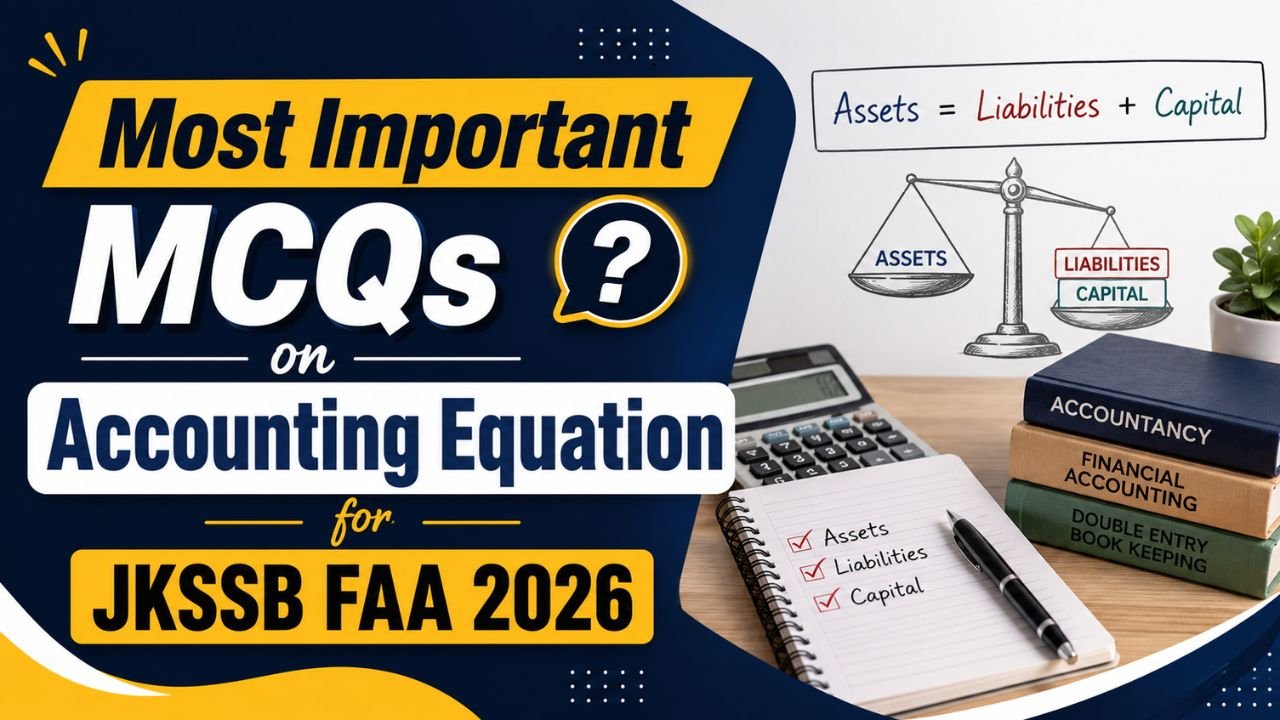
Dear aspirants, practice the Most Important MCQs on Accounting Equation for JKSSB FAA 2026, specially prepared by Exam Waves. These questions will help you understand key concepts, test your knowledge, improve accuracy, and strengthen your Accountancy preparation for the examination.
Q1. Which of the following statements correctly describe the Accounting Equation?
- It signifies that the assets of a business are always equal to the total of its liabilities and capital.
- The equation can be expressed as Assets = Liabilities + Capital.
- The fundamental equation provides the foundation for the Double Entry Book-keeping system.
- Capital can be calculated by subtracting liabilities from total assets.
A) 1 and 2 only
B) 1, 2 and 3 only
C) 2, 3 and 4 only
D) 1, 2, 3 and 4
Answer: D
Q2. Which of the following equations are correctly derived from the Accounting Equation?
- Assets = Capital + Liabilities
- Capital = Total Assets − Liabilities
- Liabilities = Assets − Capital
- Capital = Assets + Liabilities
A) 1 and 2 only
B) 1, 2 and 3 only
C) 2, 3 and 4 only
D) 1, 2, 3 and 4
Answer: B
Q3. Seraj started a business by introducing cash of ₹30,000. Which of the following correctly represents the Accounting Equation immediately after this transaction?
A) Cash ₹30,000 = Capital ₹30,000 + Liabilities ₹0
B) Cash ₹30,000 = Capital ₹0 + Liabilities ₹30,000
C) Cash ₹30,000 = Capital ₹30,000 + Liabilities ₹30,000
D) Cash ₹60,000 = Capital ₹30,000 + Liabilities ₹30,000
Answer: A
Q4. Mushtaq started a business with cash of ₹30,000. Consider the following statements regarding the effect of this transaction:
- Cash becomes an asset of ₹30,000.
- Capital becomes ₹30,000.
- No liability arises from the transaction.
- Both sides of the Accounting Equation are equal to ₹30,000.
Which of the statements given above are correct?
A) 1 and 2 only
B) 1, 2 and 3 only
C) 2, 3 and 4 only
D) 1, 2, 3 and 4
Answer: D
Q5. Asif started a business with cash ₹30,000 and later purchased machinery worth ₹10,000 on credit. Which of the following correctly represents his financial position after the credit purchase?
A) Cash ₹20,000 + Machinery ₹10,000 = Capital ₹30,000 + Sundry Creditors ₹0
B) Cash ₹30,000 + Machinery ₹10,000 = Capital ₹30,000 + Sundry Creditors ₹10,000
C) Cash ₹30,000 + Machinery ₹10,000 = Capital ₹40,000 + Sundry Creditors ₹10,000
D) Cash ₹40,000 = Capital ₹30,000 + Sundry Creditors ₹10,000
Answer: B
Q6. Irfan has cash of ₹30,000 in his business and purchases machinery worth ₹10,000 on credit. Which of the following statements correctly describe the effect of this transaction?
- Machinery increases the assets by ₹10,000.
- Cash continues to remain ₹30,000.
- Sundry Creditors increase by ₹10,000.
- Capital continues to remain ₹30,000.
A) 1 and 3 only
B) 1, 2 and 3 only
C) 2, 3 and 4 only
D) 1, 2, 3 and 4
Answer: D
Q7. Aamir starts his business with ₹30,000 cash and subsequently purchases machinery worth ₹10,000 on credit. Which of the following equations correctly shows the position after both transactions?
A) ₹30,000 + ₹10,000 = ₹30,000 + ₹10,000
B) ₹20,000 + ₹10,000 = ₹30,000 + ₹10,000
C) ₹30,000 + ₹10,000 = ₹40,000 + ₹10,000
D) ₹30,000 + ₹20,000 = ₹30,000 + ₹10,000
Answer: A
Q8. Shahid has Cash ₹30,000 and Machinery ₹10,000, while his Capital is ₹30,000 and Sundry Creditors are ₹10,000. He then purchases goods worth ₹5,000. Which of the following correctly represents the new composition of his assets?
A) Cash ₹30,000 + Machinery ₹10,000 + Stock ₹5,000
B) Cash ₹25,000 + Machinery ₹10,000 + Stock ₹5,000
C) Cash ₹25,000 + Machinery ₹5,000 + Stock ₹10,000
D) Cash ₹20,000 + Machinery ₹10,000 + Stock ₹5,000
Answer: B
Download Our Accountancy Master Guide 2026
Q9. Imran purchases goods worth ₹5,000 when his business has Cash ₹30,000, Machinery ₹10,000, Capital ₹30,000 and Sundry Creditors ₹10,000. Consider the following effects of the purchase:
- Cash decreases from ₹30,000 to ₹25,000.
- Stock increases by ₹5,000.
- Machinery continues to remain ₹10,000.
- Sundry Creditors continue to remain ₹10,000.
Which of the above are correct?
A) 1 and 2 only
B) 1, 2 and 3 only
C) 2, 3 and 4 only
D) 1, 2, 3 and 4
Answer: D
Q10. Adil has Cash ₹25,000, Machinery ₹10,000 and Stock ₹5,000 after completing the transactions. What will be the total value of his assets?
A) ₹30,000
B) ₹35,000
C) ₹40,000
D) ₹45,000
Answer: C
Q11. Danish has Cash ₹25,000, Machinery ₹10,000 and Stock ₹5,000. His Capital is ₹30,000 and Sundry Creditors are ₹10,000. Which of the following correctly represents his Accounting Equation?
A) ₹25,000 + ₹10,000 + ₹5,000 = ₹30,000 + ₹10,000
B) ₹25,000 + ₹10,000 = ₹30,000 + ₹10,000
C) ₹30,000 + ₹10,000 + ₹5,000 = ₹30,000 + ₹10,000
D) ₹25,000 + ₹5,000 = ₹30,000 + ₹10,000
Answer: A
Q12. Sameer carries out the following transactions. Arrange them in the same chronological order as the transactions:
- Purchases goods worth ₹5,000.
- Starts business with cash ₹30,000.
- Purchases machinery worth ₹10,000 on credit.
A) 1 → 2 → 3
B) 2 → 1 → 3
C) 2 → 3 → 1
D) 3 → 2 → 1
Answer: C
Q13. Match the stages of transactions carried out by Seraj with the corresponding total value of assets:
| List I | List II |
|---|---|
| A. Started business with cash ₹30,000 | 1. ₹40,000 |
| B. Purchased machinery worth ₹10,000 on credit | 2. ₹30,000 |
| C. Purchased goods worth ₹5,000 after the above transactions | 3. ₹40,000 |
Which of the following is correctly matched?
A) A-2, B-1, C-3
B) A-1, B-2, C-3
C) A-3, B-1, C-2
D) A-2, B-3, C-1
Answer: A
Q14. Mushtaq starts a business with cash ₹30,000 and purchases machinery worth ₹10,000 on credit. Which of the following statements correctly explain why the Accounting Equation remains balanced after the purchase of machinery?
- Total assets become ₹40,000.
- Capital continues to remain ₹30,000.
- Sundry Creditors become ₹10,000 because the machinery was purchased on credit.
- Assets of ₹40,000 are equal to Capital ₹30,000 plus Sundry Creditors ₹10,000.
A) 1 and 2 only
B) 1, 2 and 3 only
C) 2, 3 and 4 only
D) 1, 2, 3 and 4
Answer: D
Q15. Asif starts a business with ₹30,000 cash, purchases machinery worth ₹10,000 on credit and then purchases goods worth ₹5,000. Consider the following statements regarding the final position of his business:
- Capital remains ₹30,000.
- Sundry Creditors amount to ₹10,000.
- Cash becomes ₹25,000 after the purchase of goods.
- Machinery is ₹10,000 and Stock is ₹5,000.
- Total Assets are ₹40,000 and are equal to Capital ₹30,000 plus Sundry Creditors ₹10,000.
Which of the statements given above are correct?
A) 1, 2 and 3 only
B) 1, 2, 4 and 5 only
C) 2, 3, 4 and 5 only
D) 1, 2, 3, 4 and 5
Answer: D