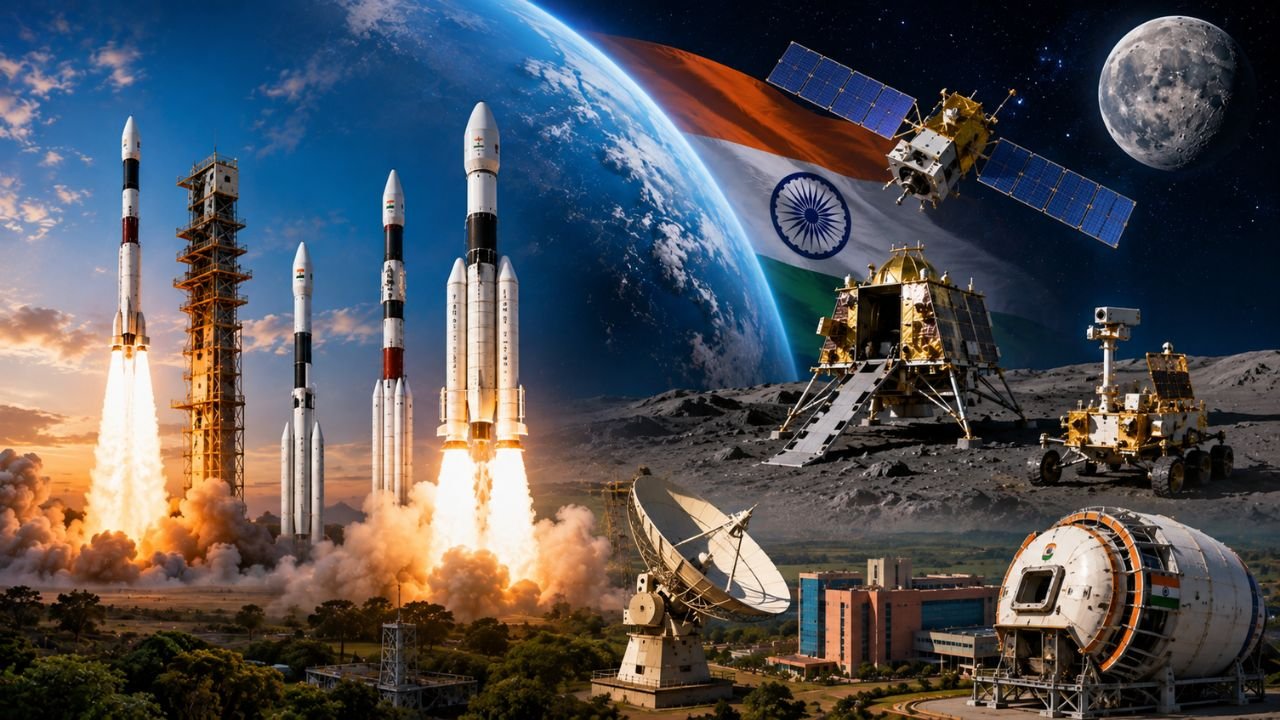
India has developed a series of indigenous launch vehicles to place satellites into orbit and execute scientific missions. These launch vehicles have enabled India to achieve remarkable success in lunar exploration, Mars exploration, solar observation, and future human spaceflight.
This article covers India’s major launch vehicles, Chandrayaan missions, Mangalyaan, Aditya-L1, Gaganyaan, and major ISRO centres.
Launch Vehicles of India
1. SLV-3 (Satellite Launch Vehicle)
SLV-3 was India’s first indigenous satellite launch vehicle.
| Particular | Details |
|---|---|
| Full Form | Satellite Launch Vehicle |
| First Successful Launch | 1980 |
Brief Explanation
- India’s first indigenous satellite launch vehicle.
2. ASLV (Augmented Satellite Launch Vehicle)
ASLV was developed to increase the payload capacity over SLV.
| Particular | Details |
|---|---|
| Full Form | Augmented Satellite Launch Vehicle |
| Operational Period | 1987–1994 |
Brief Explanation
- Developed to increase payload capacity over SLV.
3. PSLV (Polar Satellite Launch Vehicle)
PSLV is one of ISRO’s most reliable launch vehicles.
| Particular | Details |
|---|---|
| Full Form | Polar Satellite Launch Vehicle |
| First Successful Launch | 1994 |
Brief Explanation
- Known as the Workhorse of ISRO because of its reliability.
4. GSLV (Geosynchronous Satellite Launch Vehicle)
GSLV is used to launch heavier communication satellites.
| Particular | Details |
|---|---|
| Full Form | Geosynchronous Satellite Launch Vehicle |
| First Launch | 2001 |
Brief Explanation
- Used for launching heavier communication satellites.
5. LVM3 (Formerly GSLV Mk III)
LVM3 is India’s heaviest operational launch vehicle.
| Particular | Details |
|---|---|
| First Operational Mission | 2017 |
Brief Explanation
- India’s heaviest launch vehicle.
- Used for Chandrayaan-2, Chandrayaan-3, and future Gaganyaan missions.
Chandrayaan Missions
Chandrayaan-1
India’s first mission to the Moon.
| Particular | Details |
|---|---|
| Launch Date | 22 October 2008 |
| Objective | Lunar Exploration |
Achievement
- Discovered evidence of water molecules on the Moon.
Chandrayaan-2
India’s second lunar mission.
| Particular | Details |
|---|---|
| Launch Date | 22 July 2019 |
| Components | Orbiter, Vikram Lander, Pragyan Rover |
Achievement
- Orbiter continues to function successfully.
Chandrayaan-3
India’s third lunar mission.
| Particular | Details |
|---|---|
| Launch Date | 14 July 2023 |
| Moon Landing | 23 August 2023 |
Achievement
- India became the first country to land near the Moon’s South Pole.
Mars Orbiter Mission (Mangalyaan)
India’s first interplanetary mission.
| Particular | Details |
|---|---|
| Launch Date | 5 November 2013 |
| Mars Orbit Entry | 24 September 2014 |
Achievement
- India became the first country to reach Mars orbit on its first attempt.
Aditya-L1 Mission
India’s first dedicated solar mission.
| Particular | Details |
|---|---|
| Launch Date | 2 September 2023 |
| Destination | Sun–Earth L1 Point |
Achievement
- India’s first dedicated mission to study the Sun.
Gaganyaan Mission
India’s first planned human spaceflight mission.
| Particular | Details |
|---|---|
| Objective | Human Spaceflight Mission |
| Agency | ISRO |
| Planned Crew | Indian Astronauts (Vyomnauts) |
Brief Explanation
- Aims to send Indian astronauts into Low-Earth Orbit using an indigenous spacecraft.
Major ISRO Centres
| Centre | Location | Established | Function |
|---|---|---|---|
| ISRO Headquarters | Bengaluru | 1969 | Administration |
| Vikram Sarabhai Space Centre (VSSC) | Thiruvananthapuram | 1963 | Launch Vehicles |
| Satish Dhawan Space Centre (SDSC) | Sriharikota | 1971 | Rocket Launches |
| U. R. Rao Satellite Centre (URSC) | Bengaluru | 1972 | Satellite Development |
| Liquid Propulsion Systems Centre (LPSC) | Thiruvananthapuram | 1985 | Rocket Engines |
| National Remote Sensing Centre (NRSC) | Hyderabad | 1974 | Remote Sensing |
Quick Revision Table
| Topic | Answer |
|---|---|
| First Indigenous Launch Vehicle | SLV-3 |
| Workhorse of ISRO | PSLV |
| Heaviest Launch Vehicle | LVM3 |
| Chandrayaan-1 | 22 Oct 2008 |
| Chandrayaan-2 | 22 Jul 2019 |
| Chandrayaan-3 Launch | 14 Jul 2023 |
| Chandrayaan-3 Landing | 23 Aug 2023 |
| Mars Mission | Mangalyaan |
| Aditya-L1 Launch | 2 Sep 2023 |
| Gaganyaan Objective | Human Spaceflight |
| VSSC Function | Launch Vehicles |
| SDSC Function | Rocket Launches |
| URSC Function | Satellite Development |
| LPSC Function | Rocket Engines |
| NRSC Function | Remote Sensing |
Conclusion
India’s launch vehicles and space missions demonstrate the country’s rapid progress in space technology and exploration. Knowledge of SLV-3, PSLV, GSLV, LVM3, Chandrayaan missions, Mangalyaan, Aditya-L1, Gaganyaan, and major ISRO centres is essential for candidates preparing for SSC, UPSC, Banking, Railway, JKSSB, Defence, State PSC, and other competitive examinations.
Important MCQ’S on Launch Vehicles and Space Missions of India: Static GK
Q1. Which of the following statements are correct?
- SLV-3 was India’s first indigenous satellite launch vehicle.
- Its first successful launch took place in 1980.
- SLV stands for Satellite Launch Vehicle.
A) 1 only
B) 1 and 2 only
C) 2 and 3 only
D) 1, 2 and 3
✅ Answer: D
Q2. Which one of the following pairs is correctly matched?
A) ASLV — Augmented Satellite Launch Vehicle
B) PSLV — Polar Space Launch Vehicle
C) GSLV — General Satellite Launch Vehicle
D) LVM3 — Light Vehicle Mission-3
✅ Answer: A
Q3. Which of the following statements are correct regarding ASLV?
- It was developed to increase payload capacity over SLV.
- It remained operational from 1987 to 1994.
- It preceded the development of PSLV.
A) 1 only
B) 1 and 2 only
C) 2 and 3 only
D) 1, 2 and 3
✅ Answer: D
Q4. Which launch vehicle is popularly known as the “Workhorse of ISRO”?
A) SLV-3
B) PSLV
C) GSLV
D) LVM3
✅ Answer: B
Q5. Which of the following statements are correct?
- PSLV achieved its first successful launch in 1994.
- GSLV is used to launch heavier communication satellites.
- LVM3 is India’s heaviest operational launch vehicle.
A) 1 only
B) 1 and 2 only
C) 2 and 3 only
D) 1, 2 and 3
✅ Answer: D
Q6. LVM3 is primarily associated with which of the following missions?
- Chandrayaan-2
- Chandrayaan-3
- Future Gaganyaan Mission
A) 1 only
B) 1 and 2 only
C) 2 and 3 only
D) 1, 2 and 3
✅ Answer: D
Q7. Which of the following statements are correct regarding Chandrayaan-1?
- It was launched on 22 October 2008.
- Its objective was lunar exploration.
- It discovered evidence of water molecules on the Moon.
A) 1 only
B) 1 and 2 only
C) 2 and 3 only
D) 1, 2 and 3
✅ Answer: D
Q8. Which one of the following pairs is incorrectly matched?
A) Chandrayaan-2 — Vikram Lander
B) Chandrayaan-2 — Pragyan Rover
C) Chandrayaan-2 — Orbiter
D) Chandrayaan-2 — Mangalyaan Rover
✅ Answer: D
Q9. Which of the following statements are correct regarding Chandrayaan-2?
- It was launched on 22 July 2019.
- It consisted of an Orbiter, Vikram Lander, and Pragyan Rover.
- The Orbiter continues to function successfully.
A) 1 only
B) 1 and 2 only
C) 2 and 3 only
D) 1, 2 and 3
✅ Answer: D
Q10. Which one of the following achievements is associated with Chandrayaan-3?
A) First Indian satellite
B) Discovery of water molecules
C) First country to land near the Moon’s South Pole
D) First Mars mission
✅ Answer: C
Q11. Which of the following statements are correct regarding Chandrayaan-3?
- It was launched on 14 July 2023.
- It landed on the Moon on 23 August 2023.
- India became the first country to land near the Moon’s South Pole.
A) 1 only
B) 1 and 2 only
C) 2 and 3 only
D) 1, 2 and 3
✅ Answer: D
Q12. Which one of the following statements correctly describes the Mars Orbiter Mission (Mangalyaan)?
A) India’s first lunar mission
B) India’s first communication satellite
C) India’s first interplanetary mission
D) India’s first human spaceflight mission
✅ Answer: C
Q13. Which of the following statements are correct regarding Mangalyaan?
- It was launched on 5 November 2013.
- It entered Mars orbit on 24 September 2014.
- India became the first country to reach Mars orbit on its first attempt.
A) 1 only
B) 1 and 2 only
C) 2 and 3 only
D) 1, 2 and 3
✅ Answer: D
Q14. Aditya-L1 Mission is associated with which of the following?
A) Human Spaceflight
B) Lunar Exploration
C) Solar Observation
D) Earth Observation
✅ Answer: C
Q15. Which of the following statements are correct regarding Aditya-L1?
- It was launched on 2 September 2023.
- Its destination is the Sun–Earth L1 Point.
- It is India’s first dedicated mission to study the Sun.
A) 1 only
B) 1 and 2 only
C) 2 and 3 only
D) 1, 2 and 3
✅ Answer: D
Q16. Which one of the following correctly describes the Gaganyaan Mission?
A) India’s first lunar mission
B) India’s first Mars mission
C) India’s first planned human spaceflight mission
D) India’s first remote sensing mission
✅ Answer: C
Q17. Which of the following statements are correct regarding the Gaganyaan Mission?
- Its objective is human spaceflight.
- It is being developed by ISRO.
- The planned crew consists of Indian astronauts (Vyomnauts).
A) 1 only
B) 1 and 2 only
C) 2 and 3 only
D) 1, 2 and 3
✅ Answer: D
Q18. Which one of the following pairs is correctly matched?
A) Vikram Sarabhai Space Centre — Launch Vehicles
B) Satish Dhawan Space Centre — Satellite Development
C) U. R. Rao Satellite Centre — Rocket Engines
D) NRSC — Rocket Launches
✅ Answer: A
Q19. Which of the following statements are correct?
- Satish Dhawan Space Centre is located at Sriharikota.
- U. R. Rao Satellite Centre is located in Bengaluru.
- Liquid Propulsion Systems Centre develops rocket engines.
A) 1 only
B) 1 and 2 only
C) 2 and 3 only
D) 1, 2 and 3
✅ Answer: D
Q20. Arrange the following launch vehicles according to their first successful launch/first operational mission.
- SLV-3
- PSLV
- GSLV
- LVM3
A) 1 → 2 → 3 → 4
B) 2 → 1 → 3 → 4
C) 1 → 3 → 2 → 4
D) 3 → 2 → 1 → 4
✅ Answer: A