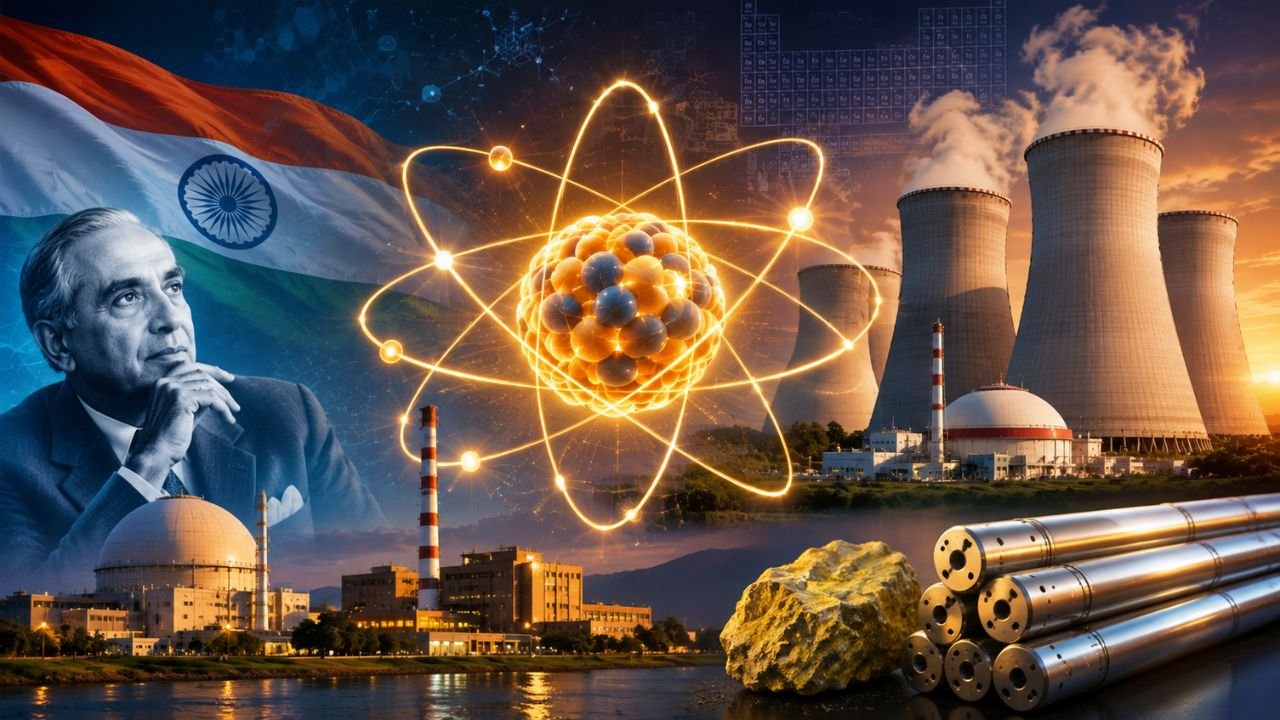
India’s Three-Stage Nuclear Power Programme was designed by Dr. Homi Jehangir Bhabha to ensure long-term energy security by making efficient use of the country’s available nuclear resources. The programme consists of three successive stages, each using different reactor technologies and fuels.
India’s Three-Stage Nuclear Power Programme
India’s nuclear power programme consists of three stages, each designed to utilize different nuclear fuels while increasing the availability of fissile material for the next stage.
Stage 1: Pressurized Heavy Water Reactors (PHWRs)
The first stage uses Pressurized Heavy Water Reactors (PHWRs) to generate electricity while producing plutonium for the next stage.
| Component | Details |
|---|---|
| Reactor Type | Pressurized Heavy Water Reactors (PHWRs) |
| Fuel Used | Natural Uranium |
| Output | Electricity + Plutonium |
| Main Objective | Generate electricity and produce plutonium for Stage 2 of India’s nuclear power programme |
Important Facts
- Stage 1 uses Pressurized Heavy Water Reactors (PHWRs).
- Natural Uranium is used as fuel.
- Electricity is generated during this stage.
- Plutonium produced in this stage is used in the Fast Breeder Reactor programme.
Stage 2: Fast Breeder Reactors (FBRs)
The second stage focuses on producing more fissile material than it consumes.
| Component | Details |
|---|---|
| Reactor Type | Fast Breeder Reactors (FBRs) |
| Fuel Used | Plutonium + Uranium-238 |
| Output | More Plutonium |
| Main Objective | Produce more fissile material than is consumed |
Important Facts
- Fast Breeder Reactors are used in Stage 2.
- Fuel consists of Plutonium and Uranium-238.
- The objective is to produce additional fissile material for future use.
Stage 3: Thorium-Based Reactors
The final stage aims to utilize India’s abundant thorium resources.
| Component | Details |
|---|---|
| Reactor Type | Thorium-Based Reactors |
| Fuel Used | Thorium-232 |
| Output | Uranium-233 |
| Main Objective | Utilize India’s vast thorium reserves for long-term energy security |
Important Facts
- Stage 3 uses Thorium-Based Reactors.
- Thorium-232 serves as the primary fuel.
- Uranium-233 is produced during this stage.
- The primary objective is long-term energy security.
India’s Thorium Reserves
According to the uploaded book, India possesses one of the world’s largest thorium reserves, mainly along the coasts of:
- Tamil Nadu
- Odisha
- Andhra Pradesh
Major Nuclear Power Plants in India
| Nuclear Power Plant | State | Year of Establishment | Installed Capacity |
|---|---|---|---|
| Kudankulam Nuclear Power Plant | Tamil Nadu | 2013 (Unit-1 Commissioned) | 2000 MW |
| Tarapur Atomic Power Station | Maharashtra | 1969 | 1400 MW |
| Rajasthan Atomic Power Station (RAPS) | Rajasthan | 1973 | 1180 MW |
| Kakrapar Atomic Power Station (KAPS) | Gujarat | 1993 | 1140 MW |
| Kaiga Generating Station | Karnataka | 2000 | 880 MW |
| Narora Atomic Power Station (NAPS) | Uttar Pradesh | 1991 | 440 MW |
| Madras Atomic Power Station (MAPS) | Tamil Nadu | 1984 | 440 MW |
Important Facts on Nuclear Power Plants
- Kudankulam Nuclear Power Plant has the highest installed capacity listed in the book (2000 MW).
- Tarapur Atomic Power Station was commissioned in 1969.
- Rajasthan Atomic Power Station was established in 1973.
- Kakrapar Atomic Power Station is located in Gujarat.
- Kaiga Generating Station is located in Karnataka.
- Narora Atomic Power Station is situated in Uttar Pradesh.
- Madras Atomic Power Station is located in Tamil Nadu.
Nuclear Tests of India
Pokhran-I
| Particular | Details |
|---|---|
| Name | Smiling Buddha |
| Date | 18 May 1974 |
| Place | Pokhran, Rajasthan |
| Prime Minister | Indira Gandhi |
Importance
India’s first nuclear test.
Pokhran-II
| Particular | Details |
|---|---|
| Name | Operation Shakti |
| Date | 11–13 May 1998 |
| Place | Pokhran, Rajasthan |
| Prime Minister | Atal Bihari Vajpayee |
Importance
India declared itself a nuclear weapon state.
Important Atomic Energy Institutions
| Institution | Year |
|---|---|
| Atomic Energy Commission (AEC) | 1948 |
| Department of Atomic Energy (DAE) | 1954 |
| Nuclear Power Corporation of India Ltd. (NPCIL) | 1987 |
| Atomic Minerals Directorate (AMD) | 1949 |
Conclusion
India’s Three-Stage Nuclear Power Programme reflects the country’s long-term strategy for energy security and efficient use of nuclear resources. Understanding the three stages, major nuclear power plants, Pokhran nuclear tests, and atomic energy institutions is essential for scoring well in SSC, UPSC, Banking, Railway, JKSSB, Defence, and other competitive examinations.
Important MCQ’S on India’s Three-Stage Nuclear Power Programme
Q1. Which of the following statements are correct?
- India’s Three-Stage Nuclear Power Programme was designed by Dr. Homi Jehangir Bhabha.
- The programme aims to ensure long-term energy security.
- It utilizes India’s available nuclear resources efficiently.
A) 1 only
B) 1 and 2 only
C) 2 and 3 only
D) 1, 2 and 3
✅ Answer: D
Q2. Which one of the following pairs is correctly matched?
A) Stage 1 — Pressurized Heavy Water Reactors (PHWRs)
B) Stage 2 — Thorium-Based Reactors
C) Stage 3 — Fast Breeder Reactors
D) Stage 1 — Gas-Cooled Reactors
✅ Answer: A
Q3. Which of the following statements are correct regarding Stage 1 of India’s Nuclear Power Programme?
- It uses Natural Uranium as fuel.
- It generates electricity.
- It produces plutonium for the next stage.
A) 1 only
B) 1 and 2 only
C) 2 and 3 only
D) 1, 2 and 3
✅ Answer: D
Q4. The plutonium produced during Stage 1 is mainly utilized in:
A) Thorium-Based Reactors
B) Fast Breeder Reactors
C) APSARA Reactor
D) CIRUS Reactor
✅ Answer: B
Q5. Which of the following statements are correct regarding Stage 2?
- Stage 2 uses Fast Breeder Reactors (FBRs).
- The fuel consists of Plutonium and Uranium-238.
- The objective is to produce more fissile material than is consumed.
A) 1 only
B) 1 and 2 only
C) 2 and 3 only
D) 1, 2 and 3
✅ Answer: D
Q6. Which one of the following is the correct fuel combination used in Stage 2 of India’s Three-Stage Nuclear Power Programme?
A) Natural Uranium
B) Thorium-232
C) Plutonium + Uranium-238
D) Uranium-233
✅ Answer: C
Q7. Which of the following statements are correct regarding Stage 3?
- It uses Thorium-Based Reactors.
- Thorium-232 is used as fuel.
- Uranium-233 is produced as output.
A) 1 only
B) 1 and 2 only
C) 2 and 3 only
D) 1, 2 and 3
✅ Answer: D
Q8. The primary objective of Stage 3 is to:
A) Produce plutonium
B) Generate hydroelectricity
C) Utilize India’s thorium reserves for long-term energy security
D) Develop thermal power stations
✅ Answer: C
Q9. Which of the following states are mentioned in the book as having major thorium reserves?
- Tamil Nadu
- Odisha
- Andhra Pradesh
A) 1 only
B) 1 and 2 only
C) 2 and 3 only
D) 1, 2 and 3
✅ Answer: D
Q10. Arrange the following stages of India’s Nuclear Power Programme in the correct sequence.
- Fast Breeder Reactors
- Thorium-Based Reactors
- Pressurized Heavy Water Reactors
A) 3–1–2
B) 1–3–2
C) 2–1–3
D) 3–2–1
✅ Answer: A
Q11. Which one of the following Nuclear Power Plants has the highest installed capacity mentioned in the book?
A) Tarapur Atomic Power Station
B) Kakrapar Atomic Power Station
C) Kudankulam Nuclear Power Plant
D) Rajasthan Atomic Power Station
✅ Answer: C
Q12. Which of the following statements are correct?
- Tarapur Atomic Power Station was commissioned in 1969.
- Rajasthan Atomic Power Station was established in 1973.
- Kakrapar Atomic Power Station is located in Gujarat.
A) 1 only
B) 1 and 2 only
C) 2 and 3 only
D) 1, 2 and 3
✅ Answer: D
Q13. Which one of the following pairs is incorrectly matched?
A) Kaiga Generating Station — Karnataka
B) Narora Atomic Power Station — Uttar Pradesh
C) Madras Atomic Power Station — Maharashtra
D) Kudankulam Nuclear Power Plant — Tamil Nadu
✅ Answer: C
Q14. Which of the following statements are correct regarding Pokhran-I?
- It was code-named “Smiling Buddha.”
- It was conducted on 18 May 1974.
- It was India’s first nuclear test.
A) 1 only
B) 1 and 2 only
C) 2 and 3 only
D) 1, 2 and 3
✅ Answer: D
Q15. Which one of the following correctly describes Pokhran-II?
A) Conducted in 1974 under Indira Gandhi
B) Code-named “Smiling Buddha”
C) Conducted during the tenure of Atal Bihari Vajpayee under the code name “Operation Shakti”
D) Conducted before Pokhran-I
✅ Answer: C
Q16. Which of the following statements are correct?
- Pokhran-II was conducted between 11–13 May 1998.
- It took place at Pokhran in Rajasthan.
- India declared itself a nuclear weapon state after this test.
A) 1 only
B) 1 and 2 only
C) 2 and 3 only
D) 1, 2 and 3
✅ Answer: D
Q17. Which one of the following institutions was established first?
A) Atomic Minerals Directorate (AMD)
B) Department of Atomic Energy (DAE)
C) Nuclear Power Corporation of India Limited (NPCIL)
D) Atomic Energy Commission (AEC)
✅ Answer: D
Q18. Arrange the following Atomic Energy Institutions in chronological order of establishment.
- Atomic Energy Commission (AEC)
- Atomic Minerals Directorate (AMD)
- Department of Atomic Energy (DAE)
- Nuclear Power Corporation of India Limited (NPCIL)
A) 1–2–3–4
B) 2–1–3–4
C) 1–3–2–4
D) 3–1–2–4
✅ Answer: A
Q19. Which of the following statements are correct?
- Atomic Energy Commission was established in 1948.
- Atomic Minerals Directorate was established in 1949.
- Department of Atomic Energy was established in 1954.
A) 1 only
B) 1 and 2 only
C) 2 and 3 only
D) 1, 2 and 3
✅ Answer: D
Q20. Which of the following statements correctly summarize India’s Three-Stage Nuclear Power Programme?
- Stage 1 produces plutonium using Natural Uranium.
- Stage 2 uses Fast Breeder Reactors to generate more fissile material.
- Stage 3 utilizes Thorium-232 for long-term energy security.
A) 1 only
B) 1 and 2 only
C) 2 and 3 only
D) 1, 2 and 3
✅ Answer: D