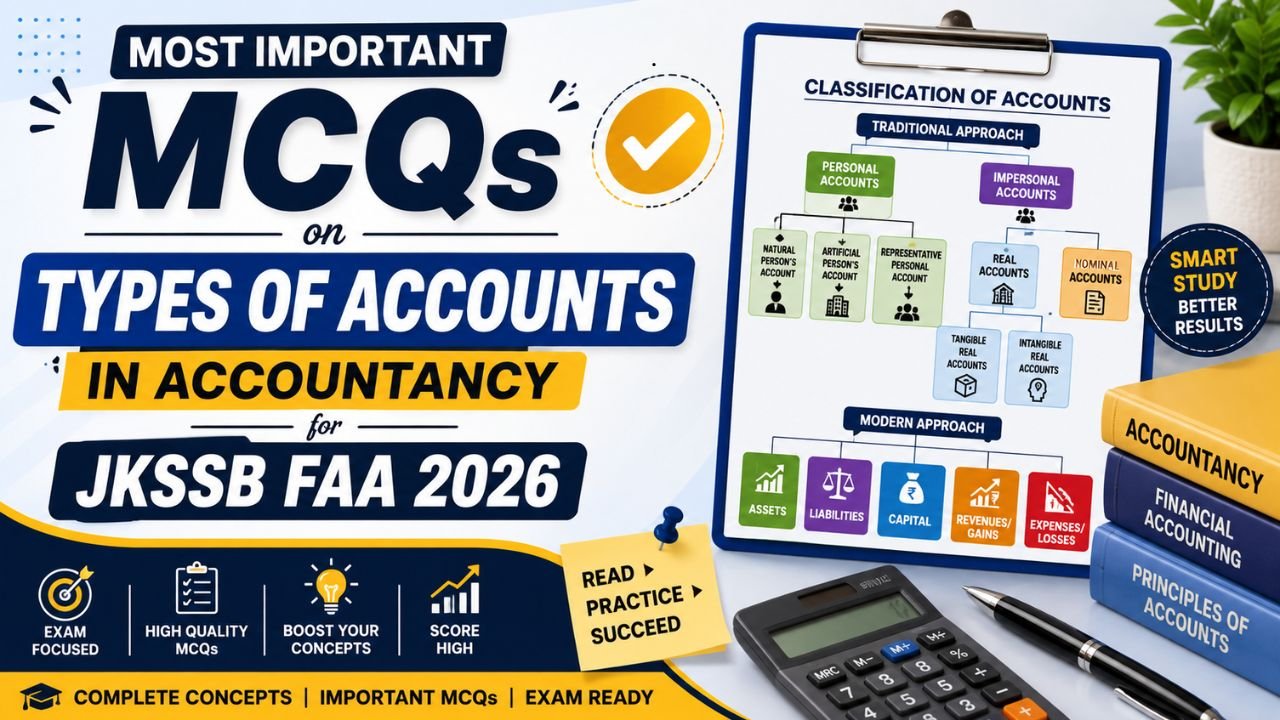
Dear aspirants, practice the Most Important MCQs on Types of Accounts in Accountancy for JKSSB FAA 2026, specially prepared by Exam Waves. These questions will help you understand account classification, debit-credit rules, and strengthen your Accountancy preparation for the exam.
Q1. Which of the following statements correctly describe the classification of accounts under the Traditional Approach?
- Accounts are broadly classified into Personal Accounts and Impersonal Accounts.
- Impersonal Accounts are further divided into Real Accounts and Nominal Accounts.
- Personal Accounts are further divided into Natural, Artificial and Representative Personal Accounts.
- Real Accounts can be classified into Tangible and Intangible Real Accounts.
A) 1 and 2 only
B) 1, 2 and 3 only
C) 2, 3 and 4 only
D) 1, 2, 3 and 4
Answer: D
Q2. Consider the following accounts:
- Muzaffar’s A/c
- J&K Bank A/c
- Outstanding Rent A/c
- Goodwill A/c
- Wages A/c
Which of the following correctly classifies the first three accounts under Personal Accounts?
A) 1-Natural, 2-Artificial, 3-Representative
B) 1-Artificial, 2-Natural, 3-Representative
C) 1-Natural, 2-Representative, 3-Artificial
D) 1-Representative, 2-Artificial, 3-Natural
Answer: A
Q3. Which of the following statements correctly describe a Natural Person’s Account?
- It relates to an individual human being.
- Muzaffar’s A/c can be classified as a Natural Person’s Account.
- J&K Bank A/c is also a Natural Person’s Account because a bank deals with individuals.
- It is one of the categories of Personal Accounts.
A) 1 and 2 only
B) 1, 2 and 4 only
C) 2, 3 and 4 only
D) 1, 2, 3 and 4
Answer: B
Q4. Assertion (A): J&K Bank A/c is classified as an Artificial Person’s Account under the Traditional Approach.
Reason (R): Artificial Person’s Accounts represent organizations or institutions created by law.
Choose the correct answer:
A) Both A and R are true, and R is the correct explanation of A
B) Both A and R are true, but R is not the correct explanation of A
C) A is true, but R is false
D) A is false, but R is true
Answer: A
Q5. Which of the following groups contains only Representative Personal Accounts?
A) Outstanding Rent A/c, Income Received in Advance A/c and Prepaid Wages A/c
B) Outstanding Rent A/c, Goodwill A/c and Prepaid Wages A/c
C) J&K Bank A/c, Outstanding Rent A/c and Income Received in Advance A/c
D) Machinery A/c, Prepaid Wages A/c and Outstanding Rent A/c
Answer: A
Q6. Match List I with List II and select the correct answer:
| List I | List II |
|---|---|
| A. Natural Person’s Account | 1. Outstanding Rent A/c |
| B. Artificial Person’s Account | 2. Muzaffar’s A/c |
| C. Representative Personal Account | 3. J&K Bank A/c |
| D. Intangible Real Account | 4. Goodwill A/c |
A) A-2, B-3, C-1, D-4
B) A-3, B-2, C-4, D-1
C) A-2, B-1, C-3, D-4
D) A-4, B-3, C-1, D-2
Answer: A
Q7. Which of the following statements correctly distinguish Tangible Real Accounts from Intangible Real Accounts?
- Tangible Real Accounts represent assets that can be seen, touched and felt.
- Intangible Real Accounts represent assets that cannot be seen or touched but have value.
- Machinery A/c is an example of a Tangible Real Account.
- Goodwill A/c is an example of an Intangible Real Account.
A) 1 and 2 only
B) 1, 2 and 3 only
C) 2, 3 and 4 only
D) 1, 2, 3 and 4
Answer: D
Q8. Consider the following accounts:
- Machinery A/c
- Stock of Goods A/c
- Land A/c
- Cash A/c
- Goodwill A/c
- Patent A/c
Which of the following correctly identifies only the Tangible Real Accounts?
A) 1, 2, 3 and 4
B) 1, 3, 5 and 6
C) 2, 4, 5 and 6
D) 1, 2, 3, 4, 5 and 6
Answer: A
Q9. Which of the following statements correctly describe Nominal Accounts?
- They relate to expenses and losses.
- They also relate to income and gains.
- Wages A/c and Stationery A/c are examples of Nominal Accounts.
- Under the Golden Rule, all expenses and losses are debited while all incomes and gains are credited.
A) 1 and 2 only
B) 1, 2 and 3 only
C) 2, 3 and 4 only
D) 1, 2, 3 and 4
Answer: D
Download our Accountancy Master Guide 2026
Q10. Match the types of accounts under the Traditional Approach with their Golden Rules:
| List I | List II |
|---|---|
| A. Personal Account | 1. Debit what comes in, Credit what goes out |
| B. Real Account | 2. Debit all Expenses and Losses, Credit all Incomes and Gains |
| C. Nominal Account | 3. Debit the Receiver, Credit the Giver |
A) A-3, B-1, C-2
B) A-1, B-3, C-2
C) A-3, B-2, C-1
D) A-2, B-1, C-3
Answer: A
Q11. According to the Modern Approach, all accounts are divided into which of the following five categories?
- Assets
- Liabilities
- Capital
- Expenses/Losses
- Revenues/Gains
A) 1, 2 and 3 only
B) 1, 2, 3 and 4 only
C) 2, 3, 4 and 5 only
D) 1, 2, 3, 4 and 5
Answer: D
Q12. Consider the following accounts under the Modern Approach:
- Machinery A/c
- Goodwill A/c
- Furniture A/c
- Creditors A/c
- Bank Loan A/c
Which of the following correctly classifies them?
A) 1, 2 and 3 are Assets; 4 and 5 are Liabilities
B) 1 and 2 are Assets; 3, 4 and 5 are Liabilities
C) 1, 3 and 4 are Assets; 2 and 5 are Liabilities
D) 1, 2, 3 and 5 are Assets; 4 is a Liability
Answer: A
Q13. Which of the following statements correctly describe the fundamental rules for Assets and Expenses under the Modern Approach?
- An increase in Asset is recorded as Debit.
- A decrease in Asset is recorded as Credit.
- An increase in Expense is recorded as Debit.
- A decrease in Expense is recorded as Credit.
A) 1 and 3 only
B) 1, 2 and 3 only
C) 2, 3 and 4 only
D) 1, 2, 3 and 4
Answer: D
Q14. Which of the following statements correctly describe the rules for Liability, Capital and Revenue under the Modern Approach?
- Increase in Liability is Credit.
- Increase in Capital is Credit.
- Increase in Revenue is Credit.
- Decrease in Liability, Capital and Revenue is Debit.
A) 1 and 2 only
B) 1, 2 and 3 only
C) 2, 3 and 4 only
D) 1, 2, 3 and 4
Answer: D
Q15. Assertion (A): An increase in Machinery A/c is recorded on the Debit side under the Modern Approach.
Reason (R): Machinery A/c is classified as an Asset Account, and an increase in an Asset is Debit.
Choose the correct answer:
A) Both A and R are true, and R is the correct explanation of A
B) Both A and R are true, but R is not the correct explanation of A
C) A is true, but R is false
D) A is false, but R is true
Answer: A
Q16. Match List I with the appropriate category under the Modern Approach:
| List I | List II |
|---|---|
| A. Creditors A/c | 1. Revenue and Gains |
| B. Muzaffar’s Capital A/c | 2. Expenses and Losses |
| C. Commission Received A/c | 3. Liability |
| D. Loss by Fire A/c | 4. Capital |
A) A-3, B-4, C-1, D-2
B) A-4, B-3, C-2, D-1
C) A-3, B-1, C-4, D-2
D) A-2, B-4, C-1, D-3
Answer: A
Q17. Consider the following pairs under the Modern Approach:
- Machinery A/c — Asset
- Bank Overdraft A/c — Liability
- Rent Received A/c — Revenue
- Printing & Stationery A/c — Expense
- Goodwill A/c — Asset
How many of the above pairs are correctly matched?
A) Only two
B) Only three
C) Only four
D) All five
Answer: D
Q18. Asif is revising the fundamental Debit and Credit rules under the Modern Approach. Which of the following combinations is entirely correct?
A) Asset Increase—Debit; Liability Increase—Credit; Capital Increase—Credit; Revenue Increase—Credit; Expense Increase—Debit
B) Asset Increase—Credit; Liability Increase—Debit; Capital Increase—Credit; Revenue Increase—Debit; Expense Increase—Credit
C) Asset Increase—Debit; Liability Increase—Debit; Capital Increase—Credit; Revenue Increase—Credit; Expense Increase—Credit
D) Asset Increase—Credit; Liability Increase—Credit; Capital Increase—Debit; Revenue Increase—Debit; Expense Increase—Debit
Answer: A
Q19. Consider the following accounts:
- Dividend Received A/c
- Rent Received A/c
- Interest Received A/c
- Wages A/c
- Loss by Fire A/c
- Printing & Stationery A/c
Which of the following correctly classifies them under the Modern Approach?
A) 1, 2 and 3 are Revenues/Gains; 4, 5 and 6 are Expenses/Losses
B) 1, 2 and 4 are Revenues/Gains; 3, 5 and 6 are Expenses/Losses
C) 1, 3 and 5 are Revenues/Gains; 2, 4 and 6 are Expenses/Losses
D) 1, 2, 3 and 4 are Revenues/Gains; 5 and 6 are Expenses/Losses
Answer: A
Q20. Consider the following statements regarding both the Traditional and Modern approaches to Classification of Accounts:
- The Traditional Approach includes Personal, Real and Nominal Accounts.
- Personal Accounts may be Natural, Artificial or Representative.
- Real Accounts may be Tangible or Intangible.
- The Modern Approach classifies accounts into Assets, Liabilities, Capital, Revenues/Gains and Expenses/Losses.
- Under the Modern Approach, increases in Assets and Expenses are debited, while increases in Liabilities, Capital and Revenue are credited.
Which of the statements given above are correct?
A) 1, 2 and 3 only
B) 1, 2, 3 and 4 only
C) 2, 3, 4 and 5 only
D) 1, 2, 3, 4 and 5
Answer: D