The Alchon Huns in Kashmir is an important topic in the Ancient History of Kashmir. Questions related to Toramana, Mihirkula, Gopaditya, Yudhistra-I, the restored Gonanda Dynasty, Meghavahana, Matrigupta, Pravarasena II, and Shalimar Garden are frequently asked in JKSSB, JKPSC, JK Police, JK Bank, JK High Court, and other Jammu and Kashmir competitive examinations.
This article Exam Waves (A leading Coaching Academy) explains all the important facts about the Alchon Huns in Kashmir in easy and simple way so that students can understand better.
Who were the Alchon Huns?
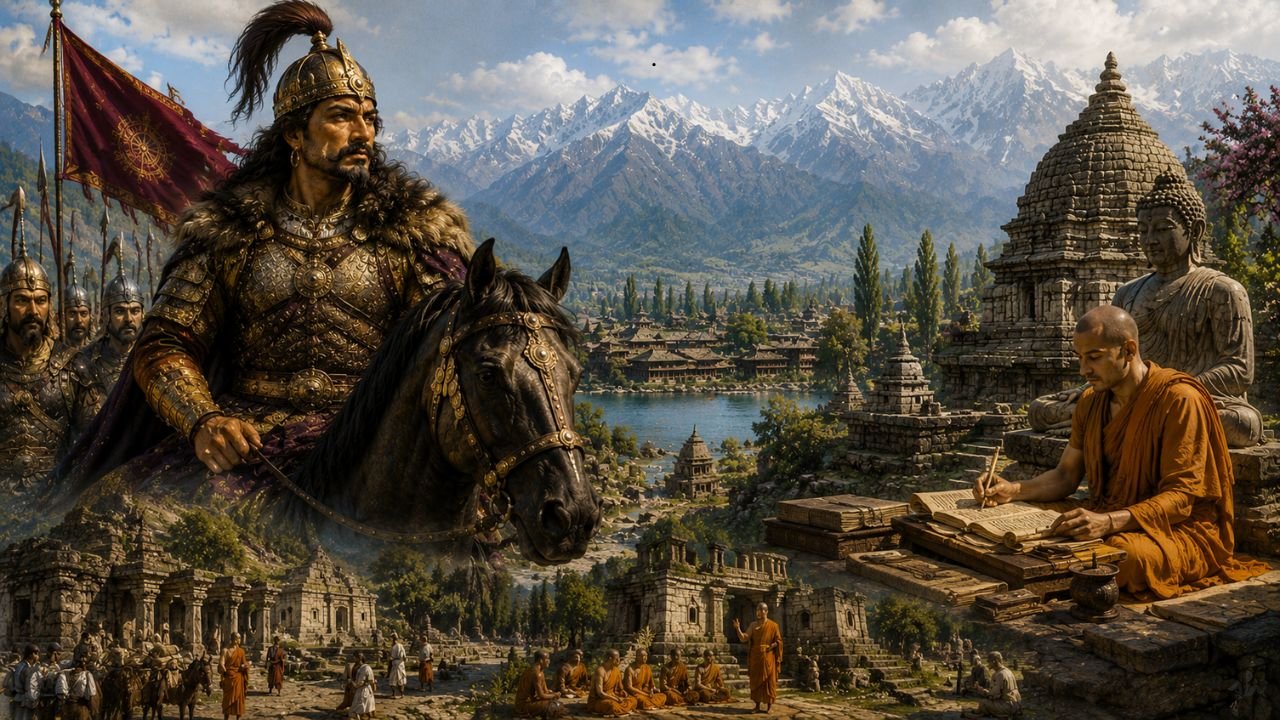
The Alchon Huns were tribes from Asia and South Asia. They established their rule in Kashmir during the 4th–5th century.
Important facts
- The Alchon Huns were tribes from Asia and South Asia.
- They established their rule during the 4th–5th century.
- They entered India through the Hindu Kush.
- Toramana was an important Hun ruler who attacked through the Hindu Kush route.
Mihirkula
The most famous Alchon Hun ruler associated with Kashmir was Mihirkula.
Important facts
- Mihirkula succeeded his father Toramana.
- Many historians compared him with “Indian Nero.”
- Mihirkula was known for his cruelty.
- After being defeated by Yashodharman and Baladitya, Mihirkula fled to Kashmir.
Gopaditya
During this period, Gopaditya played an important role in Kashmir.
Important facts
- Gopaditya built the Jyestheshwara Temple.
- The temple is known today as the Shankaracharya Temple.
- It was built on Gopadri Hill in Srinagar.
Yudhistra-I
Yudhistra-I was one of the last Hun rulers of Kashmir.
This is an important factual point for competitive examinations.
Restored Gonanda Dynasty (Book III of Rajatarangini)
After the Hun period, the restored Gonanda Dynasty became important in Kashmir.
Meghavahana
Meghavahana was the founder of the restored Gonanda Dynasty.
Important facts
- He founded the restored Gonanda Dynasty.
- He was the son of Yudhistra’s first grandson.
- He prohibited the slaughter of animals.
His policy against animal slaughter is an important examination point.
Succession after Meghavahana
The succession of rulers after Meghavahana is important.
Shresthsen
- Meghavahana was succeeded by Shresthsen.
Hiranya
- Shresthsen was succeeded by Hiranya.
Matrigupta
Matrigupta was an important ruler of this period.
Important fact
- Matrigupta obtained the kingdom with the help of Vikramaditya of Ujjain.
Pravarasena II
Pravarasena II was another important ruler of the restored Gonanda Dynasty.
Important facts
- He was the nephew of Hiranya.
- He restored the kingdom from Matrigupta.
- He built Srinagar as the capital.
- He built the Shalimar Garden.
The foundation of Srinagar and the construction of Shalimar Garden are important historical facts.
Last ruler of the dynasty
According to the source:
- The last ruler was Baladitya.
- He died without a male heir.
Importance of the Alchon Hun period
The Alchon Hun period was important because it was followed by the restoration of local rule under the Gonanda Dynasty. This period also saw:
- The construction of important religious monuments.
- The restoration of political authority.
- The development of Srinagar.
- The building of the Shalimar Garden.
Quick revision table
| Topic | Important Fact |
|---|---|
| Origin of Alchon Huns | Asia and South Asia |
| Period of rule | 4th–5th century |
| Entry route | Hindu Kush |
| Toramana | Important Hun ruler |
| Mihirkula | Son of Toramana |
| Mihirkula | Compared with “Indian Nero” |
| Defeated by | Yashodharman and Baladitya |
| Gopaditya | Built Jyestheshwara (Shankaracharya) Temple |
| Temple location | Gopadri Hill, Srinagar |
| Yudhistra-I | One of the last Hun rulers |
| Meghavahana | Founder of restored Gonanda Dynasty |
| Meghavahana | Prohibited animal slaughter |
| Matrigupta | Helped by Vikramaditya of Ujjain |
| Pravarasena II | Built Srinagar as capital |
| Pravarasena II | Built Shalimar Garden |
| Last ruler | Baladitya |
Important facts for JKSSB & JKPSC
- The Alchon Huns were tribes from Asia and South Asia.
- They ruled Kashmir during the 4th–5th century.
- They entered through the Hindu Kush.
- Toramana was an important Hun ruler.
- Mihirkula succeeded Toramana.
- Mihirkula was compared with “Indian Nero.”
- He fled to Kashmir after being defeated by Yashodharman and Baladitya.
- Gopaditya built the Jyestheshwara (Shankaracharya) Temple.
- The temple is located on Gopadri Hill in Srinagar.
- Yudhistra-I was one of the last Hun rulers of Kashmir.
- Meghavahana founded the restored Gonanda Dynasty.
- He prohibited the slaughter of animals.
- Matrigupta obtained the kingdom with the help of Vikramaditya of Ujjain.
- Pravarasena II restored the kingdom from Matrigupta.
- He built Srinagar as the capital and Shalimar Garden.
- Baladitya was the last ruler and died without a male heir.
Conclusion
The Alchon Huns played an important role in the ancient history of Kashmir. Their rule under Toramana and Mihirkula was followed by the restoration of the Gonanda Dynasty under Meghavahana. The contributions of Gopaditya, Matrigupta, and Pravarasena II, especially the construction of the Shankaracharya Temple, Srinagar, and Shalimar Garden, are important topics for JKSSB, JKPSC, JK Police, JK Bank, JK High Court, and other Jammu and Kashmir competitive examinations.
Important MCQ’S on Alchon Huns in Kashmir for all Competitive Exams
Q1. Which of the following statements correctly describe the Alchon Huns and their rule in Kashmir?
- The Alchon Huns were tribes from Asia and South Asia.
- They established their rule during the 4th–5th century.
- They entered India through the Hindu Kush.
- Toramana was one of the important Hun rulers associated with Kashmir.
A) 1 and 2 only
B) 1, 2 and 3 only
C) 2, 3 and 4 only
D) 1, 2, 3 and 4
Answer: D
Q2. Which of the following statements correctly describe Mihirkula?
- Mihirkula was the son of Toramana.
- Many historians compared him with “Indian Nero.”
- He was known for his cruelty.
- He fled to Kashmir after being defeated by Yashodharman and Baladitya.
A) 1 and 2 only
B) 1, 2 and 3 only
C) 2, 3 and 4 only
D) 1, 2, 3 and 4
Answer: D
Q3. Which of the following statements correctly describe the historical importance of Gopaditya?
- Gopaditya built the Jyestheshwara Temple.
- The temple is now known as the Shankaracharya Temple.
- It was built on Gopadri Hill in Srinagar.
- Gopaditya founded the Karkota Dynasty.
A) 1 and 2 only
B) 1, 2 and 3 only
C) 2, 3 and 4 only
D) 1, 2, 3 and 4
Answer: B
Q4. Which of the following statements correctly describe Yudhistra-I and the restored Gonanda Dynasty?
- Yudhistra-I was one of the last Hun rulers of Kashmir.
- Meghavahana founded the restored Gonanda Dynasty.
- Meghavahana was the son of Yudhistra’s first grandson.
- Meghavahana prohibited the slaughter of animals.
A) 1 and 2 only
B) 1, 2 and 3 only
C) 2, 3 and 4 only
D) 1, 2, 3 and 4
Answer: D
Q5. Which of the following statements correctly describe the succession after Meghavahana?
- Meghavahana was succeeded by Shresthsen.
- Shresthsen was succeeded by Hiranya.
- Hiranya was followed by Matrigupta.
- This succession belongs to the restored Gonanda Dynasty.
A) 1 and 2 only
B) 1, 2 and 3 only
C) 2, 3 and 4 only
D) 1, 2, 3 and 4
Answer: D
Q6. Which of the following statements correctly describe Matrigupta?
- Matrigupta obtained the kingdom with the help of Vikramaditya of Ujjain.
- He founded Srinagar as the capital.
- He belonged to the restored Gonanda period.
- His rule was later challenged by Pravarasena II.
A) 1 and 3 only
B) 1, 3 and 4 only
C) 2, 3 and 4 only
D) 1, 2, 3 and 4
Answer: B
Q7. Which of the following statements correctly describe Pravarasena II?
- He was the nephew of Hiranya.
- He restored the kingdom from Matrigupta.
- He built Srinagar as the capital.
- He built the Shalimar Garden.
A) 1 and 2 only
B) 1, 2 and 3 only
C) 2, 3 and 4 only
D) 1, 2, 3 and 4
Answer: D
Q8. Match List I with List II.
List I
- Toramana
- Mihirkula
- Gopaditya
- Pravarasena II
List II
a. Built Srinagar as the capital
b. Father of Mihirkula
c. Built the Jyestheshwara (Shankaracharya) Temple
d. Compared with “Indian Nero”
A) 1-b, 2-d, 3-c, 4-a
B) 1-d, 2-b, 3-a, 4-c
C) 1-c, 2-a, 3-d, 4-b
D) 1-b, 2-c, 3-d, 4-a
Answer: A
Q9. Which of the following statements correctly summarize the contributions of the restored Gonanda rulers?
- Meghavahana prohibited animal slaughter.
- Matrigupta received support from Vikramaditya of Ujjain.
- Pravarasena II established Srinagar as the capital.
- Pravarasena II built the Shalimar Garden.
A) 1 and 2 only
B) 1, 2 and 3 only
C) 2, 3 and 4 only
D) 1, 2, 3 and 4
Answer: D
Q10. Which of the following statements correctly summarize the Alchon Hun period and its aftermath in Kashmir?
- The Alchon Huns entered through the Hindu Kush.
- Mihirkula fled to Kashmir after his defeat.
- The restored Gonanda Dynasty was founded by Meghavahana.
- Baladitya was the last ruler and died without a male heir.
A) 1 and 2 only
B) 1, 2 and 3 only
C) 2, 3 and 4 only
D) 1, 2, 3 and 4
Answer: D