Ashoka is one of the most important rulers in the ancient history of Kashmir. Questions related to Ashoka, Buddhism in Kashmir, Mahayantika, Pandrethan, Jaluka, and the First International Buddhist Conference are frequently asked in JKSSB, JKPSC, JK Police, JK Bank, JK High Court, and other Jammu and Kashmir competitive examinations.
This article explains all the important facts about Ashoka in Kashmir which will help you to solve any questions regarding Ashoka.
Who was Ashoka?
Ashoka was an important ruler of ancient India and played a major role in the development of Buddhism in Kashmir.
Family background
- Ashoka was the son of Bindusara.
- He was the grandson of Chandragupta.
These facts are important for competitive examinations.
Buddhism during Ashoka’s reign
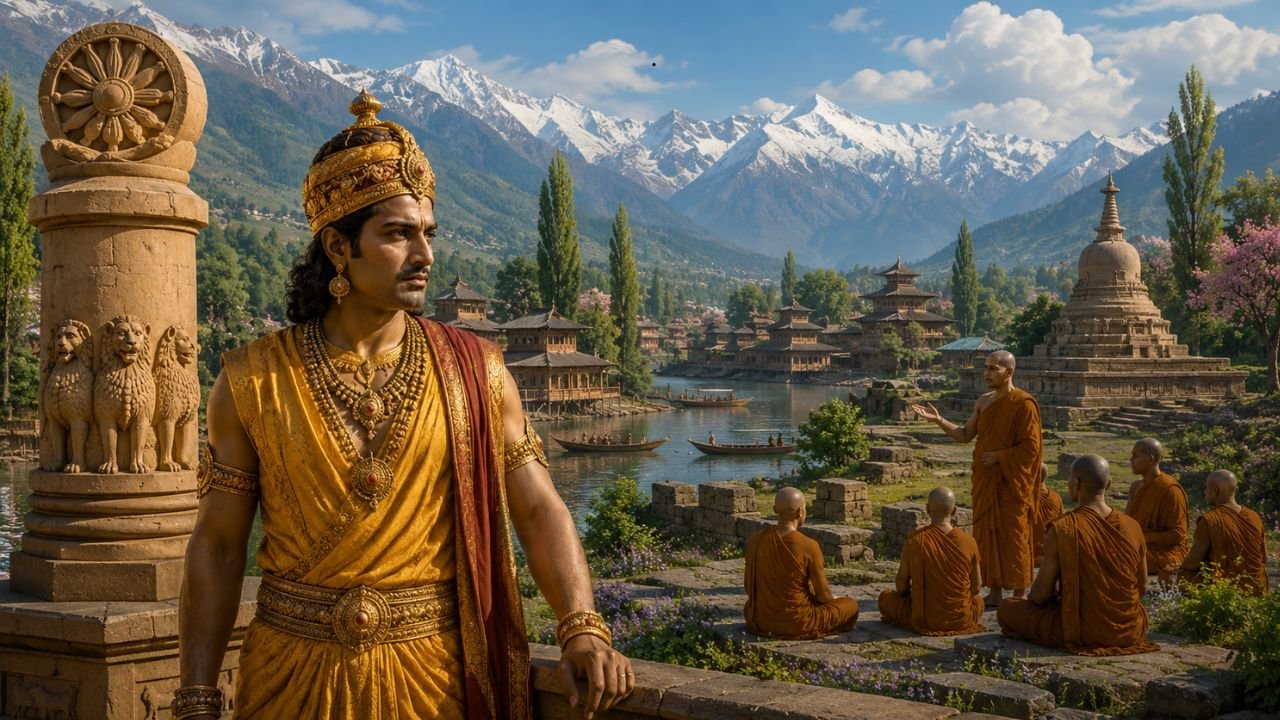
The most important feature of Ashoka’s rule in Kashmir was the spread of Buddhism.
According to the source:
- Buddhism flourished in Kashmir during Ashoka’s reign.
- He sent Mahayantika to propagate Buddhism in Kashmir.
This helped in the growth of Buddhist culture and religious activities in the region.
Hiuen Tsang’s account
According to Hiuen Tsang:
- 500 monks came to Kashmir during Ashoka’s reign.
This shows that Kashmir had become an important centre of Buddhism.
Foundation of Pandrethan
Ashoka is credited with founding Pandrethan, which is identified with present-day Srinagar.
This is an important factual point for JKSSB and JKPSC examinations.
Construction activities
Ashoka carried out important religious and architectural works in Kashmir.
He built:
- Viharas
- Temples
These constructions promoted Buddhism and religious learning in the region.
Important places associated with Ashoka
The article mentions the following places:
- Vijayeshwara in Bijbehara
- Shukaletra in Hushkar
These locations are associated with Ashoka’s activities in Kashmir.
Introduction of saffron cultivation
One of the most important facts mentioned in the source is that Madhyantika introduced saffron cultivation in Kashmir.
This point is frequently asked in Jammu and Kashmir competitive examinations.
First International Buddhist Conference
Ashoka organized the First International Buddhist Conference at Srinagar.
This highlights the importance of Kashmir as a major Buddhist centre during his reign.
Successor of Ashoka
Ashoka was succeeded by his son Jaluka.
Important facts about Jaluka
- Jaluka was the son of Ashoka.
- He cleared Kashmir from the Mlechhas.
- During his reign, Shaivism flourished in Kashmir.
This shows that the religious environment of Kashmir changed during Jaluka’s rule.
Damodar II
After Jaluka:
- Jaluka was succeeded by his son Damodar II.
This continued the succession of rulers after Ashoka.
Quick revision table
| Topic | Important Fact |
|---|---|
| Father of Ashoka | Bindusara |
| Grandfather of Ashoka | Chandragupta |
| Religion during his reign | Buddhism flourished |
| Buddhist missionary | Mahayantika |
| Hiuen Tsang’s account | 500 monks came to Kashmir |
| Founded city | Pandrethan (present-day Srinagar) |
| Religious constructions | Viharas and temples |
| Important places | Vijayeshwara and Shukaletra |
| Saffron cultivation | Introduced by Madhyantika |
| Buddhist conference | First International Buddhist Conference at Srinagar |
| Successor | Jaluka |
| Jaluka’s achievement | Cleared Kashmir from Mlechhas |
| Religion during Jaluka’s reign | Shaivism flourished |
| Next successor | Damodar II |
Important facts for JKSSB & JKPSC
- Ashoka was the son of Bindusara and grandson of Chandragupta.
- Buddhism flourished in Kashmir during Ashoka’s reign.
- Mahayantika was sent to propagate Buddhism.
- According to Hiuen Tsang, 500 monks came to Kashmir.
- Ashoka founded Pandrethan (present-day Srinagar).
- He built viharas and temples.
- Vijayeshwara in Bijbehara and Shukaletra in Hushkar are associated with his reign.
- Madhyantika introduced saffron cultivation in Kashmir.
- Ashoka organized the First International Buddhist Conference at Srinagar.
- Ashoka was succeeded by Jaluka.
- Jaluka cleared Kashmir from the Mlechhas.
- Shaivism flourished during Jaluka’s reign.
- Jaluka was succeeded by Damodar II.
Conclusion
Ashoka played a significant role in the ancient history of Kashmir by promoting Buddhism, founding Pandrethan, building viharas and temples, and organizing the First International Buddhist Conference at Srinagar. His reign made Kashmir an important Buddhist centre. The succession of Jaluka and Damodar II, along with the spread of Buddhism and saffron cultivation, are important topics for JKSSB, JKPSC, JK Police, JK Bank, and other Jammu and Kashmir competitive examinations.
Important MCQ’s on Ashoka in Kashmir for all Competitive Exams
Q1. Which of the following statements correctly describe Ashoka in relation to Kashmir?
- Ashoka was the son of Bindusara.
- He was the grandson of Chandragupta.
- Buddhism flourished in Kashmir during his reign.
- He played an important role in promoting Buddhism in Kashmir.
A) 1 and 2 only
B) 1, 2 and 3 only
C) 2, 3 and 4 only
D) 1, 2, 3 and 4
Answer: D
Q2. Which of the following statements correctly describe the spread of Buddhism during Ashoka’s reign?
- Mahayantika was sent to propagate Buddhism in Kashmir.
- According to Hiuen Tsang, 500 monks came to Kashmir.
- Kashmir became an important Buddhist centre during his reign.
- Buddhism declined during Ashoka’s reign.
A) 1 and 2 only
B) 1, 2 and 3 only
C) 2, 3 and 4 only
D) 1, 2, 3 and 4
Answer: B
Q3. According to the article, which of the following achievements are associated with Ashoka in Kashmir?
- Foundation of Pandrethan
- Construction of viharas
- Construction of temples
- Organization of the First International Buddhist Conference at Srinagar
A) 1 and 2 only
B) 1, 2 and 3 only
C) 2, 3 and 4 only
D) 1, 2, 3 and 4
Answer: D
Q4. Which of the following statements correctly describe Pandrethan in relation to Ashoka?
A) Pandrethan was founded by Jaluka.
B) Pandrethan is identified with present-day Srinagar.
C) Pandrethan was the capital founded by Lalitaditya.
D) Pandrethan was established during the Kushan period.
Answer: B
Q5. Which of the following places are associated with Ashoka’s activities in Kashmir?
- Vijayeshwara in Bijbehara
- Shukaletra in Hushkar
- Parihaspora
- Martand
A) 1 and 2 only
B) 1, 2 and 3 only
C) 2, 3 and 4 only
D) 1, 2, 3 and 4
Answer: A
Q6. Which of the following statements correctly describe the contribution of Madhyantika?
- He introduced saffron cultivation in Kashmir.
- He was associated with the spread of Buddhism.
- His activities are connected with Ashoka’s reign in Kashmir.
- He built the Martand Sun Temple.
A) 1 and 2 only
B) 1, 2 and 3 only
C) 2, 3 and 4 only
D) 1, 2, 3 and 4
Answer: B
Q7. Which of the following statements correctly describe the First International Buddhist Conference ?
- It was organized by Ashoka.
- It was held at Srinagar.
- It highlights the importance of Kashmir as a Buddhist centre.
- It was organized during Jaluka’s reign.
A) 1 and 2 only
B) 1, 2 and 3 only
C) 2, 3 and 4 only
D) 1, 2, 3 and 4
Answer: B
Q8. Which of the following statements correctly describe Jaluka?
- Jaluka was the son of Ashoka.
- He cleared Kashmir from the Mlechhas.
- Shaivism flourished during his reign.
- He was succeeded by Damodar II.
A) 1 and 2 only
B) 1, 2 and 3 only
C) 2, 3 and 4 only
D) 1, 2, 3 and 4
Answer: D
Q9. Match List I with List II.
List I
- Ashoka
- Mahayantika
- Jaluka
- Damodar II
List II
a. Introduced saffron cultivation through his associate
b. Succeeded Jaluka
c. Propagated Buddhism in Kashmir
d. Founded Pandrethan
A) 1-d, 2-c, 3-a, 4-b
B) 1-c, 2-d, 3-b, 4-a
C) 1-d, 2-a, 3-c, 4-b
D) 1-a, 2-c, 3-d, 4-b
Answer: A
Q10. Which of the following statements correctly summarize Ashoka’s role in the ancient history of Kashmir?
- He promoted Buddhism in Kashmir.
- He founded Pandrethan.
- He built viharas and temples.
- His reign was followed by the rule of Jaluka and later Damodar II.
A) 1 and 2 only
B) 1, 2 and 3 only
C) 2, 3 and 4 only
D) 1, 2, 3 and 4
Answer: D