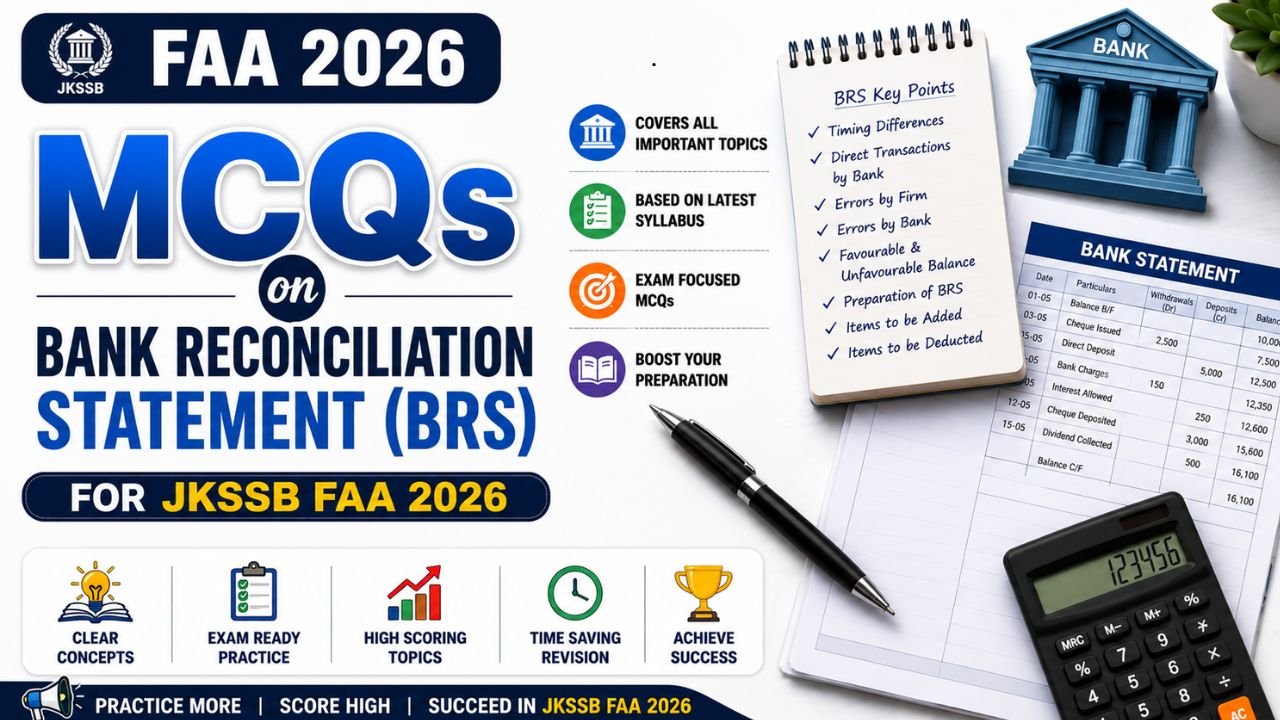
Prepare for JKSSB FAA 2026 with these important Bank Reconciliation Statement (BRS) MCQs, specially prepared by Exam Waves. Practice key questions on Cash Book, Pass Book, bank balances, timing differences, errors, and BRS preparation.
Q1. Which of the following statements correctly describe a Bank Reconciliation Statement?
- It is prepared by the depositor.
- Its purpose is to reconcile the Cash Book balance with the Pass Book balance on a certain date.
- It becomes necessary when the bank balance shown in the firm’s Cash Book and Pass Book do not tally.
- Timing differences and errors are among the causes of differences between the two balances.
A) 1 and 2 only
B) 1, 2 and 3 only
C) 2, 3 and 4 only
D) 1, 2, 3 and 4
Answer: D
Q2. Consider the following situations responsible for timing differences between the Cash Book and Pass Book:
- Cheques issued by the business but not yet presented for payment.
- Cheques paid into the bank but not yet collected.
- Cheques deposited or bills discounted but subsequently dishonoured.
- Amount directly deposited by customers into the firm’s bank account.
Which of the above may cause differences between the two balances?
A) 1 and 2 only
B) 1, 2 and 3 only
C) 2, 3 and 4 only
D) 1, 2, 3 and 4
Answer: D
Q3. Assertion (A): A cheque issued by a company but not yet presented for payment may cause a difference between the Cash Book and Pass Book balances.
Reason (R): The cheque is immediately entered in the Cash Book when issued, while the bank records it only when the receiving party presents it for payment.
Choose the correct answer:
A) Both A and R are true, and R is the correct explanation of A
B) Both A and R are true, but R is not the correct explanation of A
C) A is true, but R is false
D) A is false, but R is true
Answer: A
Q4. Match List I with List II and select the correct answer:
| List I | List II |
|---|---|
| A. Cheque issued but not presented | 1. Customer directly deposits money into firm’s bank account |
| B. Cheque deposited but not collected | 2. Entered immediately in Cash Book but not yet presented to bank |
| C. Direct deposit by customer | 3. Bank records the cheque only after collection |
| D. Dishonoured cheque | 4. Cheque deposited or bill discounted is dishonoured |
A) A-2, B-3, C-1, D-4
B) A-3, B-2, C-4, D-1
C) A-2, B-1, C-3, D-4
D) A-4, B-3, C-1, D-2
Answer: A
Q5. Which of the following statements correctly describe direct transactions made by the bank?
- A bank may make payments on standing instructions for items such as insurance premium.
- A customer may know about such payment only after seeing the Pass Book.
- Interest and dividends collected by the bank on behalf of a customer are directly credited.
- Such transactions can create differences between the Cash Book and Pass Book.
A) 1 and 2 only
B) 1, 2 and 3 only
C) 2, 3 and 4 only
D) 1, 2, 3 and 4
Answer: D
Q6. Which of the following are identified as errors committed by the firm while recording transactions?
- Error in recording transactions.
- Wrong amount debited or credited in the Cash Book.
- Omission of a transaction.
- Error in totalling the bank column in the Cash Book.
A) 1 and 2 only
B) 1, 2 and 3 only
C) 2, 3 and 4 only
D) 1, 2, 3 and 4
Answer: D
Q7. Which of the following correctly identifies errors committed by the bank while recording transactions?
- Wrong amount debited or credited in the Pass Book.
- Wrong totalling in the bank column of the Pass Book.
- Wrong amount entered in the Cash Book by the firm.
- Omission of a transaction from the firm’s Cash Book.
A) 1 and 2 only
B) 1, 2 and 3 only
C) 2, 3 and 4 only
D) 1, 2, 3 and 4
Answer: A
Q8. Consider the following statements regarding the preparation of a Bank Reconciliation Statement:
- It can be prepared by taking either the Cash Book balance or Pass Book balance as the starting point.
- It can be prepared without adjusting the Cash Book balance.
- Debit balance as per Cash Book represents a favourable balance.
- Credit balance as per Pass Book represents a favourable balance.
Which of the statements given above are correct?
A) 1 and 2 only
B) 1, 2 and 3 only
C) 2, 3 and 4 only
D) 1, 2, 3 and 4
Answer: D
Q9. Match the following balances with their correct meanings:
| List I | List II |
|---|---|
| A. Debit balance as per Cash Book | 1. Unfavourable balance |
| B. Credit balance as per Pass Book | 2. Favourable balance |
| C. Debit balance as per Pass Book | 3. Favourable balance |
| D. Credit balance as per Cash Book | 4. Unfavourable balance |
Which of the following is correctly matched?
A) A-2, B-3, C-1, D-4
B) A-1, B-2, C-4, D-3
C) A-2, B-1, C-3, D-4
D) A-4, B-3, C-2, D-1
Answer: A
Q10. Which of the following statements correctly describe favourable and unfavourable balances?
- Debit balance as per Cash Book means balance available at bank.
- Credit balance as per Pass Book means deposits made by the firm are more than withdrawals.
- Credit balance as per Cash Book and Debit balance as per Pass Book represent unfavourable balances.
- Bank Overdraft means withdrawals exceed the amount deposited in the bank.
A) 1 and 2 only
B) 1, 2 and 3 only
C) 2, 3 and 4 only
D) 1, 2, 3 and 4
Answer: D
Q11. Consider the four situations for preparing a BRS:
- Debit balance as per Cash Book is given and balance as per Pass Book is to be ascertained.
- Credit balance as per Pass Book is given and balance as per Cash Book is to be ascertained.
- Credit balance as per Cash Book (Bank Overdraft) is given and balance as per Pass Book is to be ascertained.
- Debit balance as per Pass Book (Overdraft) is given and balance as per Cash Book is to be ascertained.
Which of the above situations are covered in the preparation of BRS?
A) 1 and 2 only
B) 1, 2 and 3 only
C) 2, 3 and 4 only
D) 1, 2, 3 and 4
Answer: D
Q12. Starting with a Debit Balance as per Cash Book, which of the following items are to be ADDED to the Cash Book balance while preparing BRS?
- Cheques issued but not yet presented.
- Interest allowed by the bank.
- Direct deposit made by customers into the firm’s bank account.
- Interest, dividend and commission collected by the bank but not recorded in the Cash Book.
A) 1 and 2 only
B) 1, 2 and 3 only
C) 2, 3 and 4 only
D) 1, 2, 3 and 4
Answer: D
Q13. Starting with a Debit Balance as per Cash Book, which of the following items are to be DEDUCTED while preparing BRS?
- Cheques deposited into the bank but not yet collected.
- Bank charges debited by the bank in the Pass Book.
- Payments made by the bank on the customer’s behalf.
- Cheques dishonoured but not recorded in the Cash Book.
- Interest on overdraft charged by the bank.
A) 1, 2 and 3 only
B) 1, 2, 3 and 4 only
C) 2, 3, 4 and 5 only
D) 1, 2, 3, 4 and 5
Answer: D
Q14. Assertion (A): When starting BRS with a credit balance as per Pass Book, all items normally added to the Cash Book balance are deducted, and all items normally deducted are added.
Reason (R): A credit balance as per Pass Book represents the opposite presentation of the corresponding favourable bank balance compared with the Cash Book.
Choose the correct answer:
A) Both A and R are true, and R is the correct explanation of A
B) Both A and R are true, but R is not the correct explanation of A
C) A is true, but R is false
D) A is false, but R is true
Answer: A
Q15. Consider the following statements regarding the preparation of BRS:
- When starting with a Debit Balance as per Cash Book, cheques issued but not presented are added.
- Cheques deposited but not yet collected are deducted.
- Interest allowed by the bank is added.
- Bank charges appearing only in the Pass Book are deducted.
- Direct deposits by customers into the firm’s bank account are added.
- Cheques dishonoured but not recorded in the Cash Book are deducted.
- If both the Cash Book and Pass Book show an overdraft balance, the opposite direction of the normal deposit-balance treatment is followed.
Which of the statements given above are correct?
A) 1, 2, 3 and 4 only
B) 1, 2, 3, 4, 5 and 6 only
C) 2, 3, 4, 5, 6 and 7 only
D) 1, 2, 3, 4, 5, 6 and 7
Answer: D