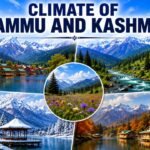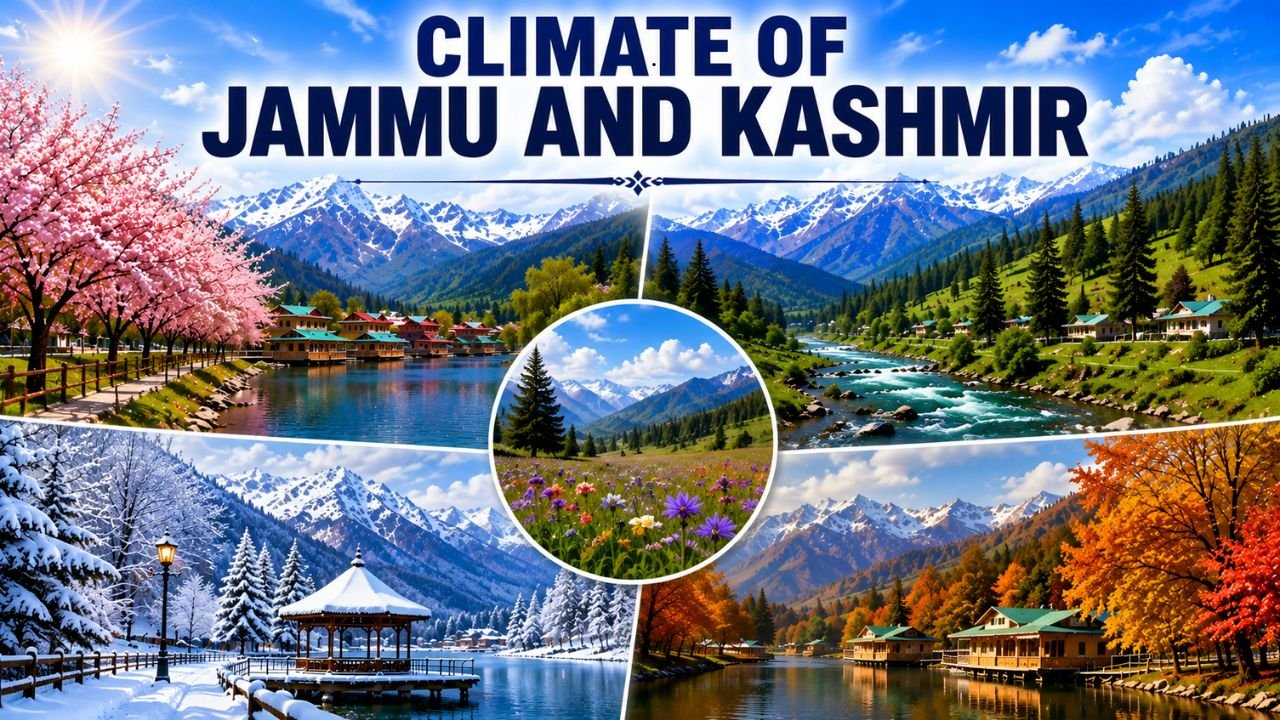
Dear aspirants, if you are preparing for JKSSB or any other competitive exams, the Climate of Jammu and Kashmir is an important topic in J&K Geography.
In this article, Exam Waves Coaching Academy provides short notes and important MCQs on the climate of Jammu, the climate of the Kashmir Valley, rainfall, temperature, seasons of Kashmir, Chilla-i-Kalan and other important climatic facts useful for all competitive examinations.
Climate of Jammu and Kashmir
The Union Territory of Jammu and Kashmir is situated in the subtropical latitudes, but its climate varies considerably from one region to another.
The climate of the wider region can be divided into three major zones:
- Sub-tropical Region – Jammu
- Temperate Region – Kashmir Valley
- Arctic Cold Desert – Ladakh
These climatic differences are mainly reflected in temperature, rainfall and seasonal conditions.
Climate of Jammu
The southern parts of Jammu have a humid sub-tropical climate.
Important Features
- In the hot summer months, the temperature may reach about 46°C.
- Hot winds are locally called Loo.
- Pleasant nights caused by cool winds are locally known as Dadu.
- July to September receives very heavy rainfall.
- Winters are generally cold and foggy because of the westerly winds.
Important Months
- Coldest month – January
- Hottest month – June
An exceptionally high temperature of 47°C was recorded in May–June 1953.
Winter Rainfall in Jammu
Winter rainfall in Jammu is mainly associated with temperate cyclones, commonly connected with westerly weather systems.
- During winter, these systems cause rainfall in Jammu.
- They originate from the Mediterranean Sea region.
Quick Fact
Winter rainfall in Jammu → Westerly systems → Mediterranean region
Climate of Kashmir Valley
The Kashmir Valley experiences a temperate climate.
- Summers are generally pleasant.
- Winters are very cold.
- The year can be divided into four broad seasons on the basis of precipitation and temperature:
- Winter
- Spring
- Summer
- Autumn
1. Winter Season in Kashmir
Period: November to February
Winter is the coldest season in Kashmir.
Important Features
- January is the coldest month.
- Kashmir receives about 120 cm of snow.
- Cirrus clouds are associated with heavy rain.
- Western disturbances from the Mediterranean Sea bring rainfall.
- Rainfall brought by these cyclones is locally known as Alamgir.
Remember
Winter rainfall in Kashmir → Western Disturbances → Alamgir
2. Spring Season in Kashmir
Period: March to May
Spring is locally known as Sonth.
- March is the wettest month.
Quick Fact
Sonth → Spring → March to May
3. Summer Season in Kashmir
Period: June to September
Important characteristics include:
- July is the hottest month.
- Maximum temperature may rise up to approximately 35°C.
- Relative humidity ranges between 40% and 60%.
- Showers occurring in September are locally known as Kambarka.
4. Autumn Season in Kashmir
Autumn is locally known as Harud.
Period: October to November
- The main period is given as mid-October to mid-November.
- It is associated with least disturbed weather.
Quick Fact
Harud → Autumn → Least disturbed weather
Six Traditional Seasons of Kashmir
Besides the four broad climatic seasons, Kashmir also has traditional seasonal divisions.
| Kashmiri Season | English Equivalent | Period |
|---|---|---|
| Sonth | Spring | Mid-March to mid-May |
| Grishm | Summer | Mid-May to mid-July |
| Wahrat | Rainy | Mid-July to mid-September |
| Harud | Autumn | Mid-September to mid-November |
| Wandh | Winter | Mid-November to mid-January |
| Sheshur | Ice Cold | Mid-January to mid-March |
Chilla-i-Kalan
Chilla-i-Kalan is the severe winter period of Kashmir.
During this period:
- Temperature may fall below 0°C.
- Duration: 40 days
- Period: 21 December to 30 January
Chilla-i-Khurd
Chilla-i-Khurd means the Small Cold.
- Duration: 20 days
- Period: 31 January to 19 February
Chilla-i-Bachha
Chilla-i-Bachha means the Baby Cold.
- Duration: 10 days
- Period: 19 February to 2 March
Important Sequence
Chilla-i-Kalan → Chilla-i-Khurd → Chilla-i-Bachha
40 Days → 20 Days → 10 Days
Climate Classification
The climate codes shown for the three regions are:
| Region | Climate Code |
|---|---|
| Jammu | Cwa/Ca |
| Kashmir | Dfb |
| Ladakh | Dwd |
In broad terms:
- Jammu – Sub-tropical climatic conditions
- Kashmir – Temperate climatic conditions
- Ladakh – Cold/arctic desert conditions
Important Rainfall Fact
Reasi district receives the maximum rainfall in a year in Jammu and Kashmir
Jammu vs Kashmir Climate
| Feature | Jammu | Kashmir Valley |
|---|---|---|
| General Climate | Humid sub-tropical | Temperate |
| Summer | Very hot | Pleasant |
| Winter | Cold and foggy | Very cold |
| Coldest Month | January | January |
| Hottest Month | June | July |
| Important Winter Influence | Westerly systems | Western disturbances |
| Local Climatic Terms | Loo, Dadu | Sonth, Harud, Alamgir, Kambarka |
Quick Revision
| Topic | Important Fact |
|---|---|
| Jammu climate | Humid sub-tropical |
| Kashmir Valley climate | Temperate |
| Ladakh climate | Arctic cold desert |
| Hot winds of Jammu | Loo |
| Pleasant cool nights | Dadu |
| Jammu’s coldest month | January |
| Jammu’s hottest month | June |
| Heavy rainfall in Jammu | July–September |
| Kashmir’s coldest month | January |
| Kashmir’s hottest month | July |
| Spring in Kashmir | Sonth |
| Autumn in Kashmir | Harud |
| September showers | Kambarka |
| Winter cyclonic rainfall | Alamgir |
| Wettest month | March |
| Chilla-i-Kalan | 40 days |
| Chilla-i-Khurd | 20 days |
| Chilla-i-Bachha | 10 days |
| Maximum rainfall district | Reasi |
Conclusion
The Climate of Jammu and Kashmir varies greatly because of its diverse physical features. Jammu has a humid sub-tropical climate, while the Kashmir Valley experiences a temperate climate. The wider region also includes the cold desert climate of Ladakh.
For JKSSB exams, students should particularly remember the local names of seasons, hottest and coldest months, western disturbances, Chilla-i-Kalan, Chilla-i-Khurd, Chilla-i-Bachha and important rainfall facts.
Important MCQ’s on the Climate of Jammu and Kashmir for all Competitive Exams
Q1. Consider the following statements regarding the climatic divisions of Jammu and Kashmir and the wider region:
- Jammu represents the sub-tropical climatic region.
- Kashmir Valley represents the temperate climatic region.
- Ladakh represents the arctic cold desert region.
- Kashmir Valley experiences a typical tropical monsoon climate throughout the year.
Which of the statements given above are correct?
A) 1, 2 and 4 only
B) 1, 2 and 3 only
C) 1, 3 and 4 only
D) 2, 3 and 4 only
Answer: B
Q2. Match the following regions with their characteristic climatic conditions:
| List-I | List-II |
|---|---|
| A. Jammu | 1. Arctic cold desert |
| B. Kashmir Valley | 2. Humid sub-tropical |
| C. Ladakh | 3. Temperate |
| D. Southern Jammu | 4. Hot summers with heavy seasonal rainfall |
Select the correct answer:
A) A-3, B-2, C-4, D-1
B) A-1, B-4, C-2, D-3
C) A-2, B-3, C-1, D-4
D) A-4, B-1, C-3, D-2
Answer: C
Q3. Consider the following statements regarding the climate of Jammu:
- Southern Jammu experiences a humid sub-tropical climate.
- Summer temperatures may reach approximately 46°C.
- The hottest month is generally June.
- The coldest month is generally December.
Which of the statements given above are correct?
A) 1, 2 and 3 only
B) 1, 2 and 4 only
C) 1, 3 and 4 only
D) 2, 3 and 4 only
Answer: A
Q4. Match the following local climatic terms with their correct meanings:
| List-I | List-II |
|---|---|
| A. Loo | 1. Spring |
| B. Dadu | 2. Hot summer winds |
| C. Sonth | 3. Autumn |
| D. Harud | 4. Pleasant nights caused by cool winds |
Select the correct answer:
A) A-4, B-2, C-3, D-1
B) A-2, B-4, C-1, D-3
C) A-3, B-1, C-4, D-2
D) A-1, B-3, C-2, D-4
Answer: B
Q5. Consider the following statements regarding rainfall and winter conditions in Jammu:
- Jammu receives very heavy rainfall from July to September.
- Winters are generally cold and foggy.
- Westerly weather systems contribute to winter rainfall.
- These winter systems originate primarily over the Bay of Bengal.
Which of the statements given above are correct?
A) 1, 2 and 4 only
B) 1, 3 and 4 only
C) 2, 3 and 4 only
D) 1, 2 and 3 only
Answer: D
Q6. Which of the following combinations are correctly matched?
- January — Coldest month in Jammu
- June — Hottest month in Jammu
- July — Hottest month in Kashmir Valley
- March — Wettest month in Kashmir Valley
Select the correct answer:
A) 1, 2 and 3 only
B) 1, 3 and 4 only
C) 1, 2, 3 and 4
D) 2 and 4 only
Answer: C
Q7. Consider the following statements regarding the climate of Kashmir Valley:
- Kashmir Valley experiences a temperate climate.
- Summers are generally pleasant.
- Winters are very cold.
- January is considered the hottest month of the valley.
Which of the statements given above are correct?
A) 1, 2 and 3 only
B) 1, 2 and 4 only
C) 1, 3 and 4 only
D) 2, 3 and 4 only
Answer: A
Q8. Match the following climatic terms of Kashmir with their correct associations:
| List-I | List-II |
|---|---|
| A. Alamgir | 1. September showers |
| B. Kambarka | 2. Spring |
| C. Sonth | 3. Winter cyclonic rainfall |
| D. Harud | 4. Autumn |
Select the correct answer:
A) A-1, B-3, C-4, D-2
B) A-3, B-1, C-2, D-4
C) A-2, B-4, C-1, D-3
D) A-4, B-2, C-3, D-1
Answer: B
Q9. Consider the following statements regarding winter in Kashmir:
- The broad winter season extends from November to February.
- January is the coldest month.
- Kashmir receives about 120 cm of snow.
- Winter precipitation is entirely caused by the summer monsoon.
Which of the statements given above are correct?
A) 1, 2 and 4 only
B) 1, 3 and 4 only
C) 1, 2 and 3 only
D) 2, 3 and 4 only
Answer: C
Q10. Which of the following statements regarding spring and summer in Kashmir are correct?
- Spring is locally called Sonth.
- March is the wettest month.
- July is the hottest month.
- Relative humidity during summer remains approximately 80–90%.
Select the correct answer:
A) 1, 2 and 3 only
B) 1, 2 and 4 only
C) 1, 3 and 4 only
D) 2, 3 and 4 only
Answer: A
Q11. Match the traditional Kashmiri seasons with their correct periods:
| List-I | List-II |
|---|---|
| A. Sonth | 1. Mid-July to mid-September |
| B. Grishm | 2. Mid-March to mid-May |
| C. Wahrat | 3. Mid-September to mid-November |
| D. Harud | 4. Mid-May to mid-July |
Select the correct answer:
A) A-4, B-2, C-3, D-1
B) A-2, B-4, C-1, D-3
C) A-1, B-3, C-4, D-2
D) A-3, B-1, C-2, D-4
Answer: B
Q12. Arrange the following traditional seasons of Kashmir in their correct annual sequence:
- Wahrat
- Sonth
- Harud
- Grishm
- Wandh
- Sheshur
Select the correct sequence beginning with spring:
A) 2 → 4 → 1 → 3 → 5 → 6
B) 2 → 1 → 4 → 3 → 6 → 5
C) 4 → 2 → 1 → 5 → 3 → 6
D) 6 → 2 → 4 → 3 → 1 → 5
Answer: A
Q13. Consider the following pairs:
- Sonth — Spring
- Grishm — Summer
- Wahrat — Rainy season
- Wandh — Autumn
Which of the pairs given above are correctly matched?
A) 1, 2 and 4 only
B) 1, 3 and 4 only
C) 2, 3 and 4 only
D) 1, 2 and 3 only
Answer: D
Q14. Match the following traditional seasons with their English equivalents:
| List-I | List-II |
|---|---|
| A. Harud | 1. Ice Cold |
| B. Wandh | 2. Rainy |
| C. Sheshur | 3. Winter |
| D. Wahrat | 4. Autumn |
Select the correct answer:
A) A-3, B-4, C-2, D-1
B) A-4, B-3, C-1, D-2
C) A-2, B-1, C-4, D-3
D) A-1, B-2, C-3, D-4
Answer: B
Q15. Consider the following statements regarding Chilla-i-Kalan:
- It represents a period of severe winter cold in Kashmir.
- Its duration is 40 days.
- It extends from 21 December to 30 January.
- It is immediately followed by Chilla-i-Bachha.
Which of the statements given above are correct?
A) 1, 2 and 4 only
B) 1, 3 and 4 only
C) 1, 2 and 3 only
D) 2, 3 and 4 only
Answer: C
Q16. Match the following cold periods with their durations:
| List-I | List-II |
|---|---|
| A. Chilla-i-Kalan | 1. 10 days |
| B. Chilla-i-Khurd | 2. 40 days |
| C. Chilla-i-Bachha | 3. 20 days |
| D. Total of the three periods | 4. 70 days |
Select the correct answer:
A) A-3, B-2, C-4, D-1
B) A-2, B-3, C-1, D-4
C) A-4, B-1, C-3, D-2
D) A-1, B-4, C-2, D-3
Answer: B
Q17. Arrange the following cold periods of Kashmir in the correct chronological order:
- Chilla-i-Bachha
- Chilla-i-Kalan
- Chilla-i-Khurd
Which of the following is correct?
A) 3 → 2 → 1
B) 1 → 2 → 3
C) 2 → 3 → 1
D) 2 → 1 → 3
Answer: C
Q18. Consider the following statements:
- Chilla-i-Khurd is known as the Small Cold.
- It lasts for 20 days.
- Chilla-i-Bachha is known as the Baby Cold.
- Chilla-i-Bachha lasts for 40 days.
Which of the statements given above are correct?
A) 1, 2 and 3 only
B) 1, 2 and 4 only
C) 1, 3 and 4 only
D) 2, 3 and 4 only
Answer: A
Q19. Match the following regions with the climate codes associated with them:
| List-I | List-II |
|---|---|
| A. Jammu | 1. Dwd |
| B. Kashmir | 2. Dfb |
| C. Ladakh | 3. Cwa/Ca |
Select the correct answer:
A) A-2, B-1, C-3
B) A-1, B-3, C-2
C) A-3, B-2, C-1
D) A-3, B-1, C-2
Answer: C
Q20. Consider the following statements regarding important climatic facts:
- Reasi receives the maximum annual rainfall in Jammu and Kashmir.
- Loo refers to hot winds experienced in Jammu during summer.
- Kambarka refers to showers occurring in Kashmir during September.
- Harud is the local name for the spring season in Kashmir.
Which of the statements given above are correct?
A) 1, 2 and 4 only
B) 1, 3 and 4 only
C) 2, 3 and 4 only
D) 1, 2 and 3 only
Answer: D