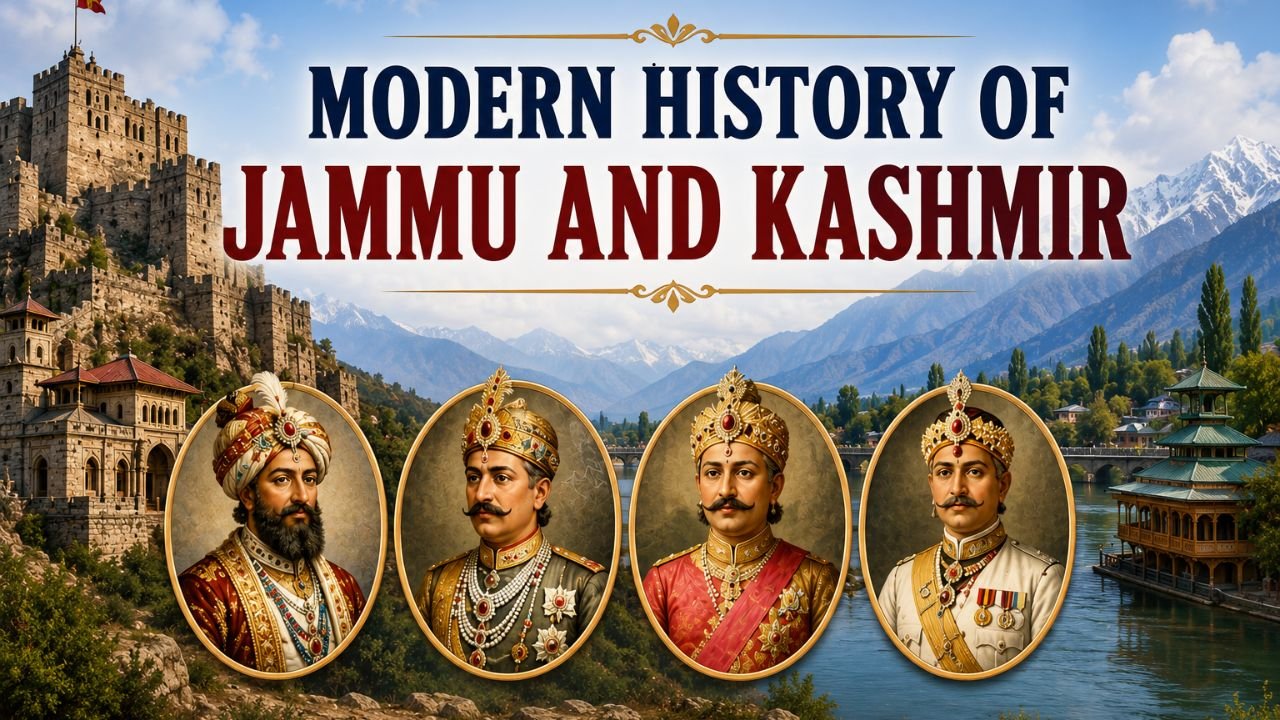
Dear aspirants, if you are preparing for any JKSSB exam, the Modern History of Jammu and Kashmir is an important part of J&K History.
In this article, Exam Waves Academy provides short and simple notes on the Battle of Gumat, Treaty of Lahore, Treaty of Amritsar, Dogra Rule, Maharaja Gulab Singh, Ranbir Singh, Pratap Singh, Hari Singh and the Instrument of Accession.
Battle of Gumat (Jammu, 1808)
The Battle of Gumat was fought in 1808 between the Sikhs and Hindu Rajputs.
- It was fought on the banks of the Tawi River.
- The Sikh forces were led by Sardar Hukam Singh Chimni.
- The Dogra forces were led by Mian Mota.
- The Sikhs emerged victorious and established their influence in Jammu.
- Gulab Singh was only 16 years old at that time.
- His bravery impressed the Sikhs.
- He was recruited into Maharaja Ranjit Singh’s service.
- Jammu became part of the Lahore Darbar in 1816 under Sardar Hukam Singh.
Treaty of Lahore
The Treaty of Lahore was signed on 9 March 1846.
- It followed the Anglo-Sikh War.
- The Sikhs were defeated.
- They had to cede Kashmir to the East India Company (EIC).
Treaty of Amritsar – 1846
The Treaty of Amritsar is one of the most important events in the modern history of Jammu and Kashmir.
- It is also known as the Sale Deed of Kashmir.
- It was signed between Gulab Singh and Lord Hardinge, the Viceroy.
- It was signed on 16 March 1846.
- The treaty contains 10 Articles.
- Through this treaty, Jammu and Kashmir came into existence as a princely state.
Remember
Treaty of Amritsar → 16 March 1846 → Gulab Singh → 10 Articles
Dogra Rule in Jammu and Kashmir (1846–1947)
Dogra rule lasted from 1846 to 1947.
The important Dogra rulers covered in the supplied notes are:
Gulab Singh → Ranbir Singh → Pratap Singh → Hari Singh
Maharaja Gulab Singh
Maharaja Gulab Singh was the first ruler covered under Dogra Rule in the notes.
Important Facts
- His Raj Tilak was performed by Ranjit Singh at Jia Pot Temple, Akhnoor, on 17 June 1822.
- Under him, Zorawar Singh conquered Ladakh in 1839–40.
- He appointed Mian Hathu as Governor of Rajouri.
- Lord Hardinge visited the valley in 1844.
- In 1850, Walter Lawrence came to Kashmir via Banihal route, according to the supplied notes.
- He divided the state into three provinces — Jammu, Kashmir and Ladakh along Gilgit.
- Kashmir was divided into the districts of Kamraz and Maraz.
- Jammu was divided into Jammu, Kherpal, Kishtwar and Jasrota.
Reforms and Developments
- Introduced rationing of rice.
- Founded Pharma Trust.
- Reformed the Begar system.
- Regularised the Shali system.
- Began construction of the Raghunath Mandir complex in 1851.
Maharaja Ranbir Singh (1856–1885)
Maharaja Ranbir Singh ruled from 1856 to 1885.
Administrative Divisions
- Jammu — 7 Wazarats
- Kashmir — 6 Wazarats
Important Developments
During his period:
- Construction of the Rawalpindi–Srinagar cart road began.
- Telegraph service was established between Jammu and Srinagar.
- Raghunath Temple and Shiva Temple of Jammu are associated with his period.
- Ranbir Darbar was established at Akbar’s model.
- RPC – Ranbir Penal Code was introduced.
- Adalat-ul-Sadar (Chief Court) was established.
- In 1877, the Adalat-ul-Aliya was established.
Quick Fact
Ranbir Singh → Ranbir Penal Code → Ranbir Darbar → Telegraph Service
Maharaja Pratap Singh (1885–1925)
Maharaja Pratap Singh ruled from 1885 to 1925.
His period witnessed several important administrative and infrastructural developments.
Important Facts
- British Residency was established at Srinagar in 1885.
- The first Resident was Sir Oliver St. Johnson.
- Walter Lawrence was appointed for land settlement in 1887.
- Urdu was introduced as the court language.
- The first college in Srinagar was opened in 1905 by Annie Besant and later became S.P. College.
- S.P.S. Museum was established at Srinagar in 1898.
- The Prince of Wales College, Jammu was established in 1907.
- Primary education was made free.
- A Department of Agriculture and Mining was established.
- Banihal Cart Road was developed.
- A silk factory was established in Srinagar in 1897.
- The Mohra Hydroelectric Project was established in 1907.
- Telephone lines were established in Jammu and Srinagar.
- The Gilgit Agency was established in 1889.
Maharaja Hari Singh (1925–1947)
Hari Singh, son of Amar Singh, ruled from 1925 to 1947.
Several important social, administrative and political reforms are associated with his reign.
Important Reforms
- He abolished polyandry among Buddhists.
- He prohibited child marriage in 1928.
- He banned trafficking of women.
- Primary education was made compulsory.
- A High Court was established in 1928.
- J&K Bank was established in 1938.
- Permanent Residents provisions were introduced.
- A legislature known as Praja Parishad was established in 1934.
- Panchayat Raj was introduced.
Instrument of Accession – 1947
The Instrument of Accession is one of the most important events in the modern history of Jammu and Kashmir.
- It was signed on 26 October 1947.
- It was between Maharaja Hari Singh and Lord Mountbatten.
- Maharaja Hari Singh later entered into an agreement with Sheikh Abdullah on 5 March 1948.
Important Date
26 October 1947 → Instrument of Accession
Quick Revision Table
| Topic | Important Fact |
|---|---|
| Battle of Gumat | 1808 |
| Location | Banks of Tawi River |
| Gulab Singh’s age | 16 years |
| Jammu joined Lahore Darbar | 1816 |
| Treaty of Lahore | 9 March 1846 |
| Treaty of Amritsar | 16 March 1846 |
| Articles in Treaty of Amritsar | 10 |
| Dogra Rule | 1846–1947 |
| Gulab Singh’s Raj Tilak | 17 June 1822 |
| Ranbir Singh | 1856–1885 |
| Ranbir Penal Code | Ranbir Singh |
| Pratap Singh | 1885–1925 |
| British Residency at Srinagar | 1885 |
| Silk Factory, Srinagar | 1897 |
| S.P.S. Museum | 1898 |
| Prince of Wales College | 1907 |
| Mohra Hydroelectric Project | 1907 |
| Hari Singh | 1925–1947 |
| High Court | 1928 |
| J&K Bank | 1938 |
| Instrument of Accession | 26 October 1947 |
Important MCQs on Modern History of Jammu and Kashmir for all Competitive Exams
Q1. Consider the following statements regarding the Battle of Gumat (1808):
- It was fought between the Sikhs and Hindu Rajputs.
- It was fought on the banks of the Tawi River.
- The Sikh forces were led by Sardar Hukam Singh Chimni.
- The Dogra forces were led by Hari Singh Nalwa.
Which of the statements given above are correct according to the notes?
A) 1, 2 and 4 only
B) 1, 2 and 3 only
C) 1, 3 and 4 only
D) 2, 3 and 4 only
Answer: B
Q2. Match the following events with their correct dates:
| List-I | List-II |
|---|---|
| A. Battle of Gumat | 1. 16 March 1846 |
| B. Gulab Singh’s Raj Tilak | 2. 1808 |
| C. Treaty of Lahore | 3. 17 June 1822 |
| D. Treaty of Amritsar | 4. 9 March 1846 |
Select the correct answer:
A) A-3, B-2, C-1, D-4
B) A-4, B-1, C-2, D-3
C) A-2, B-3, C-4, D-1
D) A-1, B-4, C-3, D-2
Answer: C
Q3. Arrange the following events in the correct chronological order:
- Treaty of Amritsar
- Battle of Gumat
- Gulab Singh’s Raj Tilak
- Treaty of Lahore
Select the correct sequence:
A) 2 → 3 → 4 → 1
B) 3 → 2 → 1 → 4
C) 2 → 4 → 3 → 1
D) 3 → 2 → 4 → 1
Answer: A
Q4. Consider the following statements regarding the Treaty of Amritsar:
- It was signed on 16 March 1846.
- It is also referred to in the notes as the Sale Deed of Kashmir.
- It was signed between Gulab Singh and Lord Hardinge.
- The treaty consisted of 12 Articles.
Which of the statements given above are correct according to the supplied material?
A) 1, 2 and 4 only
B) 1, 3 and 4 only
C) 2, 3 and 4 only
D) 1, 2 and 3 only
Answer: D
Q5. With reference to Maharaja Gulab Singh, consider the following statements:
- His Raj Tilak was performed by Ranjit Singh at Jia Pot Temple, Akhnoor.
- The Raj Tilak took place on 17 June 1822.
- Under him, Zorawar Singh conquered Ladakh in 1839–40.
- He established the J&K Bank in 1938.
Which of the statements given above are correct?
A) 1, 2 and 3 only
B) 1, 2 and 4 only
C) 1, 3 and 4 only
D) 2, 3 and 4 only
Answer: A
Q6. Match the following developments with the Dogra rulers:
| List-I | List-II |
|---|---|
| A. Ranbir Penal Code | 1. Hari Singh |
| B. British Residency at Srinagar | 2. Gulab Singh |
| C. Rationing of rice | 3. Ranbir Singh |
| D. High Court established in 1928 | 4. Pratap Singh |
Select the correct answer:
A) A-4, B-3, C-1, D-2
B) A-3, B-4, C-2, D-1
C) A-2, B-1, C-4, D-3
D) A-1, B-2, C-3, D-4
Answer: B
Q7. Consider the following statements regarding Maharaja Ranbir Singh’s reign (1856–1885):
- Jammu was divided into 7 Wazarats.
- Kashmir was divided into 6 Wazarats.
- Telegraph service was established between Jammu and Srinagar.
- The British Residency was established at Srinagar in 1885 under Ranbir Singh.
Which of the statements given above are correct according to the notes?
A) 1, 2 and 4 only
B) 1, 3 and 4 only
C) 1, 2 and 3 only
D) 2, 3 and 4 only
Answer: C
Q8. Consider the following pairs:
- Ranbir Darbar — Established on Akbar’s model
- Adalat-ul-Sadar — Chief Court
- Adalat-ul-Aliya — Established in 1877
- Ranbir Penal Code — Introduced during Hari Singh’s reign
Which of the pairs given above are correctly matched according to the notes?
A) 1, 2 and 4 only
B) 1, 3 and 4 only
C) 2, 3 and 4 only
D) 1, 2 and 3 only
Answer: D
Q9. Match the following developments during Pratap Singh’s reign with their correct years:
| List-I | List-II |
|---|---|
| A. British Residency at Srinagar | 1. 1897 |
| B. Gilgit Agency | 2. 1885 |
| C. Silk Factory at Srinagar | 3. 1898 |
| D. S.P.S. Museum | 4. 1889 |
Select the correct answer:
A) A-2, B-4, C-1, D-3
B) A-4, B-2, C-3, D-1
C) A-1, B-3, C-4, D-2
D) A-3, B-1, C-2, D-4
Answer: A
Q10. Consider the following statements about the reign of Maharaja Pratap Singh:
- The British Residency was established at Srinagar in 1885.
- Walter Lawrence was appointed for land settlement in 1887.
- Urdu replaced Persian as the court language.
- The first college at Srinagar was opened in 1905 by Annie Besant according to the notes.
Which of the statements given above are correct?
A) 1 and 2 only
B) 1, 2, 3 and 4
C) 2, 3 and 4 only
D) 1, 3 and 4 only
Answer: B
Q11. Arrange the following developments of Pratap Singh’s reign in chronological order:
- Mohra Hydroelectric Project
- British Residency at Srinagar
- Silk Factory at Srinagar
- S.P.S. Museum at Srinagar
Select the correct sequence:
A) 3 → 2 → 4 → 1
B) 2 → 4 → 3 → 1
C) 2 → 3 → 4 → 1
D) 4 → 2 → 1 → 3
Answer: C
Q12. Consider the following statements regarding Maharaja Hari Singh:
- He was the son of Amar Singh.
- His reign is given as 1925–1947.
- He prohibited child marriage in 1928.
- The Mohra Hydroelectric Project was established during his reign in 1907.
Which of the statements given above are correct?
A) 1, 2 and 4 only
B) 1, 3 and 4 only
C) 2, 3 and 4 only
D) 1, 2 and 3 only
Answer: D
Q13. Match the following reforms/developments with their correct associations:
| List-I | List-II |
|---|---|
| A. J&K Bank | 1. 1928 |
| B. High Court | 2. 1938 |
| C. Legislature/Praja Parishad | 3. Hari Singh’s reign |
| D. Panchayat Raj | 4. 1934 |
Select the correct answer according to the notes:
A) A-2, B-1, C-4, D-3
B) A-1, B-2, C-3, D-4
C) A-4, B-3, C-2, D-1
D) A-3, B-4, C-1, D-2
Answer: A
Q14. Consider the following statements regarding the Instrument of Accession:
- It was signed on 26 October 1947.
- It involved Maharaja Hari Singh and Lord Mountbatten, as presented in the supplied notes.
- It is an important event associated with the final phase of Dogra rule.
- It was signed immediately after the Treaty of Amritsar in March 1846.
Which of the statements given above are correct according to the supplied material?
A) 1, 2 and 4 only
B) 1, 2 and 3 only
C) 1, 3 and 4 only
D) 2, 3 and 4 only
Answer: B
Q15. Arrange the following rulers/events in the correct chronological sequence:
- Maharaja Hari Singh’s reign begins
- Maharaja Ranbir Singh’s reign begins
- Maharaja Pratap Singh’s reign begins
- Instrument of Accession is signed
Which of the following is the correct sequence?
A) 3 → 2 → 1 → 4
B) 2 → 1 → 3 → 4
C) 2 → 3 → 1 → 4
D) 1 → 2 → 3 → 4
Answer: C