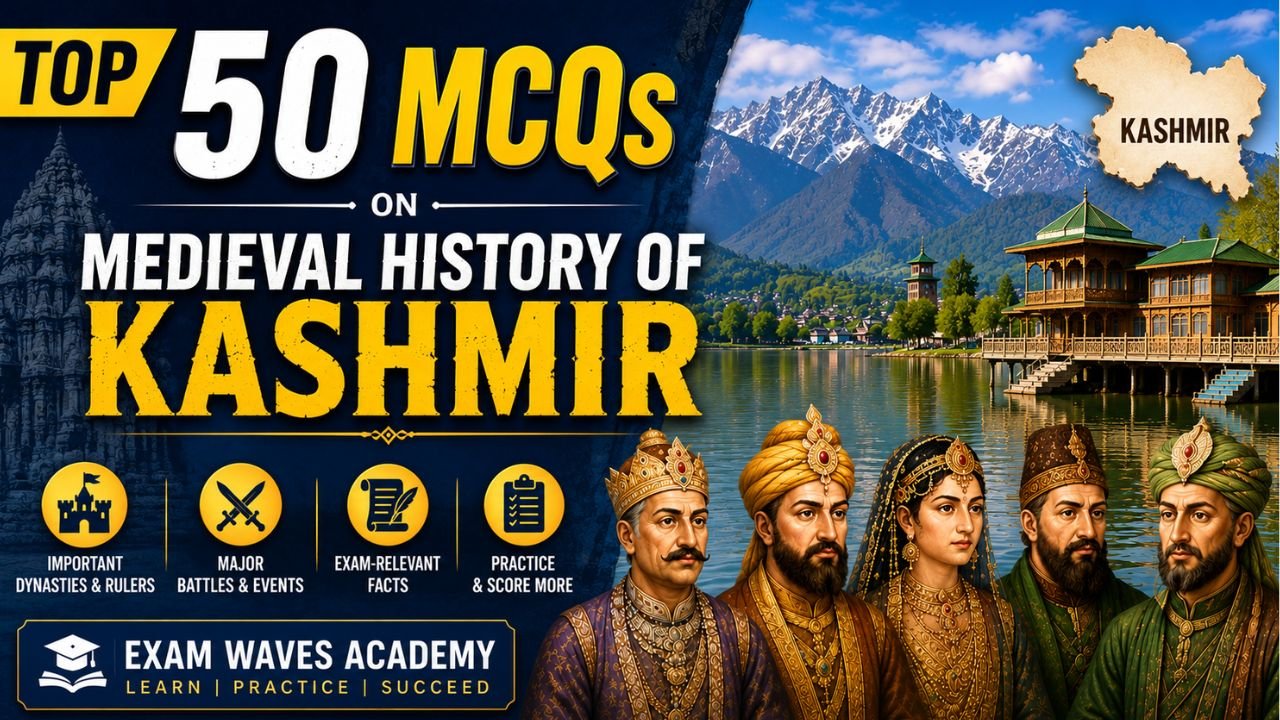
Dear aspirants, are you preparing for any JKSSB Exam 2026? If yes, this practice set by Exam Waves Academy will help you revise the Medieval History of Kashmir through 50 important MCQs. These questions cover major dynasties, rulers, battles, important events and other exam-relevant facts to strengthen your preparation.
Q1. Consider the following statements regarding Avantivarman and the establishment of the Utpala Dynasty:
- Avantivarman was the founder of the Utpala Dynasty.
- He was the son of Sukhavarman and grandson of Utpala.
- His reign extended from 855 CE to 883 CE.
- His reign is mentioned in Book VII of Rajatarangini.
Which of the statements given above are correct?
A) 1, 2 and 3 only
B) 1, 2 and 4 only
C) 1, 3 and 4 only
D) 2, 3 and 4 only
Answer: A
Q2. Match the following personalities and places associated with the reign of Avantivarman:
| List-I | List-II |
|---|---|
| A. Sura | 1. Founder of Sopore |
| B. Bhatta Kallata | 2. Prime Minister |
| C. Suyya | 3. Court poet |
| D. Avantipur | 4. Founded by Avantivarman |
Select the correct answer:
A) A-3, B-2, C-4, D-1
B) A-2, B-3, C-1, D-4
C) A-1, B-4, C-2, D-3
D) A-4, B-1, C-3, D-2
Answer: B
Q3. Arrange the following rulers associated with the Utpala period in their correct chronological order:
- Sugandha
- Shankaravarman
- Avantivarman
- Gopalavarman
A) 2 → 3 → 4 → 1
B) 3 → 4 → 2 → 1
C) 3 → 2 → 4 → 1
D) 4 → 3 → 2 → 1
Answer: C
Q4. Consider the following pairs regarding temples and developments of the Utpala period:
- Avantisvara — Dedicated to Shiva
- Avantiswami — Dedicated to Vishnu
- Sopore — Founded by Suyya
- Avantipur — Founded by Shankaravarman
Which of the pairs given above are correctly matched?
A) 1, 2 and 4 only
B) 2, 3 and 4 only
C) 1, 3 and 4 only
D) 1, 2 and 3 only
Answer: D
Download Our Jammu & Kashmir General Knowledge Book
Q5. Consider the following statements regarding Shankaravarman and his administration:
- Shankaravarman was the son of Avantivarman.
- His reign was associated with heavy taxation.
- Forced labour during his period was known as Bharod.
- Kalhana described him as the Catherine of Kashmir.
Which of the statements given above are correct?
A) 1, 2 and 3 only
B) 1, 2 and 4 only
C) 2, 3 and 4 only
D) 1, 3 and 4 only
Answer: A
Q6. Match the following rulers with their respective periods:
| List-I | List-II |
|---|---|
| A. Avantivarman | 1. 904–906 CE |
| B. Shankaravarman | 2. 902–904 CE |
| C. Gopalavarman | 3. 855–883 CE |
| D. Sugandha | 4. 883–902 CE |
Select the correct answer:
A) A-4, B-3, C-1, D-2
B) A-3, B-4, C-2, D-1
C) A-2, B-1, C-4, D-3
D) A-1, B-2, C-3, D-4
Answer: B
Q7. Consider the following statements regarding Queen Sugandha and her place in the political history of Kashmir:
- Sugandha was the wife of Shankaravarman.
- She was known by the masculine epithet Sri Sugandha Deva.
- She was killed by Tantrin soldiers at Nispalaka Vihara.
- She was the daughter of Simhraja of Lohara.
Which of the statements given above are correct?
A) 1, 3 and 4 only
B) 1, 2 and 4 only
C) 1, 2 and 3 only
D) 2, 3 and 4 only
Answer: C
Q8. Arrange the following political figures of the post-Sugandha period in their correct chronological order:
- Unmattavanti
- Partha
- Chakravarman
- Suravarman-I
A) 3 → 2 → 4 → 1
B) 2 → 4 → 3 → 1
C) 4 → 2 → 3 → 1
D) 2 → 3 → 4 → 1
Answer: D
Q9. Match the following personalities of the tenth century with the facts associated with them:
| List-I | List-II |
|---|---|
| A. Partha | 1. Son of Yashaskara |
| B. Yashaskara | 2. Ten-year-old ruler |
| C. Sangrama Deva | 3. Son of Prabhakaradeva |
| D. Parva Gupta | 4. Minister who killed Sangrama Deva |
A) A-2, B-3, C-1, D-4
B) A-3, B-2, C-4, D-1
C) A-1, B-4, C-2, D-3
D) A-4, B-1, C-3, D-2
Answer: A
Q10. Consider the following statements regarding Kshemagupta and Queen Didda:
- Kshemagupta succeeded Parva Gupta.
- Kshemagupta married Princess Didda.
- Didda was the daughter of Simhraja, ruler of Lohara.
- Didda became the founder of the Shah Mir Dynasty after Kshemagupta’s death.
Which of the statements given above are correct?
A) 1, 3 and 4 only
B) 1, 2 and 3 only
C) 1, 2 and 4 only
D) 2, 3 and 4 only
Answer: B
Q11. Arrange the following phases associated with Queen Didda in their correct chronological sequence:
- Independent rule of Didda
- Kshemagupta’s reign
- Regency of Didda
- Transfer of crown to Sangram Raja
A) 3 → 2 → 1 → 4
B) 2 → 1 → 3 → 4
C) 2 → 3 → 1 → 4
D) 1 → 2 → 3 → 4
Answer: C
Q12. Consider the following pairs regarding Queen Didda and her family:
- Kshemagupta — Husband of Didda
- Abhimanyu II — Minor son of Didda
- Sangram Raja — Nephew of Didda
- Jaya Simha — Brother of Didda
Which of the pairs given above are correctly matched?
A) 1, 2 and 4 only
B) 1, 3 and 4 only
C) 2, 3 and 4 only
D) 1, 2 and 3 only
Answer: D
Q13. Consider the following statements regarding the establishment of the Lohara Dynasty:
- Sangram Raja was the founder of the Lohara Dynasty.
- The Loharas belonged to the Khasa tribe.
- The dynasty is mentioned in Book VII of Rajatarangini.
- Sangram Raja came to power in 1128 CE.
Which of the statements given above are correct?
A) 1, 2 and 3 only
B) 1, 3 and 4 only
C) 2, 3 and 4 only
D) 1, 2 and 4 only
Answer: A
Q14. Match the following Lohara rulers or personalities with the facts associated with them:
| List-I | List-II |
|---|---|
| A. Sangram Raja | 1. Son of Sangram Raja |
| B. Tunga | 2. Army leader |
| C. Ananta Deva | 3. Founder of Lohara Dynasty |
| D. Kalasha | 4. Successor of Ananta Deva |
A) A-2, B-3, C-4, D-1
B) A-3, B-2, C-1, D-4
C) A-4, B-1, C-3, D-2
D) A-1, B-4, C-2, D-3
Answer: B
Q15. Consider the following statements regarding Mahmud Ghazni’s attack on Kashmir:
- The attack occurred during the reign of Sangram Raja.
- Sangram Raja resisted the external threat.
- Tunga was associated with Sangram Raja as an army leader.
- Mahmud Ghazni subsequently became ruler of the Lohara Dynasty.
Which of the statements given above are correct?
A) 1, 2 and 4 only
B) 2, 3 and 4 only
C) 1, 2 and 3 only
D) 1, 3 and 4 only
Answer: C
Q16. Arrange the following rulers connected with the Lohara period in their correct chronological order:
- Jaya Simha
- Ananta Deva
- Sangram Raja
- Harsha
A) 2 → 3 → 4 → 1
B) 3 → 4 → 2 → 1
C) 4 → 3 → 2 → 1
D) 3 → 2 → 4 → 1
Answer: D
Q17. Consider the following pairs regarding the Second Lohara Dynasty:
- Uchchala — First ruler of Second Lohara Dynasty
- Damaras — Helped Uchchala
- Sussala — Brother and successor of Uchchala
- Radda Devi — Wife of Sangram Raja
Which of the pairs given above are correctly matched?
A) 1, 2 and 3 only
B) 1, 3 and 4 only
C) 2, 3 and 4 only
D) 1, 2 and 4 only
Answer: A
Q18. Match the following sections of Rajatarangini with the historical personalities or periods :
| List-I | List-II |
|---|---|
| A. Book V | 1. Second Lohara Dynasty |
| B. Book VI | 2. Queen Didda |
| C. Book VII | 3. Avantivarman/Utpala |
| D. Book VIII | 4. Lohara Dynasty |
A) A-2, B-3, C-1, D-4
B) A-3, B-2, C-4, D-1
C) A-4, B-1, C-3, D-2
D) A-1, B-4, C-2, D-3
Answer: B
Q19. Consider the following statements regarding the Deva Dynasty:
- Vuppadeva is mentioned as its founder.
- Srimadeva assumed the throne in 1286 AD.
- Suhadeva succeeded Srimadeva in 1301 AD.
- The Battle of Shopian took place during Suhadeva’s reign.
Which of the statements given above are correct?
A) 1, 2 and 4 only
B) 1, 3 and 4 only
C) 1, 2 and 3 only
D) 2, 3 and 4 only
Answer: C
Q20. Match the following personalities associated with the transition from the Deva period to Muslim rule:
| List-I | List-II |
|---|---|
| A. Dulacha | 1. Minister of Rinchin |
| B. Rinchin | 2. Mongol invader |
| C. Bulbul Shah | 3. Converted to Islam as Sadr-ud-din |
| D. Shah Mir | 4. Influenced Rinchin’s conversion |
A) A-3, B-2, C-1, D-4
B) A-4, B-1, C-3, D-2
C) A-1, B-4, C-2, D-3
D) A-2, B-3, C-4, D-1
Answer: D
Q21. Arrange the following personalities/events in the correct chronological sequence:
- Shah Mir establishes his dynasty
- Dulacha invades Kashmir
- Rinchin becomes Sultan Sadr-ud-din
- Death of Kota Rani
A) 2 → 3 → 4 → 1
B) 3 → 2 → 1 → 4
C) 2 → 4 → 3 → 1
D) 4 → 2 → 3 → 1
Answer: A
Q22. Consider the following statements regarding Rinchin:
- He came to Kashmir from Ladakh.
- He married Kota Rani.
- He adopted the name Sultan Sadr-ud-din after conversion.
- He founded the Chak Dynasty in 1561.
Which of the statements given above are correct?
A) 1, 2 and 4 only
B) 1, 2 and 3 only
C) 1, 3 and 4 only
D) 2, 3 and 4 only
Answer: B
Q23. Consider the following pairs regarding Kota Rani and the final phase before Shah Mir rule:
- Udayan Deva — Husband of Kota Rani
- Bhatta Bhikshana — Prime Minister
- Andar Kot — Capital
- Tunga — Prime Minister of Kota Rani
Which of the pairs given above are correctly matched?
A) 1, 2 and 4 only
B) 2, 3 and 4 only
C) 1, 2 and 3 only
D) 1, 3 and 4 only
Answer: C
Q24. Arrange the following Shah Mir rulers in their correct chronological order:
- Sikandar
- Shihab-ud-din
- Ala-ud-din
- Qutb-ud-din
A) 2 → 3 → 4 → 1
B) 3 → 4 → 2 → 1
C) 4 → 3 → 2 → 1
D) 3 → 2 → 4 → 1
Answer: D
Q25. Match the following Shah Mir rulers with the developments associated with them:
| List-I | List-II |
|---|---|
| A. Ala-ud-din | 1. Golden Age of Kashmir |
| B. Shihab-ud-din | 2. Founded Alauddinpur |
| C. Sikandar | 3. Founded Shadipora |
| D. Zain-ul-Abidin | 4. Introduced Jizya |
A) A-2, B-3, C-4, D-1
B) A-3, B-2, C-1, D-4
C) A-4, B-1, C-3, D-2
D) A-1, B-4, C-2, D-3
Answer: A
Q26. Consider the following statements regarding Shihab-ud-din:
- He was the son of Ala-ud-din.
- He founded Shihab-ud-din Pura or Shadipora.
- He adopted the title Alamgir.
- He introduced Jizya into Kashmir.
Which of the statements given above are correct?
A) 1, 2 and 4 only
B) 1, 2 and 3 only
C) 1, 3 and 4 only
D) 2, 3 and 4 only
Answer: B
Q27. Consider the following pairs regarding religious personalities and the Shah Mir period:
- Mir Syed Ali Hamdani — Arrival during Shihab-ud-din’s reign
- 700 Syeds — Associated with Mir Syed Ali Hamdani’s arrival
- Muhammad Hamdani — Invited to Kashmir in 1393
- Bulbul Shah — Invited by Emperor Akbar in 1589
Which of the pairs given above are correctly matched?
A) 1, 2 and 4 only
B) 1, 3 and 4 only
C) 1, 2 and 3 only
D) 2, 3 and 4 only
Answer: C
Q28. Arrange the following developments associated with the Shah Mir period in chronological order:
- Reign of Zain-ul-Abidin
- Reign of Ala-ud-din
- Reign of Sikandar
- Reign of Shihab-ud-din
A) 4 → 2 → 3 → 1
B) 2 → 3 → 4 → 1
C) 3 → 2 → 4 → 1
D) 2 → 4 → 3 → 1
Answer: D
Q29. Match the following achievements or places with Zain-ul-Abidin:
| List-I | List-II |
|---|---|
| A. Nowshahar | 1. Persian craft |
| B. Zainakadal | 2. New city |
| C. Papier-mâché | 3. Wooden bridge |
| D. Jana Raja | 4. Continued Rajatarangini |
A) A-2, B-3, C-1, D-4
B) A-3, B-2, C-4, D-1
C) A-1, B-4, C-3, D-2
D) A-4, B-1, C-2, D-3
Answer: A
Q30. Consider the following statements regarding Zain-ul-Abidin:
- His reign extended from 1420 CE to 1470 CE.
- His reign is described as the Golden Age of Kashmir.
- He abolished Jizya.
- He founded the Lohara Dynasty.
Which of the statements given above are correct?
A) 1, 2 and 4 only
B) 1, 2 and 3 only
C) 2, 3 and 4 only
D) 1, 3 and 4 only
Answer: B
Q31. Arrange the following Chak rulers in the sequence:
- Yousuf Shah
- Hussain Shah
- Ghazi Shah
- Ali Shah
A) 3 → 4 → 2 → 1
B) 2 → 3 → 4 → 1
C) 3 → 2 → 4 → 1
D) 4 → 2 → 3 → 1
Answer: C
Q32. Consider the following pairs regarding the Chak Dynasty:
- Ghazi Chak — Founder of Chak Dynasty
- Habba Khatoon — Wife of Yousuf Shah Chak
- Yaqoob Shah Chak — Last ruler of Chak Dynasty
- Qasim Khan — Founder of Chak Dynasty
Which of the pairs given above are correctly matched?
A) 1, 2 and 4 only
B) 2, 3 and 4 only
C) 1, 3 and 4 only
D) 1, 2 and 3 only
Answer: D
Q33. Match the following personalities associated with the end of Chak rule and the rise of Mughal power:
| List-I | List-II |
|---|---|
| A. Yousuf Shah Chak | 1. Mughal Governor |
| B. Habba Khatoon | 2. Wife of Yousuf Shah |
| C. Qasim Khan | 3. Exiled by Akbar |
| D. Shams Chak | 4. Chak leader at Hastivanj |
A) A-3, B-2, C-1, D-4
B) A-2, B-3, C-4, D-1
C) A-4, B-1, C-2, D-3
D) A-1, B-4, C-3, D-2
Answer: A
Q34. Consider the following statements regarding Mirza Mohammad Haider Dughlat:
- His first campaign towards Kashmir took place in 1533.
- His second campaign was undertaken under Humayun.
- He entered the valley in 1540.
- He wrote Gulab Nama.
Which of the statements given above are correct?
A) 1, 2 and 4 only
B) 1, 2 and 3 only
C) 1, 3 and 4 only
D) 2, 3 and 4 only
Answer: B
Q35. Consider the following pairs regarding the Battle of Hastivanj:
- Date — 10 October 1586
- Location — Near Pir Ki Gali
- Mughal commander — Qasim Khan
- Result — Establishment of Afghan rule in Kashmir
Which of the pairs given above are correctly matched?
A) 1, 2 and 4 only
B) 1, 3 and 4 only
C) 1, 2 and 3 only
D) 2, 3 and 4 only
Answer: C
Q36. Arrange the following Mughal emperors associated with Kashmir in their correct chronological order:
- Aurangzeb
- Akbar
- Shah Jahan
- Jahangir
A) 4 → 2 → 3 → 1
B) 2 → 3 → 4 → 1
C) 3 → 2 → 4 → 1
D) 2 → 4 → 3 → 1
Answer: D
Q37. Match the following personalities with Akbar’s visits or developments in Kashmir:
| List-I | List-II |
|---|---|
| A. Raja Todar Mal | 1. Third visit |
| B. Faizi | 2. First visit |
| C. Abul Fazl | 3. Second visit |
| D. Mariam-uz-Zamani | 4. First visit |
A) A-2, B-4, C-3, D-1
B) A-3, B-2, C-1, D-4
C) A-4, B-1, C-2, D-3
D) A-1, B-3, C-4, D-2
Answer: A
Q38. Consider the following statements regarding Jahangir and Kashmir:
- Jahangir visited Kashmir seven times.
- Kishtwar was conquered in 1622 during his reign.
- Persian was introduced as the official language according to the notes.
- Chashma Shahi was built by Jahangir himself in 1589.
Which of the statements given above are correct?
A) 1, 2 and 4 only
B) 1, 2 and 3 only
C) 1, 3 and 4 only
D) 2, 3 and 4 only
Answer: B
Q39. Match the following Mughal-period monuments and gardens with the personalities associated with them:
| List-I | List-II |
|---|---|
| A. Achabal Garden | 1. Dara Shikoh |
| B. Pather Masjid | 2. Ali Mardan Khan |
| C. Chashma Shahi | 3. Noor Jahan |
| D. Pari Mahal | 4. Noor Jahan |
A) A-4, B-2, C-3, D-1
B) A-3, B-1, C-2, D-4
C) A-3, B-4, C-2, D-1
D) A-2, B-3, C-1, D-4
Answer: C
Q40. Consider the following statements regarding Shah Jahan and Kashmir:
- Shah Jahan visited Kashmir four times.
- Kashmir was governed by nine governors during his period.
- Kashmir was made a separate Subah during his reign.
- He visited Kashmir seven times, more than Jahangir.
Which of the statements given above are correct?
A) 1, 2 and 4 only
B) 1, 3 and 4 only
C) 2, 3 and 4 only
D) 1, 2 and 3 only
Answer: D
Q41. Arrange the following broad political phases in the correct chronological order:
- Sikh Rule
- Chak Dynasty
- Afghan Rule
- Mughal Rule
A) 2 → 4 → 3 → 1
B) 4 → 2 → 3 → 1
C) 2 → 3 → 4 → 1
D) 3 → 4 → 2 → 1
Answer: A
Q42. Match the following Afghan-period taxes or terms with their associations:
| List-I | List-II |
|---|---|
| A. Zari Niyaz | 1. Grain |
| B. Zari Habib | 2. Nazarana |
| C. Dag-i-Shawl | 3. Merchants |
| D. Zari-i-Ashkhas | 4. Shawls and stamping |
A) A-1, B-2, C-3, D-4
B) A-2, B-1, C-4, D-3
C) A-3, B-4, C-1, D-2
D) A-4, B-3, C-2, D-1
Answer: B
Q43. Consider the following statements regarding Afghan rule in Kashmir:
- Afghan rule lasted from 1753 to 1819.
- Ahmed Shah Abdali was associated with Afghan authority over Kashmir.
- Jabbar Khan was the last Afghan governor.
- Afghan rule ended with the Battle of Hastivanj in 1586.
Which of the statements given above are correct?
A) 1, 2 and 4 only
B) 2, 3 and 4 only
C) 1, 2 and 3 only
D) 1, 3 and 4 only
Answer: C
Q44. Consider the following pairs regarding important Afghan-period personalities and their contributions:
- Amir Khan Jawan Sher — Amira Kadal
- Ata Mohd Khan — Present structure of Hari Parbat Fort
- Jabbar Khan — Last Afghan governor
- Diwan Moti Ram — Afghan ruler who built Amira Kadal
Which of the pairs given above are correctly matched?
A) 1, 2 and 4 only
B) 1, 3 and 4 only
C) 2, 3 and 4 only
D) 1, 2 and 3 only
Answer: D
Q45. Arrange the following events and political phases in their correct chronological order:
- Establishment of Sikh rule
- Establishment of Mughal rule
- Beginning of Afghan rule
- Battle of Shopian
A) 2 → 3 → 4 → 1
B) 3 → 2 → 4 → 1
C) 2 → 4 → 3 → 1
D) 4 → 2 → 3 → 1
Answer: A
Q46. Match the following aspects of the Battle of Shopian with the correct information:
| List-I | List-II |
|---|---|
| A. Date | 1. Jabbar Khan |
| B. Sikh commander | 2. 3 July 1819 |
| C. Afghan commander | 3. Beginning of Sikh rule |
| D. Historical result | 4. Hari Singh Nalwa |
A) A-4, B-2, C-3, D-1
B) A-2, B-4, C-1, D-3
C) A-1, B-3, C-4, D-2
D) A-3, B-1, C-2, D-4
Answer: B
Q47. Consider the following statements regarding Ranjit Singh and the beginning of Sikh rule in Kashmir:
- Lahore was the capital of Ranjit Singh.
- Kashmir was annexed to the Lahore Darbar.
- The Sikh conquest of Kashmir is associated with 1819.
- Ranjit Singh established the Shah Mir Dynasty after the conquest.
Which of the statements given above are correct?
A) 1, 2 and 4 only
B) 1, 3 and 4 only
C) 1, 2 and 3 only
D) 2, 3 and 4 only
Answer: C
Q48. Match the following Sikh-period personalities with the facts associated with them:
| List-I | List-II |
|---|---|
| A. Diwan Moti Ram | 1. Known as Colonel Sahib |
| B. Diwan Kirpa Ram | 2. First Sikh Governor |
| C. Mihan Singh | 3. Author of Gulab Nama |
| D. Sheikh Ghulam Muhuddin | 4. Opened Jama Masjid |
A) A-3, B-2, C-4, D-1
B) A-1, B-4, C-2, D-3
C) A-4, B-1, C-3, D-2
D) A-2, B-3, C-1, D-4
Answer: D
Q49. Consider the following pairs regarding important historical works and their associated personalities:
- Rajatarangini — Kalhana
- Continuation/second part of Rajatarangini — Jana Raja
- Tarikh-i-Rashidi — Mirza Mohammad Haider Dughlat
- Gulab Nama — Zain-ul-Abidin
Which of the pairs given above are correctly matched?
A) 1, 2 and 3 only
B) 1, 2 and 4 only
C) 1, 3 and 4 only
D) 2, 3 and 4 only
Answer: A
Q50. Arrange the following major political periods of Medieval Kashmir in the correct broad chronological sequence:
- Afghan Rule
- Lohara Dynasty
- Shah Mir Dynasty
- Utpala Dynasty
- Mughal Rule
- Chak Dynasty
- Sikh Rule
Which of the following represents the correct sequence?
A) 4 → 3 → 2 → 6 → 5 → 1 → 7
B) 4 → 2 → 3 → 6 → 5 → 1 → 7
C) 2 → 4 → 3 → 5 → 6 → 1 → 7
D) 4 → 2 → 6 → 3 → 1 → 5 → 7
Answer: B