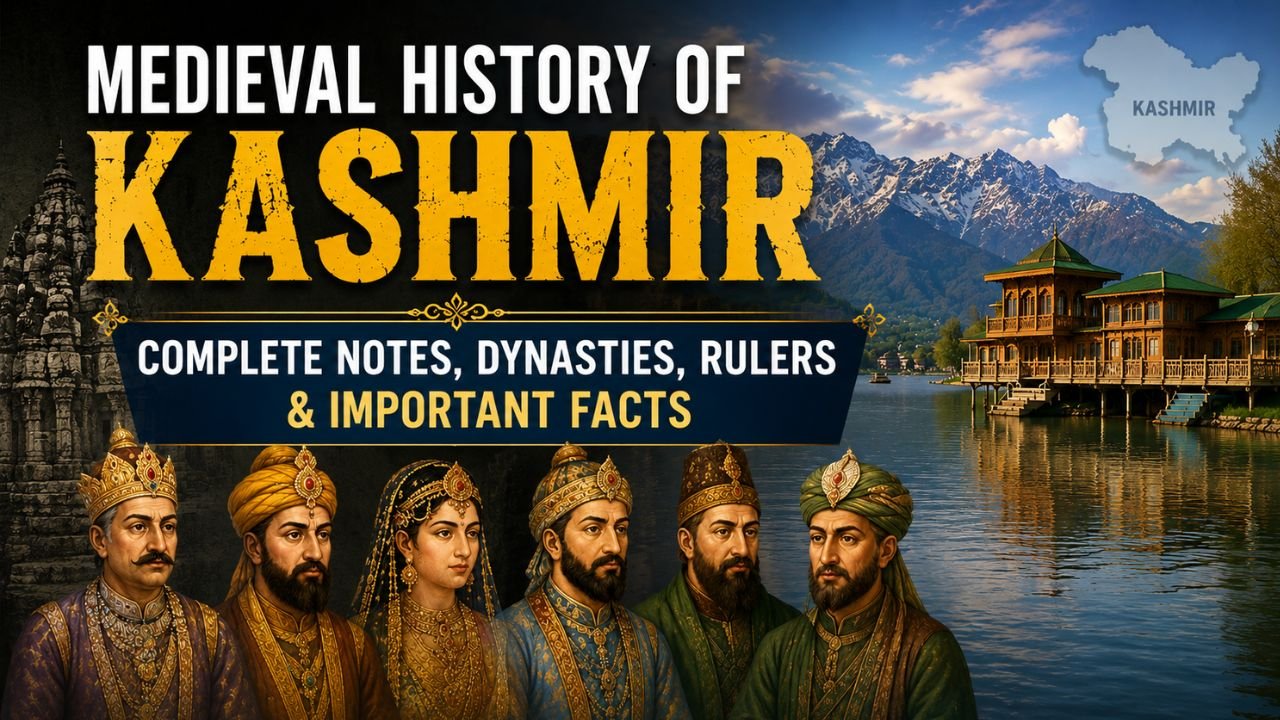
The Medieval History of Kashmir is one of the most important part in the Jammu and Kashmir General Knowledge for competitive exams. This period saw the rise and fall of several dynasties, important rulers, foreign invasions, religious and cultural changes, and major political developments.
In this complete guide, Exam Waves Academy has covered the major dynasties and rulers of Medieval Kashmir in very simple language. These notes are useful for JKSSB, JKPSC, JK Police, JK High Court and other Jammu & Kashmir competitive exams.
Medieval History of Kashmir at a Glance
| Dynasty/Rule | Important Period |
|---|---|
| Utpala Dynasty | 855–939 CE and related period |
| Lohara Dynasty | 1003–1101 |
| Second Lohara Dynasty | After Harsha |
| Deva Dynasty | 1171–1339 |
| Shah Mir Dynasty | 1339–1470 |
| Chak Dynasty | 1561–1586 |
| Mughal Rule | From 1586 |
| Afghan Rule | 1753–1819 |
| Sikh Rule | 1819–1846 |
1. Utpala Dynasty
The Utpala Dynasty is an important dynasty in the medieval history of Kashmir.
Founder – Avantivarman
Avantivarman was the founder of the Utpala Dynasty.
Important Facts
- Avantivarman was the son of Sukhavarman.
- He was the grandson of Utpala.
- He ruled from 855–883 CE.
- He is mentioned in Book V of Rajatarangini.
- His rule was known as an age of consolidation and enlightenment.
- He founded Avantipur.
- He appointed Sura as his Prime Minister.
- Bhatta Kallata was his court poet.
- He built two important temples at Avantipur:
- Avantisvara – dedicated to Shiva.
- Avantiswami – dedicated to Vishnu.
- Sopore was founded by Suyya.
Read More
2. Shankaravarman (883–902 CE)
Shankaravarman was the son of Avantivarman.
Important Facts
- His rule was known for heavy taxation.
- He organised special offices for collecting money called Grhakrtya.
- He introduced forced labour in Kashmir known as Bharod.
- Kalhana mentions 13 kinds of begar.
- Kalhana called him a modern King Midas.
3. Gopalavarman (902–904 CE)
- Gopalavarman ruled for a short period of about two years.
- He ruled under the regency of his mother Sugandha.
4. Sugandha (904–906 CE)
Sugandha was the wife of Shankaravarman.
Important Facts
- She was killed by Tantrin soldiers in the Buddhist monastery of Nispalaka Vihara.
- She was known by the masculine epithet Sri Sugandha Deva.
- She built a temple dedicated to Lord Vishnu.
- It came to be known as Vishnu Gopala Keshava.
- Suravarman II was the last ruler of the Utpala Dynasty.
5. Tantrins
The Tantrins were foot soldiers who became very powerful in Kashmir.
Important Facts
- They dominated Kashmir from 904–939 CE.
- They placed the 10-year-old Partha on the throne from 906–921 CE.
- Partha was the son of Pangu (Nirjavarman).
- Chakravarman, another son of Pangu, ruled from 923–933 CE.
- Suravarman-I was made king in 933 CE.
- Unmattavanti ruled from 937–939 CE.
6. Yashaskara (939–948 CE)
- Yashaskara was the son of Gopalavarman’s minister Prabhakaradeva.
- He came to occupy the throne of Kashmir.
- He ruled for nine years.
Sangrama Deva (948–949 CE)
- Sangrama Deva was the son of Yashaskara.
- He was killed by his minister Parva Gupta.
7. Gupta Period (948–1003)
Parva Gupta
- Parva Gupta ruled from 949–950 CE.
- He was succeeded by his son Kshemagupta.
Kshemagupta (950–958 CE)
- Kshemagupta was a weak king.
- He married Princess Didda, daughter of Simhraja, ruler of Lohara.
8. Queen Didda
Queen Didda is one of the most important personalities in the medieval history of Kashmir.
Didda as Regent (958–981 CE)
- She is mentioned in Book VI of Rajatarangini.
- After the death of Kshemagupta, his minor son Abhimanyu II came to the throne.
- Didda acted as Regent for Abhimanyu II.
- After his death, she was left with three grandsons:
- Nandigupta
- Tribhuvana
- Bhimagupta
Queen Didda (981–1003 CE)
- Didda ruled independently.
- She is also known as the “Catherine of Kashmir.”
- She transmitted the crown to her nephew Sangram Raja.
- Sangram Raja was the son of her brother Udayraja, ruler of Lohara in Poonch.
- Didda died in 1003 CE.
9. Lohara Dynasty (1003–1101)
The Lohara Dynasty followed the period of Queen Didda.
Important Facts
- The Loharas belonged to the Khasa tribe.
- The dynasty is mentioned in Book VII of Rajatarangini.
- Sangram Raja was its founder.
Sangram Raja (1003–1028 AD)
- Mahmud Ghazni attacked Kashmir during his reign.
- Sangram Raja stood against him with the help of his army leader Tunga.
Ananta Deva (1028–1063)
- He was the son of Sangram Raja.
- He committed suicide.
- His son Kalasha succeeded him in 1063.
Harsha (1089–1101)
- Harsha was killed.
- The throne then passed into the hands of Prince Uchchala.
Read More
10. Second Lohara Dynasty
The Second Lohara Dynasty is mentioned in Book VIII of Rajatarangini.
Uchchala
- Uchchala displaced Harsha with the help of the Damaras.
- He became the first ruler of the Second Lohara Dynasty.
- He was succeeded by his brother Sussala.
Jaya Simha (1128–1155 AD)
- He was the son of Sussala.
- He was the last great Hindu ruler of Kashmir, according to the notes.
- Radda Devi was his queen.
- Kalhana completed Rajatarangini during his reign.
11. Deva Dynasty (1171–1339)
The Deva Dynasty was another important ruling period in medieval Kashmir.
Important Facts
- The founder was Vuppadeva.
- The period is given as 1171–1339.
- Srimadeva assumed the throne of Kashmir in 1286 AD.
- His brother Suhadeva succeeded him in 1301 AD.
- During Suhadeva’s reign, Kashmir witnessed the invasion of Dulacha.
- Dulacha was a Mongol invader from Turkistan.
- According to the notes, his invasion lasted about eight months in 1320.
12. Rinchin
Rinchin was an important personality during this period.
Important Facts
- He came from Ladakh.
- His father was Rinchana.
- His minister Ramachandra’s daughter Kota Rani became his queen.
Rinchin as Sadr-ud-din
- Rinchin converted to Islam under the influence of Bulbul Shah (Sayyid Sharfuddin Abdul Rahman).
- He adopted the name Sultan Sadr-ud-din.
- He made Shah Mir his minister.
- He built the first mosque of Kashmir known as Bud-Masheed.
- He built Rinchenpora in memory of Bulbul Shah.
- He died in 1323.
13. Udayan Deva
- Suhadeva’s brother returned to Kashmir and married Kota Rani after the death of Rinchin.
- Udayan Deva was the last Hindu ruler of Kashmir according to the notes.
- Kota Rani was the de facto ruler.
- She appointed Bhatta Bhikshana as her Prime Minister.
- Andar Kot was her capital.
- She died in 1339.
- This marked the beginning of Muslim rule in Kashmir.
14. Shah Mir Dynasty (1339–1470)
The Shah Mir Dynasty marked an important change in the political history of Kashmir.
Important Facts
- The actual founder of Muslim rule was Shah Mir.
- Shah Mir’s dynasty ruled from 1339–1470.
- Shah Mir became the first Muslim ruler of Kashmir.
- Sultan Shams-ud-din ruled from 1339–1342 CE.
15. Ala-ud-din (1343–54)
- Ala-ud-din built Alauddinpur in Srinagar.
- He transferred his capital from Andarkot to Alauddinpur.
16. Shihab-ud-din (1354–1373)
Shihab-ud-din was an important ruler of the Shah Mir Dynasty.
Important Facts
- He was the son of Ala-ud-din.
- He was also known as Shirashamak.
- He founded Shihab-ud-din Pura (Shadipora).
- He defeated the ruler of Kangra (Central Asia).
- His period was described as the “Golden Period” of the Shah Turki Sultanate in the notes.
- He adopted the title Alamgir.
- Kota Bhatt and Udayashri were his Prime Ministers.
- During his reign, Mir Syed Ali Hamdani (RA) arrived in the valley with 700 Syeds.
17. Qutb-ud-din or Hindal (1373–89)
- During his reign, Shah Hamdan paid a second visit and stayed for two and a half years.
18. Sultan Sikandar or But Shikan (1389–1413)
Important Facts
- He was the son of Qutb-ud-din.
- He was also known as Aurangzeb of Kashmir.
- He took the throne at the age of eight.
- His mother Sura acted as Regent.
- He introduced Jizya.
- He founded the city of Sikandarpora.
- Jama Masjid Srinagar was built during his period.
- Khanqah-e-Maula Srinagar was built during his period.
- He invited Muhammad Hamdani to Kashmir in 1393.
19. Zain-ul-Abidin or Shahi Khan / Budshah
Zain-ul-Abidin is one of the best-known rulers of medieval Kashmir.
Important Facts
- He ruled from 1420–1470 CE.
- His reign is described as the Golden Age of Kashmir.
- He introduced Pashmina shawl.
- He introduced wooden architecture.
- He introduced the Persian art of papier-mâché.
- During his reign, Jana Raja wrote the second part of Rajatarangini.
- He abolished Jizya.
- He founded a new city called Nowshahar.
- He founded Zainapur, Zainakot and Zainagir.
- He built the first wooden bridge at Srinagar at Zainakadal.
- A Persian work mentioned in the notes was written during his reign.
20. Chak Dynasty (1561–1586)
The Chak Dynasty was another major dynasty in medieval Kashmir.
Founder – Ghazi Chak
- Ghazi Chak was the founder.
- The dynasty ruled from 1561–1586.
- Ghazi Chak was the first ruler of the Chak Dynasty.
- He was originally associated with Dardistan (Gilgit Hunza).
Main Rulers
The main rulers listed in the notes are:
Ghazi Shah → Hussain Shah → Ali Shah → Yousuf Shah
21. Hussain Shah Chak (1563–1570)
- He succeeded Ghazi Chak.
- He was dethroned in 1570.
- He allowed Khutba to be read in his own name.
- The notes mention that the Chak throne remained under pressure during the Mughal period.
22. Yousuf Shah Chak
Yousuf Shah Chak is one of the best-known rulers of the Chak Dynasty.
Important Facts
- His period is given as 1579–88 AD in the notes.
- He was the last independent ruler of Kashmir.
- He was married to Habba Khatoon.
- He changed the name of Gulmarg from Gaurimarg.
- He was exiled by Akbar and died at Bihar.
- The last ruler of the Chak Dynasty was Yaqoob Shah Chak.
- Yaqoob was defeated by Mughal army under Qasim Khan.
23. Mirza Mohammad Haider Dughlat
- He made his first campaign towards Kashmir in 1533 on behalf of Sultan Said Khan of Kashgar.
- Mirza made his second campaign under Humayun and entered the valley in 1540.
- He occupied Srinagar in October 1540.
- After the death of Kashmir’s ruler, he established his position.
- He wrote Tarikh-i-Rashidi.
24. Mughal Rule in Kashmir
Battle of Hastivanj
- The battle took place on 10 October 1586 near Pir Ki Gali.
- It was fought between the Mughal Governor Qasim Khan and Chak leader Shams Chak.
- The Mughals won the battle.
- It laid the foundation of Mughal rule in Kashmir.
- The fall of Srinagar is given as 14 October 1586.
25. Akbar (1586–1605)
- During Akbar’s reign, Kashmir was ruled by four subedars.
- The notes list:
- Mirza Qasim
- Mirza Yusuf Khan
- Mirza Qulich Khan
- Mirza Ali
- Akbar visited Kashmir three times.
- His first visit was in 1589.
- He was accompanied by Faizi and finance minister Raja Todar Mal.
- Todar Mal recognised the revenue assessment of Kashmir.
- Akbar was accompanied by Nizamuddin and Abul Fazl on his second visit.
- His third visit was accompanied by Queen Mariam-uz-Zamani.
- Hari Parbat Fort was constructed during his period.
- The Nagar Nagar township was also founded during his reign.
- Nasim Bagh was built during his reign.
26. Jahangir (1605–1627)
- He visited Kashmir seven times.
- During his reign, Kishtwar was conquered in 1622.
- He introduced the Persian language as the official language of Kashmir.
- He nominated Siraj-ud-din of village Kathua as Raja of Poonch in 1606.
Governors listed in the notes
- Hashim Khan
- Sardar Khan
- Ahd Beg
- Dilawar Khan
- Iradat Khan
- Itiqad Khan
Important Developments
- Shalimar Garden was built during his reign.
- Achabal Garden at Achabal was built by Noor Jahan.
- Pather Masjid was built by Noor Jahan.
- The Akhun Mulla Shah Mosque was built at Chingam Sari by Mughal prince Dara Shikoh.
27. Shah Jahan (1627–1658)
- Under Shah Jahan, Kashmir was governed by nine governors.
- He visited Kashmir four times.
- He made Kashmir a separate Subah.
- He was assisted by Kabul Subah in 1638.
- He abolished certain taxes mentioned in the notes.
Important Gardens and Buildings
- Zafar Khan
- Ali Mardan Khan
- Lashkar Khan
- Chashma Shahi – built by Ali Mardan Khan in 1632 during Shah Jahan’s reign.
- Dara Shikoh built Pari Mahal.
- Zafar Khan built Chashma Bagh and Hasan Abad Garden.
28. Aurangzeb (1658–1707)
- Aurangzeb visited Kashmir once in 1665.
- During his first visit, he was accompanied by his daughter Roshan Ara and Francois Bernier.
- During his reign, Kashmir was governed by 14 governors.
- He built Naqsh Chadar at Achabal during his period.
- Saif Khan built the Sarai at Verinag.
- Aurangzeb renovated Jama Masjid Srinagar.
29. Afghan Rule in Kashmir
Afghan rule is given in the notes as lasting from 1753–1819, a period of about 66 years.
Important Facts
- Ahmed Shah Abdali became the Afghan ruler of Kashmir.
- Kashmir remained under Afghan control until 1819.
- The notes mention 28 Afghan governors ruling Kashmir.
- Lala Khan was the first independent ruler of Kashmir during this phase, according to the notes.
- Mukarram Chak is mentioned as the first Muslim governor.
30. Facts from the Afghan Period
The notes mention several terms and taxes from this period:
- Impose Heavy Taxation
- Zari Niyaz or Nazarana
- Zari-i-Ashkhas or Marchants
- Zari Habib on grain
- Dag-i-Shawl – a tax on shawls and stamping
31. Amir Khan Jawan Sher
- He built Amira Kadal.
- He built the old Secretariat, earlier called Darabagh.
32. Ata Mohd Khan
- He built the present structure of Hari Parbat Fort.
- He issued coins in the name of Sheikh Noor-ud-din.
- He declared himself independent of Kabul.
33. Jabbar Khan
- Jabbar Khan was the last Afghan governor of Kashmir.
34. Battle of Shopian
The Battle of Shopian ended Afghan rule and opened the way for Sikh rule in Kashmir.
Important Facts
- It was fought on 3 July 1819.
- It was fought between the Sikh Empire and Durrani Empire.
- The Sikh army was led by Hari Singh Nalwa.
- Afghan forces were led by Jabbar Khan.
- The Sikhs won the battle.
- It ended about 66 years of Afghan rule.
- It established Sikh rule in Kashmir.
35. Sikh Rule (1819–1846)
The Sikh period began after the Battle of Shopian.
Ranjit Singh
- Ranjit Singh was the founder of Sikh rule.
- His capital was Lahore.
- He was requested by Pandit Birbal Dhar and Pandit Raj Kak Dhar of Kashmir to take over Kashmir.
- He annexed Kashmir on 5 July 1819, with the Battle of Shopian associated with the conquest.
- It was annexed to the Lahore Darbar.
- He was helped by Wazir Gulab and Mohammad Shah Khan in the annexation of Kashmir in 1814, as stated in the notes.
- Udho was made Wazir by Ranjit Singh.
36. Diwan Moti Ram
- He was the first Sikh Governor.
- He closed Jama Masjid in 1819.
- He was assisted by Birbal Dhar, who served as Srinagar’s administrator.
- He put a ban on Azan.
- He was helped by his Prime Minister Dewan Kirpa Ram.
- The notes mention his role in improving administration.
37. Hari Singh Nalwa
- He was known as the Baghmara (Lion of Frontier).
- Sikh Governor Imam-ud-din was forced to cooperate with Gulab Singh’s Dogra forces.
- He was defeated at Shankar Garh in 1821.
38. Diwan Kirpa Ram
- He was the author of Gulab Nama.
- During his period, Victor Jacquemont visited Kashmir.
- He participated in the Battle of Nowshara in 1823 against Ranjit Singh.
- The notes mention his administrative role during Sikh rule.
39. Mihan Singh
- He was also known as Colonel Sahib.
- He introduced popular weights and measurements.
- He established the Dharamarth Department.
- He established four Bazar Sarais during his rule.
- Vigne visited Kashmir during his period.
- Baron Charles Hugel also visited Kashmir.
40. Sheikh Ghulam Muhuddin (1841–46)
- He was the first Muslim Sikh Governor appointed by Ranjit Singh in 1842.
- He opened Jama Masjid.
- He appointed Pandit Tika Mathu as his Chief Minister.
- He built Shankarcharya Temple.
- He restored Jama Masjid and other religious places.
- He introduced the Shali system in 1846.
- He signed the Treaty of Amritsar in 1846.
Important Historical Sources and Books
For competitive exams, students should remember the important books connected with Medieval Kashmir.
| Book/Source | Important Connection |
|---|---|
| Rajatarangini | Important source of Kashmir history |
| Book V | Avantivarman/Utpala period |
| Book VI | Queen Didda |
| Book VII | Lohara Dynasty |
| Book VIII | Second Lohara Dynasty |
| Rajatarangini | Completed by Kalhana during Jaya Simha’s reign |
| Second part of Rajatarangini | Jana Raja during Zain-ul-Abidin |
| Tarikh-i-Rashidi | Mirza Mohammad Haider Dughlat |
| Gulab Nama | Diwan Kirpa Ram |
Important Battles and Invasions
| Battle/Invasion | Important Fact |
|---|---|
| Mahmud Ghazni’s attack | During Sangram Raja’s reign |
| Dulacha invasion | During Suhadeva’s period |
| Battle of Hastivanj | 10 October 1586 |
| Battle of Hastivanj | Helped establish Mughal rule |
| Battle of Shopian | 3 July 1819 |
| Battle of Shopian | Ended Afghan rule and established Sikh rule |
Important Rulers and Their Contributions
| Ruler | Important Fact |
|---|---|
| Avantivarman | Founder of Utpala Dynasty |
| Shankaravarman | Heavy taxation; Bharod |
| Didda | Catherine of Kashmir |
| Sangram Raja | Founder of Lohara Dynasty |
| Jaya Simha | Kalhana completed Rajatarangini |
| Rinchin | Converted to Islam as Sadr-ud-din |
| Shah Mir | Founder of Shah Mir Dynasty |
| Sikandar | Introduced Jizya |
| Zain-ul-Abidin | Golden Age of Kashmir |
| Ghazi Chak | Founder of Chak Dynasty |
| Yousuf Shah Chak | Married Habba Khatoon |
| Akbar | Mughal rule established in Kashmir |
| Jahangir | Visited Kashmir seven times |
| Shah Jahan | Made Kashmir a separate Subah |
| Ahmed Shah Abdali | Afghan rule |
| Ranjit Singh | Sikh rule in Kashmir |
Important Places, Buildings and Gardens
- Avantipur — Avantivarman
- Sopore — Suyya
- Sikandarpora — Sikandar
- Nowshahar — Zain-ul-Abidin
- Zainapur, Zainakot and Zainagir — Zain-ul-Abidin
- Hari Parbat Fort — important during later medieval rule
- Shalimar Garden — Jahangir’s reign
- Achabal Garden — Noor Jahan
- Pather Masjid — Noor Jahan
- Chashma Shahi — Ali Mardan Khan
- Pari Mahal — Dara Shikoh
- Amira Kadal — Amir Khan Jawan Sher
30 Most Important Facts for Exams
- Avantivarman founded the Utpala Dynasty.
- Avantivarman founded Avantipur.
- Suyya founded Sopore.
- Forced labour under Shankaravarman was called Bharod.
- Didda is known as the Catherine of Kashmir.
- Didda is mentioned in Book VI of Rajatarangini.
- Sangram Raja founded the Lohara Dynasty.
- Loharas belonged to the Khasa tribe.
- The Lohara Dynasty is mentioned in Book VII of Rajatarangini.
- The Second Lohara Dynasty is mentioned in Book VIII.
- Kalhana completed Rajatarangini during Jaya Simha’s reign.
- Dulacha invaded Kashmir during Suhadeva’s reign.
- Rinchin came from Ladakh.
- Rinchin adopted Islam and became Sadr-ud-din.
- Shah Mir was the founder of the Shah Mir Dynasty.
- Shah Mir Dynasty ruled from 1339–1470.
- Sikandar introduced Jizya.
- Zain-ul-Abidin ruled from 1420–1470.
- Zain-ul-Abidin’s reign is called the Golden Age of Kashmir in the notes.
- Ghazi Chak founded the Chak Dynasty.
- Yousuf Shah Chak was married to Habba Khatoon.
- Mirza Haider Dughlat wrote Tarikh-i-Rashidi.
- Mughal rule was established in Kashmir in 1586.
- Akbar first visited Kashmir in 1589.
- Jahangir visited Kashmir seven times.
- Shah Jahan made Kashmir a separate Subah.
- Afghan rule lasted from 1753–1819.
- Jabbar Khan was the last Afghan governor.
- The Battle of Shopian was fought on 3 July 1819.
- Sikh rule in Kashmir lasted from 1819–1846.
Conclusion
The Medieval History of Kashmir covers several important dynasties and ruling periods, from the Utpala and Lohara dynasties to the Shah Mir, Chak, Mughal, Afghan and Sikh periods. Each period contributed to the political, cultural and administrative history of Kashmir.
For JKSSB, JKPSC and other J&K competitive exams, students should focus especially on founders, rulers, dates, battles, books, religious and administrative developments, important buildings and chronological order.