
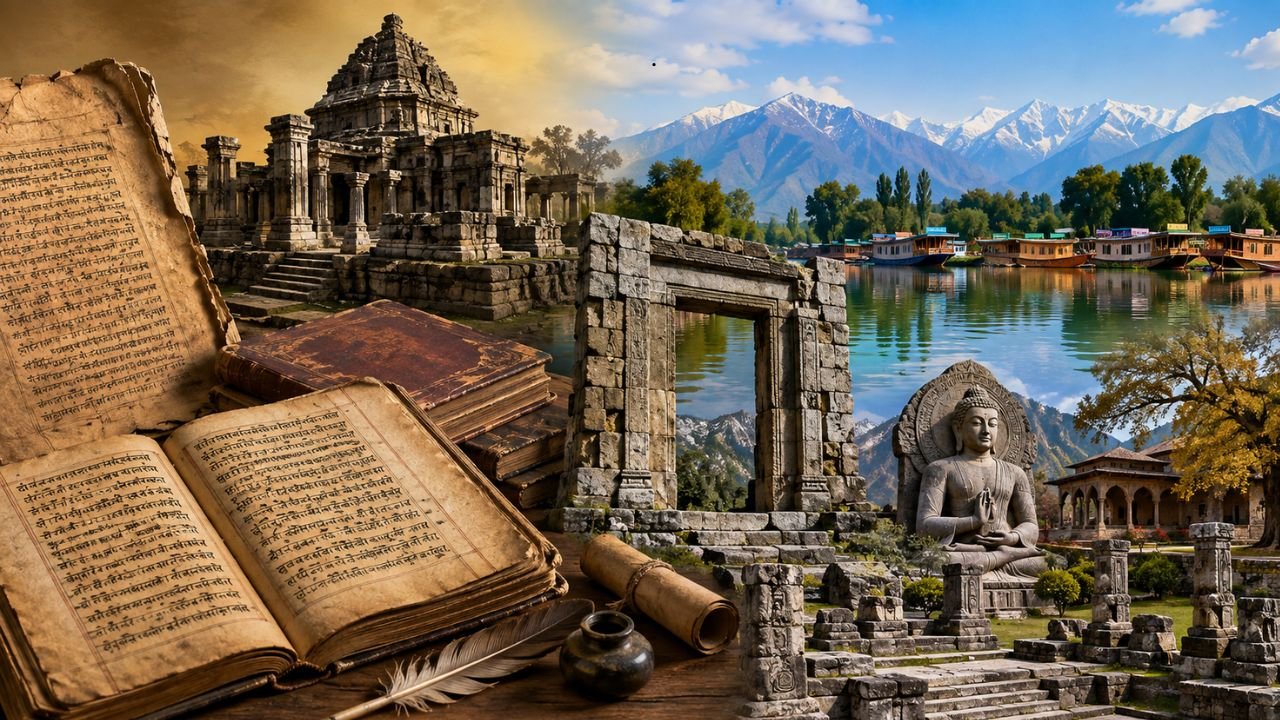
The Sources of Jammu and Kashmir History is one of the most important topic in Jammu and Kashmir General Knowledge (JK GK). Questions related to Nilamat Purana, Rajatarangini, foreign travellers, Chinese pilgrims, Persian historians, and other historical sources are frequently asked in JKSSB, JKPSC, JK Police, JK Bank, JK High Court, and other competitive examinations.
In this article, Exam Waves Coaching Academy explains all important historical sources of Jammu and Kashmir in very simple language, along with important facts and exam-oriented points.
What are the sources of Jammu and Kashmir history?
The history of Jammu and Kashmir is known from ancient religious texts, historical books, Persian writings, foreign accounts, and Chinese travellers. These sources provide information about the origin of Kashmir, ancient rulers, dynasties, culture, religion, and society.
Classification of historical sources
The historical sources of Jammu and Kashmir can be divided into the following categories:
- Nilamat Purana
- Rajatarangini
- Other Persian and Kashmiri historical sources
- Foreign accounts
- Chinese travelers
- Other foreign travelers
Nilamat Purana
Nilamat Purana is one of the earliest sources of the history of Kashmir.
Important facts
- Also known as “Kashmir Mahatmya.”
- Belongs to the 6th century AD.
- It was written by Sage Nila, the chief of the Nagas.
- According to the Nagas, the original inhabitants of Kashmir were the Nagas.
Origin of Kashmir
The Nilamat Purana states that Kashmir was originally a lake called “Satisar.”
According to the tradition:
- The lake was inhabited by a demon named Jalodbhava.
- Lord Vishnu killed Jalodbhava.
- The water was drained.
- Kashmir became suitable for human settlement.
The people named the valley Kashyap Mar or Kashyap Pur.
From this theory, the name Kashmir is believed to have originated.
Download our Complete J&K GK Book
Meaning of Kashmir
According to the source:
- KA = Water
- SHMEERA = To Desiccate
Rajatarangini
Rajatarangini is the most important historical book of Kashmir.
Important facts
- Also known as “River of Kings.”
- Written by Kalhana.
- Written during 1148–49 AD.
- Written during the reign of Jayasimha, ruler of the Lohara Dynasty.
- Originally written in Sanskrit.
- Contains 7,826 verses.
Persian translation
Mulla Ahmad translated Rajatarangini into Persian during the reign of Zain-ul-Abidin.
English translation
A. Stein translated Rajatarangini into English as “A Chronicle of the Kings of Kashmir” in 1901.
Urdu translation
Pandit Ishbaram Archand translated it into Urdu.
Continuation of Rajatarangini
The later parts of Rajatarangini were written by different historians:
- Second Part: Jonaraja
- Third Part: Srivara Pandita
- Fourth Part: Suka
Other Kashmiri historical sources
Several Persian and Kashmiri historians wrote important works on the history of Jammu and Kashmir.
Important books and authors
| Book | Author |
|---|---|
| Tarikh-i-Kashmir | Malik Haider |
| In the Court of Yousuf Shah Chak | Waqut-i-Kashmir |
| Tarikh-i-Hassan | Peer Hassan Shah |
| Akbar | Mukhtar Tawarikh Kashmir |
| Zafar Nama | Sharif Ud Din Yazdi |
These works provide information about the Sultanate period, Chak rulers, Mughal relations, and later political developments.
Foreign accounts of Kashmir
Foreign writers also described Kashmir in their writings.
Hiuen Tsang (Xuanzang)
The Chinese traveler Hiuen Tsang referred to Kashmir as “Kia-shi-milo.”
Important facts
- He reached Kashmir in 631 CE.
- He visited during the rule of the Karkota Dynasty.
Greek references
Greek writers mentioned Kashmir by different names.
Herodotus
Referred to it as Kasperya or Kaspatyros.
Arrian
Called it Kashrat.
Pliny
Named it Kashmiras.
Chinese names of Kashmir
Chinese records referred to Kashmir by different names.
Yeq
Kashmir was known as Yeq.
Pin
Kashmir was also known as Pin.
Puranic reference
In the Puranas, Kashmir is referred to as Gerek.
Ou-Kong’s account
The Chinese traveler Ou-Kong visited Kashmir in 759 CE during the reign of Lalitaditya.
He stayed for four years at present-day Ushkur.
Other foreign travelers
Several other travelers also mentioned Kashmir.
These include:
- Moorcroft
- George Trebeck
- G. T. Vigne
- Frederic Drew
- Philip Yefremov
Their accounts provide valuable information about the geography, economy, society, and culture of Kashmir.
Importance of historical sources
The sources of Jammu and Kashmir history help historians understand:
- The origin of Kashmir
- Ancient dynasties
- Political history
- Religious traditions
- Cultural development
- Foreign relations
- Social life
Among all the sources, Rajatarangini is considered the most important historical source, while Nilamat Purana is the earliest religious and cultural source.
Quick revision table
| Source | Important Fact |
|---|---|
| Nilamat Purana | Also called Kashmir Mahatmya |
| Nilamat Purana | Kashmir was originally Satisar |
| Rajatarangini | Written by Kalhana |
| Rajatarangini | Written during 1148–49 AD |
| Jayasimha | Lohara Dynasty ruler |
| A. Stein | English translation in 1901 |
| Hiuen Tsang | Reached Kashmir in 631 CE |
| Ou-Kong | Visited in 759 CE |
| Gerek | Puranic name of Kashmir |
| Kasperya | Greek reference to Kashmir |
Important facts for competitive exams
- Nilamat Purana is also known as Kashmir Mahatmya.
- It belongs to the 6th century AD.
- Sage Nila was the chief of the Nagas.
- Kashmir was originally a lake called Satisar.
- Rajatarangini was written by Kalhana.
- It was written during 1148–49 AD.
- Rajatarangini contains 7,826 verses.
- A. Stein translated it into English in 1901.
- Jonaraja wrote the second part of Rajatarangini.
- Srivara Pandita wrote the third part.
- Suka wrote the fourth part.
- Hiuen Tsang reached Kashmir in 631 CE.
- Ou-Kong visited Kashmir in 759 CE during Lalitaditya’s reign.
- In the Puranas, Kashmir is known as Gerek.
Important MCQ’S on Jammu and Kashmir Historical Sources for all Competitive Exams
Here is the top most MCQ’s for the Historical Sources of Jammu and Kashmir, which will help you to get better score in any JKSSB or JKPSC exam.
Q1. Which of the following statements correctly describe the historical sources of Jammu and Kashmir?
- The history of Jammu and Kashmir is known from religious texts, historical books, Persian writings, and foreign accounts.
- Chinese travelers also provide important information about Kashmir.
- These sources help in understanding ancient rulers, culture, and society.
- Rajatarangini is one of the important historical sources of Kashmir.
A) 1 and 2 only
B) 1, 2 and 3 only
C) 2, 3 and 4 only
D) 1, 2, 3 and 4
Answer: D
Q2. Which of the following statements correctly describe Nilamat Purana?
- It is also known as “Kashmir Mahatmya.”
- It belongs to the 6th century AD.
- It was written by Sage Nila.
- It is considered one of the earliest sources of Kashmir history.
A) 1 and 2 only
B) 1, 2 and 3 only
C) 2, 3 and 4 only
D) 1, 2, 3 and 4
Answer: D
Q3. According to Nilamat Purana, Kashmir was originally known by which of the following names?
A) Gerek
B) Satisar
C) Kashrat
D) Kasperya
Answer: B
Q4. Which of the following statements correctly explain the origin of Kashmir according to Nilamat Purana?
- Kashmir was originally a lake called Satisar.
- The lake was inhabited by the demon Jalodbhava.
- Lord Vishnu killed Jalodbhava.
- After the water was drained, Kashmir became suitable for human settlement.
A) 1 and 2 only
B) 1, 2 and 3 only
C) 2, 3 and 4 only
D) 1, 2, 3 and 4
Answer: D
Q5. According to the source, what is the meaning associated with the word “Kashmir”?
A) KA = Mountain; SHMEERA = Valley
B) KA = Water; SHMEERA = To Desiccate
C) KA = River; SHMEERA = Temple
D) KA = King; SHMEERA = Kingdom
Answer: B
Q6. Which of the following statements correctly describe Rajatarangini?
- It is also known as “River of Kings.”
- It was written by Kalhana.
- It was written during 1148–49 AD.
- It was written during the reign of Jayasimha.
A) 1 and 2 only
B) 1, 2 and 3 only
C) 2, 3 and 4 only
D) 1, 2, 3 and 4
Answer: D
Q7. Rajatarangini was written during the reign of which ruler of the Lohara Dynasty?
A) Lalitaditya
B) Avantivarman
C) Jayasimha
D) Zain-ul-Abidin
Answer: C
Q8. Which of the following statements correctly describe Rajatarangini?
- It was originally written in Sanskrit.
- It contains 7,826 verses.
- It is the most important historical book of Kashmir.
- It was originally written in Persian.
A) 1 and 2 only
B) 1, 2 and 3 only
C) 2, 3 and 4 only
D) 1, 2, 3 and 4
Answer: B
Q9. Who translated Rajatarangini into Persian during the reign of Zain-ul-Abidin?
A) A. Stein
B) Jonaraja
C) Mulla Ahmad
D) Suka
Answer: C
Q10. Which of the following statements correctly describe the English translation of Rajatarangini?
- It was translated by A. Stein.
- The English title was “A Chronicle of the Kings of Kashmir.”
- It was translated in 1901.
A) 1 only
B) 1 and 2 only
C) 2 and 3 only
D) 1, 2 and 3
Answer: D
Q11. Match the continuation of Rajatarangini with their authors.
- Second Part
- Third Part
- Fourth Part
a. Srivara Pandita
b. Jonaraja
c. Suka
A) 1-b, 2-a, 3-c
B) 1-a, 2-c, 3-b
C) 1-c, 2-b, 3-a
D) 1-b, 2-c, 3-a
Answer: A
Q12. Which of the following books and authors are correctly matched?
- Tarikh-i-Kashmir — Malik Haider
- Tarikh-i-Hassan — Peer Hassan Shah
- Zafar Nama — Sharif Ud Din Yazdi
A) 1 and 2 only
B) 1 and 3 only
C) 2 and 3 only
D) 1, 2 and 3
Answer: D
Q13. Which Chinese traveler referred to Kashmir as “Kia-shi-milo” and reached Kashmir in 631 CE?
A) Ou-Kong
B) Hiuen Tsang
C) Fa-Hien
D) Xuanzang was not mentioned
Answer: B
Q14. Which of the following statements correctly describe Hiuen Tsang’s visit to Kashmir?
- He reached Kashmir in 631 CE.
- He visited during the rule of the Karkota Dynasty.
- He referred to Kashmir as Kia-shi-milo.
A) 1 only
B) 1 and 2 only
C) 2 and 3 only
D) 1, 2 and 3
Answer: D
Q15. Which Greek historian referred to Kashmir as “Kasperya” or “Kaspatyros”?
A) Arrian
B) Pliny
C) Herodotus
D) Megasthenes
Answer: C
Q16. Match the Greek references with the names of Kashmir.
- Herodotus
- Arrian
- Pliny
a. Kashmiras
b. Kashrat
c. Kasperya / Kaspatyros
A) 1-c, 2-b, 3-a
B) 1-b, 2-a, 3-c
C) 1-a, 2-c, 3-b
D) 1-c, 2-a, 3-b
Answer: A
Q17. According to the source, Kashmir was referred to by which names in Chinese records?
- Yeq
- Pin
- Gerek
A) 1 only
B) 1 and 2 only
C) 2 and 3 only
D) 1, 2 and 3
Answer: B
Q18. In the Puranas, Kashmir is referred to by which name?
A) Kashrat
B) Satisar
C) Gerek
D) Pin
Answer: C
Q19. Which of the following statements correctly describe Ou-Kong’s visit to Kashmir?
- He visited Kashmir in 759 CE.
- He visited during the reign of Lalitaditya.
- He stayed for four years at present-day Ushkur.
A) 1 only
B) 1 and 2 only
C) 2 and 3 only
D) 1, 2 and 3
Answer: D
Q20. Which of the following travelers are listed among the other foreign travelers who mentioned Kashmir?
- Moorcroft
- George Trebeck
- G. T. Vigne
- Frederic Drew
- Philip Yefremov
A) 1, 2 and 3 only
B) 2, 3 and 4 only
C) 1, 3, 4 and 5 only
D) 1, 2, 3, 4 and 5
Answer: D


Thanku very much..i appreciate your work… again thanku