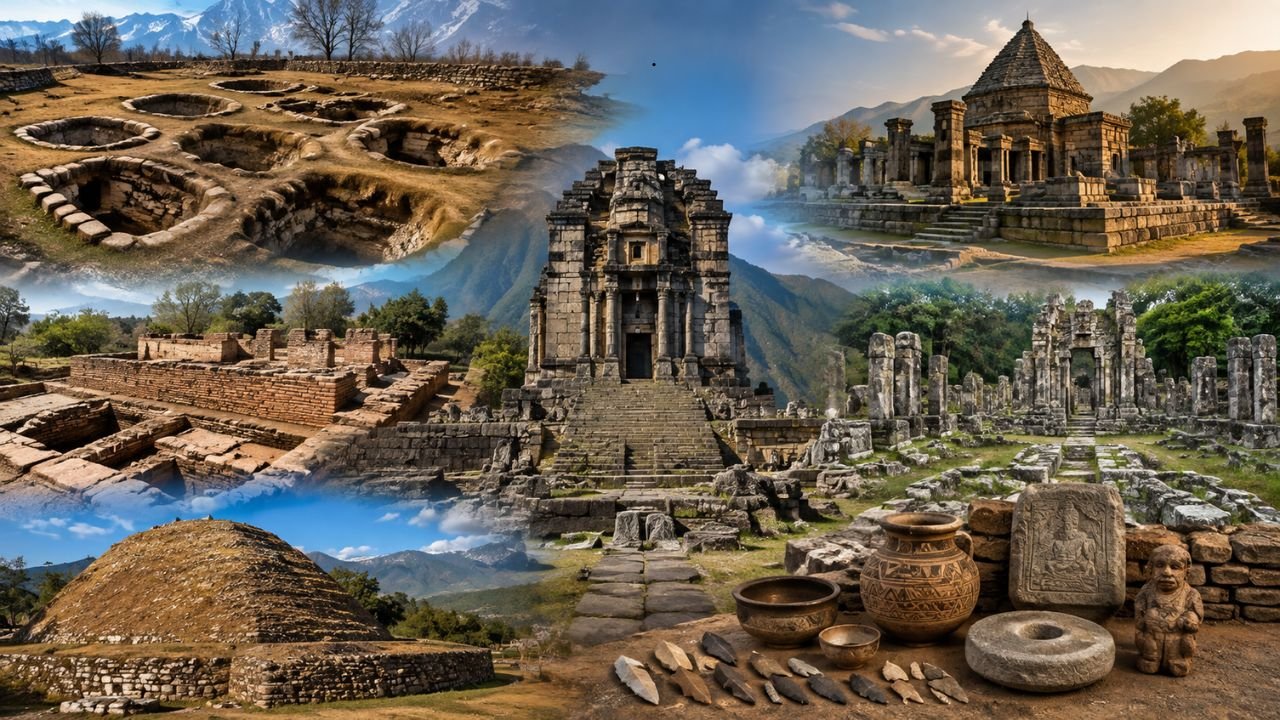
Archaeological Sites in Jammu and Kashmir is one of the most important topic in Jammu and Kashmir General Knowledge (JK GK). Questions related to Burzahom, Harwan, Ushkur, Martand, Parihaspora, and other ancient sites are frequently asked in JKSSB, JKPSC, JK Police, JK High Court, JK Bank, and other competitive examinations.
In this article, Exam Waves Coaching Academy explains all important archaeological sites of Jammu and Kashmir in very simple language, along with their historical importance, facts, and the most important MCQs which will help you to understand better.
What are archaeological sites?
Archaeological sites are places where ancient buildings, tools, pottery, coins, sculptures, temples, and other historical objects have been found.
These sites help us understand:
- Ancient civilizations
- Human settlements
- Religion and culture
- Architecture
- Trade and economy
Jammu and Kashmir has many important archaeological sites that show the rich history of the region.
Overview table of important archaeological sites
| Site | Location | Importance |
|---|---|---|
| Burzahom | Srinagar | Neolithic settlement |
| Manda (Akhnoor) | Jammu | Northernmost site of the Indus Valley Civilization (IVC) |
| Harwan | Srinagar | Buddhist remains |
| Ushkur | Baramulla | Ancient Buddhist site |
| Parihaspora | Baramulla | Capital of Lalitaditya |
| Martand | Anantnag | Ancient Sun Temple |
| Avantipur | Pulwama | Temple architecture |
| Akhnoor | Jammu | Harappan influence |
Burzahom archaeological site
Burzahom is the most famous prehistoric archaeological site in Jammu and Kashmir.
It is located near Srinagar.
Download Our J&K GK Complete Book

Why is Burzahom important?
Burzahom is known for its Neolithic (New Stone Age) settlement.
Archaeologists discovered:
- Underground pit dwellings
- Stone tools
- Bone tools
- Pottery
- Animal remains
Important fact
The people of Burzahom lived in pit houses, which were dug below the ground.
This site provides evidence of one of the earliest human settlements in Kashmir.
Manda (Akhnoor) archaeological site
Manda is one of the most important archaeological sites in the Jammu region. It is located near Akhnoor in Jammu district.
Historical importance
Manda is famous because it is the northernmost site of the Indus Valley Civilization (IVC) discovered in India. This site proves that the influence of the Harappan Civilization extended into the Jammu region.
Excavation details
- Excavated by: Archaeological Survey of India (ASI)
- Excavation period: 1976–77
- Excavation carried out by: J. P. Joshi
Geographical location
Manda is situated on the Right Bank (RB) of the River Chenab near Akhnoor.
Cultural remains discovered
Archaeologists discovered remains belonging to:
- Harappan Civilization
- Mauryan Period
- Kushan Period
These discoveries show that Manda remained an important settlement during different historical periods.
Important fact
Manda is considered the northernmost archaeological site of the Indus Valley Civilization (IVC), making it one of the most important archaeological sites of Jammu and Kashmir for competitive examinations.
Harwan archaeological site
Harwan is located near Srinagar.
It is famous for its Buddhist remains.
Discoveries at Harwan
Archaeologists found:
- Buddhist monasteries
- Terracotta tiles
- Ancient structures
- Decorative brickwork
Harwan was an important centre of Buddhist learning and culture.
Important fact
Harwan is famous for its beautiful terracotta tiles with artistic designs.
Ushkur archaeological site
Ushkur is located in Baramulla district.
It is an important Buddhist archaeological site.
Historical importance
The site contains remains of:
- Buddhist stupas
- Monasteries
- Ancient sculptures
Ushkur was connected with the spread of Buddhism in Kashmir.
Parihaspora archaeological site
Parihaspora is located in Baramulla district.
It was founded by the famous king Lalitaditya Muktapida of the Karkota Dynasty.
Historical importance
Parihaspora served as the capital city of Lalitaditya.
Archaeologists discovered:
- Temple ruins
- Sculptures
- Stone structures
- Ancient foundations
Important fact
Parihaspora reflects the advanced architecture and urban planning of ancient Kashmir.
Martand archaeological site
The Martand archaeological site is located in Anantnag district.
It is famous for the Martand Sun Temple.
Historical importance
The temple was built during the Karkota period.
It is considered one of the finest examples of ancient Kashmiri temple architecture.
Architectural features
- Massive stone pillars
- Large courtyard
- Intricate carvings
- Grand temple complex
Important fact
The Martand Sun Temple is one of the most important historical monuments of Kashmir.
Avantipur archaeological site
Avantipur is located in Pulwama district.
It was established by King Avantivarman of the Utpala Dynasty.
Discoveries
Archaeologists found:
- Temple ruins
- Stone sculptures
- Carved pillars
- Architectural remains
The site demonstrates the development of Kashmiri temple architecture.
Important fact
Avantipur contains the remains of Avantiswami Temple and Avantishwara Temple.
Akhnoor archaeological site
Akhnoor is located in the Jammu region.
It is associated with Harappan and post-Harappan cultural remains.
Archaeological discoveries
- Pottery
- Terracotta objects
- Ancient tools
- Settlement remains
Historical importance
Akhnoor shows that the Jammu region was connected with ancient civilizations.
Importance of archaeological sites in J&K
These sites help historians understand:
- Early human life
- Agriculture
- Animal domestication
- Religious development
- Buddhist influence
- Temple architecture
- Ancient kingdoms
They also provide evidence about the Neolithic, Buddhist, Karkota, and Utpala periods of Kashmir history.
Archaeological Survey of India (ASI)
Many important archaeological sites of Jammu and Kashmir are protected by the Archaeological Survey of India (ASI).
The ASI is responsible for:
- Conservation of monuments
- Excavation of archaeological sites
- Historical research
- Preservation of ancient heritage
Difference between Burzahom and Harwan
| Burzahom | Harwan |
|---|---|
| Neolithic settlement | Buddhist archaeological site |
| Pit dwellings | Monasteries and terracotta tiles |
| Stone Age culture | Buddhist culture |
| Srinagar | Srinagar |
This comparison is important for competitive examinations.
Quick revision table
| Site | Remember |
|---|---|
| Burzahom | Neolithic settlement |
| Manda (Akhnoor) | Northernmost site of the Indus Valley Civilization (IVC) |
| Harwan | Buddhist remains |
| Ushkur | Buddhist site |
| Parihaspora | Lalitaditya’s capital |
| Martand | Sun Temple |
| Avantipur | Avantivarman |
| Akhnoor | Harappan influence |
Conclusion
The archaeological sites of Jammu and Kashmir provide valuable information about the region’s ancient history, culture, religion, and architecture. Burzahom, Harwan, Ushkur, Parihaspora, Martand, Avantipur, and Akhnoor are the most important sites for competitive examinations.
Most Important MCQ’S on Archaeological Sites in Jammu and Kashmir
Practice the most important MCQs on Archaeological Sites in Jammu and Kashmir for JKSSB, JKPSC, JK Police, and other competitive exams. These questions cover Burzahom, Harwan, Martand, Avantipur, and more.
Q1. Which of the following statements correctly describe the importance of archaeological sites in Jammu and Kashmir?
- They provide evidence of ancient human settlements.
- They help historians understand religion, culture, and architecture.
- They contain remains such as pottery, tools, sculptures, and temples.
- They are important sources for studying the history of Jammu and Kashmir.
A) 1 and 2 only
B) 1, 2 and 3 only
C) 2, 3 and 4 only
D) 1, 2, 3 and 4
Answer: D
Q2. Which of the following statements correctly describe Burzahom?
- It is located near Srinagar.
- It is a Neolithic archaeological site.
- It is famous for underground pit dwellings.
- It is mainly associated with the Mughal period.
A) 1 and 2 only
B) 1, 2 and 3 only
C) 2, 3 and 4 only
D) 1, 2, 3 and 4
Answer: B
Q3. The discovery of underground pit dwellings, stone tools, bone tools, pottery, and animal remains is associated with which archaeological site of Jammu and Kashmir?
A) Harwan
B) Parihaspora
C) Burzahom
D) Avantipur
Answer: C
Q4. Which of the following statements correctly explain the significance of Burzahom in the history of Jammu and Kashmir?
A) It was the capital of Lalitaditya.
B) It is one of the earliest known human settlements in Kashmir.
C) It is famous for Buddhist monasteries and terracotta tiles.
D) It was established by Avantivarman.
Answer: B
Q5. Which of the following statements correctly describe Harwan?
- It is located near Srinagar.
- It is famous for Buddhist remains.
- Terracotta tiles have been discovered at this site.
- It was primarily a Harappan settlement.
A) 1 and 2 only
B) 1, 2 and 3 only
C) 2, 3 and 4 only
D) 1, 2, 3 and 4
Answer: B
Q6. Harwan was an important centre of which of the following?
A) Harappan civilization
B) Buddhist learning and culture
C) Mughal administration
D) Dogra architecture
Answer: B
Q7. Which of the following statements correctly describe the archaeological discoveries at Harwan?
- Buddhist monasteries
- Terracotta tiles
- Decorative brickwork
- Pit dwellings
A) 1 and 2 only
B) 1, 2 and 3 only
C) 2, 3 and 4 only
D) 1, 2, 3 and 4
Answer: B
Q8. Which archaeological site located in Baramulla district is mainly associated with Buddhism?
A) Martand
B) Ushkur
C) Akhnoor
D) Burzahom
Answer: B
Q9. Which of the following remains have been found at Ushkur?
- Buddhist stupas
- Monasteries
- Ancient sculptures
- Sun temple architecture
A) 1 and 2 only
B) 1, 2 and 3 only
C) 2, 3 and 4 only
D) 1, 2, 3 and 4
Answer: B
Q10. Which archaeological site was founded by Lalitaditya Muktapida and served as his capital city?
A) Harwan
B) Parihaspora
C) Avantipur
D) Akhnoor
Answer: B
Q11. Which of the following archaeological remains have been discovered at Parihaspora?
- Temple ruins
- Sculptures
- Stone structures
- Ancient foundations
A) 1 and 2 only
B) 1, 2 and 3 only
C) 2, 3 and 4 only
D) 1, 2, 3 and 4
Answer: D
Q12. Parihaspora reflects the advanced architecture and urban planning of which ancient period of Kashmir?
A) Afghan period
B) Karkota period
C) Dogra period
D) Sikh period
Answer: B
Q13. Which of the following statements correctly describe the Martand archaeological site?
- It is located in Anantnag district.
- It is famous for the Martand Sun Temple.
- It belongs to the Karkota period.
- It is one of the finest examples of ancient Kashmiri temple architecture.
A) 1 and 2 only
B) 1, 2 and 3 only
C) 2, 3 and 4 only
D) 1, 2, 3 and 4
Answer: D
Q14. Which architectural features are associated with the Martand Sun Temple?
- Massive stone pillars
- Large courtyard
- Intricate carvings
- Grand temple complex
A) 1 and 2 only
B) 1, 2 and 3 only
C) 2, 3 and 4 only
D) 1, 2, 3 and 4
Answer: D
Q15. Avantipur was established by which ruler of the Utpala Dynasty?
A) Lalitaditya Muktapida
B) Avantivarman
C) Zain-ul-Abidin
D) Gulab Singh
Answer: B
Q16. Which of the following archaeological remains are associated with Avantipur?
- Temple ruins
- Stone sculptures
- Carved pillars
- Architectural remains
A) 1 and 2 only
B) 1, 2 and 3 only
C) 2, 3 and 4 only
D) 1, 2, 3 and 4
Answer: D
Q17. Which archaeological site of Jammu region is associated with Harappan and post-Harappan cultural remains?
A) Burzahom
B) Harwan
C) Akhnoor
D) Ushkur
Answer: C
Q18. Which of the following discoveries have been made at Akhnoor?
- Pottery
- Terracotta objects
- Ancient tools
- Settlement remains
A) 1 and 2 only
B) 1, 2 and 3 only
C) 2, 3 and 4 only
D) 1, 2, 3 and 4
Answer: D
Q19. Match List I with List II.
List I
- Burzahom
- Harwan
- Parihaspora
- Martand
List II
a. Lalitaditya’s capital
b. Neolithic settlement
c. Buddhist remains
d. Sun Temple
A) 1-b, 2-c, 3-a, 4-d
B) 1-c, 2-b, 3-d, 4-a
C) 1-d, 2-a, 3-b, 4-c
D) 1-a, 2-d, 3-c, 4-b
Answer: A
Q20. Which of the following statements correctly describe the role of the Archaeological Survey of India (ASI) in relation to archaeological sites of Jammu and Kashmir?
- Conservation of monuments
- Excavation of archaeological sites
- Historical research
- Preservation of ancient heritage
A) 1 and 2 only
B) 1, 2 and 3 only
C) 2, 3 and 4 only
D) 1, 2, 3 and 4
Answer: D