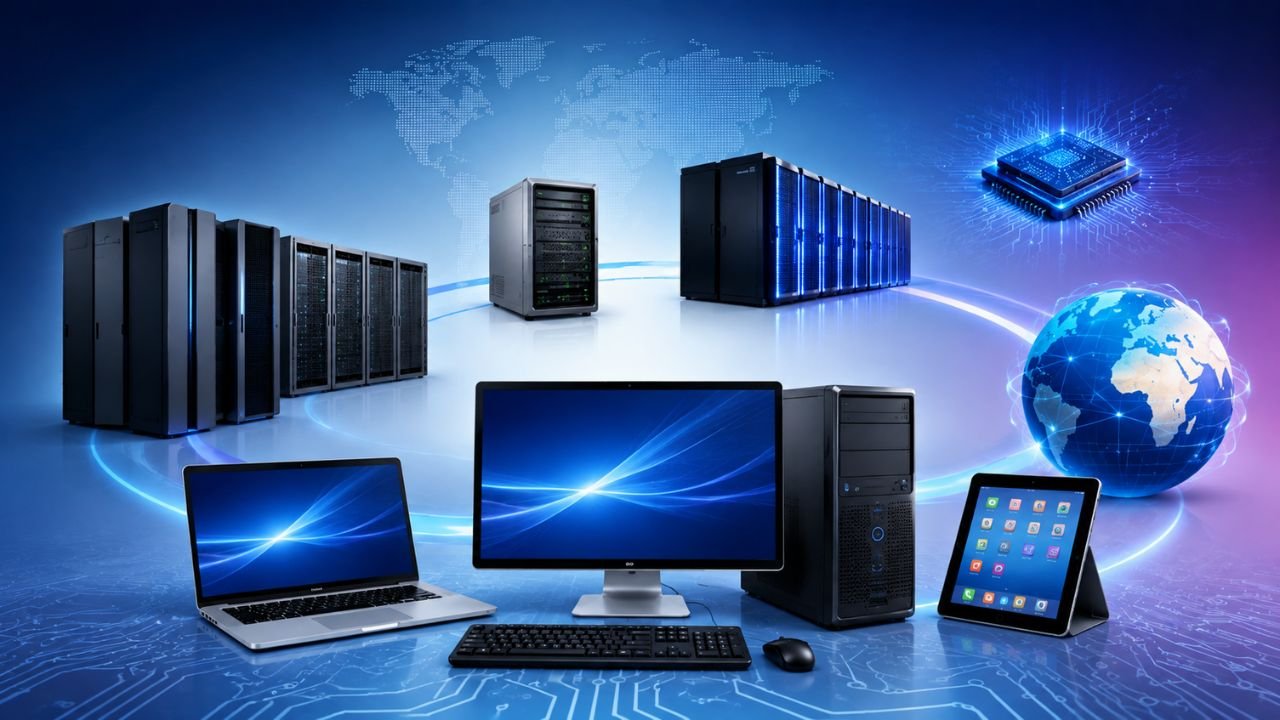
Dear aspirants, Computers are divided into different types according to their size, speed, and the work they do. Learning these types is important because questions about them are often asked in SSC, JKSSB, Banking, Railway, Defence, Police, State PSC, and many other competitive exams. In this article, you will learn about Super Computers, Mainframe Computers, Mini Computers, Micro Computers, Analog Computers, Digital Computers, and Hybrid Computers.
Classification of Computers
Computers are mainly classified into four categories:
- Super Computers
- Mainframe Computers
- Mini Computers
- Micro Computers
1. Micro Computers
Microcomputers are the smallest and most commonly used computers. They are designed for individual users and are widely used in homes, schools, colleges, and offices.
Features
- Originated in the 1970s
- Uses an 8-bit processor
- Small in size
- Low cost
- Designed for a single user
Examples
- Personal Computer (PC)
- Notebook
- Tablet
Important Facts
- PDA stands for Personal Digital Assistant.
- A PDA can be held on the palm and uses a pen (stylus) for input.
- Workstations are generally used by groups of professionals such as engineers.
- According to the book, the first laptop was developed by EPSON in 1981.
2. Mini Computers
Mini computers are more powerful than micro computers and support multiple users at the same time.
Features
- Used in multi-user systems
- Smaller than mainframe computers
- Commonly used as servers
- Used in industries for real-time applications
Examples
- HP 9000
- IBM i7
- PDP-11
Important Fact
- PDP-8 was the first Mini Computer according to the book.
3. Mainframe Computers
Mainframe computers are very large and powerful computers designed to process huge amounts of data simultaneously.
Features
- Also called Big Iron
- Can handle thousands of users simultaneously
- Multi-user and multiprogramming systems
- Used as terminals
- Widely used in banks, transportation, and e-commerce
Uses
- Banking
- Railway reservation systems
- Government departments
- Large business organizations
4. Super Computers
Super computers are the fastest and most powerful computers in the world. They are mainly used for scientific research and solving highly complex calculations.
Features
- Most expensive type of computer
- Speed is measured in FLOPS (Floating Point Operations Per Second)
- Performance can reach PetaFLOPS (10¹⁵ FLOPS)
Uses
- Weather forecasting
- Climate research
- Space research
- Oil and gas exploration
- Nuclear research
Important Super Computers
- CRAY-1 – World’s first super computer
- PARAM 8000 – India’s first super computer
- PARAM Shivay – First super computer ingeniously assembled in India
- Pratyush – India’s first Multi PetaFLOP super computer (as stated in the book)
- EKA – Asia’s first super computer
Modern Super Computers Mentioned
- FUGAKU
- FRONTIER
- SUNWAY
- SUMMIT
- TITAN
Classification Based on Data Processing
Apart from size and performance, computers are also classified according to the type of data they process.
Analog Computers
Analog computers work with continuously changing data.
Features
- Introduced by Lord Kelvin
- Performs mathematical or logical operations
- Processes continuously varying values
Example
- Speedometer
- Seismograph
- Voltmeter
Important Fact
India’s first analog computer was developed by Samarendra Kumar Mitra.
Digital Computers
Digital computers work with discrete signals and use binary numbers (0 and 1).
Features
- Works on discrete signals
- Uses binary digits (0 and 1)
- Most commonly used type of computer today
Examples
- Smartphone
- Laptop
Hybrid Computers
Hybrid computers combine the features of both analog and digital computers.
Features
- Uses both analog and digital signals
- Converts analog signals into digital form
Examples
- ECG machines
- Radar systems
- Traffic control systems
Quick Revision Table
| Type | Main Feature | Examples |
|---|---|---|
| Micro Computer | Small, low cost, single user | PC, Laptop, Tablet |
| Mini Computer | Multi-user, used as servers | HP 9000, IBM i7, PDP-11 |
| Mainframe Computer | Handles thousands of users | Banks, Railways, E-commerce |
| Super Computer | Fastest and most powerful | PARAM 8000, CRAY-1, FUGAKU |
| Data Processing Type | Works On | Examples |
|---|---|---|
| Analog Computer | Continuous signals | Speedometer, Voltmeter |
| Digital Computer | Binary (0 & 1) | Smartphone, Laptop |
| Hybrid Computer | Analog + Digital | ECG, Radar |
Conclusion
We hope this article from Exam Waves Coaching Academy helped you understand the Classification of Computers in a simple way. Computers are of different types, and each type is made for a different purpose. For example, Micro Computers are used by people every day, while Super Computers are used for scientific research and solving very complex problems.
Analog, Digital, and Hybrid Computers are also different because they process data in different ways. This topic is very important for SSC, JKSSB, Banking, Railway, Defence, Police, UPSC, State PSC, and other competitive exams, so make sure to revise it well before your exam.
Important MCQs on Classification of Computers for all Competitive Exams
Q1. Which of the following statements are correct regarding Micro Computers?
- They are designed mainly for a single user.
- They originated during the 1970s.
- They generally use an 8-bit processor.
A) 1 only
B) 1 and 2 only
C) 2 and 3 only
D) 1, 2 and 3
✅ Answer: D
Q2. Which one of the following correctly matches the type of computer with its feature?
A) Mainframe Computer — Single User
B) Mini Computer — First generation only
C) Super Computer — Highest processing speed
D) Micro Computer — Scientific research only
✅ Answer: C
Q3. Which of the following statements are correct regarding Mainframe Computers?
- They are also known as Big Iron.
- They support thousands of users simultaneously.
- They are widely used in banks and railway reservation systems.
A) 1 only
B) 1 and 2 only
C) 2 and 3 only
D) 1, 2 and 3
✅ Answer: D
Q4. Arrange the following types of computers in ascending order of processing power.
- Micro Computer
- Mini Computer
- Mainframe Computer
- Super Computer
A) 1 → 2 → 3 → 4
B) 2 → 1 → 3 → 4
C) 1 → 3 → 2 → 4
D) 2 → 3 → 1 → 4
✅ Answer: A
Q5. Which one of the following is the first Mini Computer?
A) PDP-8
B) IBM 1401
C) Apple II
D) PARAM 8000
✅ Answer: A
Q6. Which of the following statements are correct regarding Super Computers?
- They are the fastest computers.
- Their speed is measured in FLOPS.
- They are mainly used for scientific research.
A) 1 only
B) 1 and 2 only
C) 2 and 3 only
D) 1, 2 and 3
✅ Answer: D
Q7. Which one of the following is correctly matched?
A) PARAM 8000 — World’s first Super Computer
B) CRAY-1 — India’s first Super Computer
C) PARAM 8000 — India’s first Super Computer
D) EKA — First Mini Computer
✅ Answer: C
Q8. Which of the following are common applications of Super Computers?
- Weather forecasting
- Space research
- Oil exploration
A) 1 only
B) 1 and 2 only
C) 2 and 3 only
D) 1, 2 and 3
✅ Answer: D
Q9. Which one of the following computers works with continuously changing data?
A) Digital Computer
B) Analog Computer
C) Hybrid Computer
D) Micro Computer
✅ Answer: B
Q10. Which of the following statements are correct regarding Analog Computers?
- They process continuous signals.
- Lord Kelvin is associated with Analog Computers.
- Speedometers are examples of Analog Computers.
A) 1 only
B) 1 and 2 only
C) 2 and 3 only
D) 1, 2 and 3
✅ Answer: D
Q11. Which one of the following correctly describes a Digital Computer?
A) Works only with continuous data
B) Uses binary digits (0 and 1)
C) Uses analog signals only
D) Cannot store information
✅ Answer: B
Q12. Which of the following statements are correct regarding Hybrid Computers?
- They combine Analog and Digital Computers.
- ECG machines are examples of Hybrid Computers.
- They process both analog and digital signals.
A) 1 only
B) 1 and 2 only
C) 2 and 3 only
D) 1, 2 and 3
✅ Answer: D
Q13. Match List-I with List-II.
List-I
- Analog Computer
- Digital Computer
- Hybrid Computer
- Super Computer
List-II
a. Scientific Research
b. Binary Digits
c. Continuous Signals
d. ECG Machine
A) 1-c, 2-b, 3-d, 4-a
B) 1-b, 2-c, 3-a, 4-d
C) 1-d, 2-a, 3-c, 4-b
D) 1-c, 2-d, 3-b, 4-a
✅ Answer: A
Q14. Which of the following statements are correct?
- Mainframe Computers are multi-user systems.
- Mini Computers are generally used as servers.
- Micro Computers are designed mainly for individual users.
A) 1 only
B) 1 and 2 only
C) 2 and 3 only
D) 1, 2 and 3
✅ Answer: D
Q15. Which one of the following is NOT an example of a Micro Computer?
A) Desktop Computer
B) Laptop
C) Tablet
D) CRAY-1
✅ Answer: D
Q16. Arrange the following according to their usual size from smallest to largest.
- Micro Computer
- Mainframe Computer
- Mini Computer
- Super Computer
A) 1 → 3 → 2 → 4
B) 1 → 2 → 3 → 4
C) 3 → 1 → 2 → 4
D) 2 → 1 → 3 → 4
✅ Answer: A
Q17. Which of the following statements are correct regarding PDA (Personal Digital Assistant)?
- PDA stands for Personal Digital Assistant.
- It is a handheld Micro Computer.
- It uses a stylus (pen) for input.
A) 1 only
B) 1 and 2 only
C) 2 and 3 only
D) 1, 2 and 3
✅ Answer: D
Q18. Which one of the following correctly matches the computer type with its common application?
A) Super Computer — Weather Forecasting
B) Micro Computer — Space Research
C) Analog Computer — Railway Reservation
D) Mainframe Computer — Home Gaming
✅ Answer: A
Q19. Which of the following statements are correct?
- Mainframe Computers are widely used in banks.
- Digital Computers use binary digits.
- Hybrid Computers combine the features of Analog and Digital Computers.
A) 1 only
B) 1 and 2 only
C) 2 and 3 only
D) 1, 2 and 3
✅ Answer: D
Q20. Which of the following correctly represents the classification of computers discussed in the article?
- Micro Computer
- Mini Computer
- Mainframe Computer
- Super Computer
- Analog Computer
- Digital Computer
- Hybrid Computer
A) Only 1–4
B) Only 5–7
C) Only 1–6
D) All of the above
✅ Answer: D