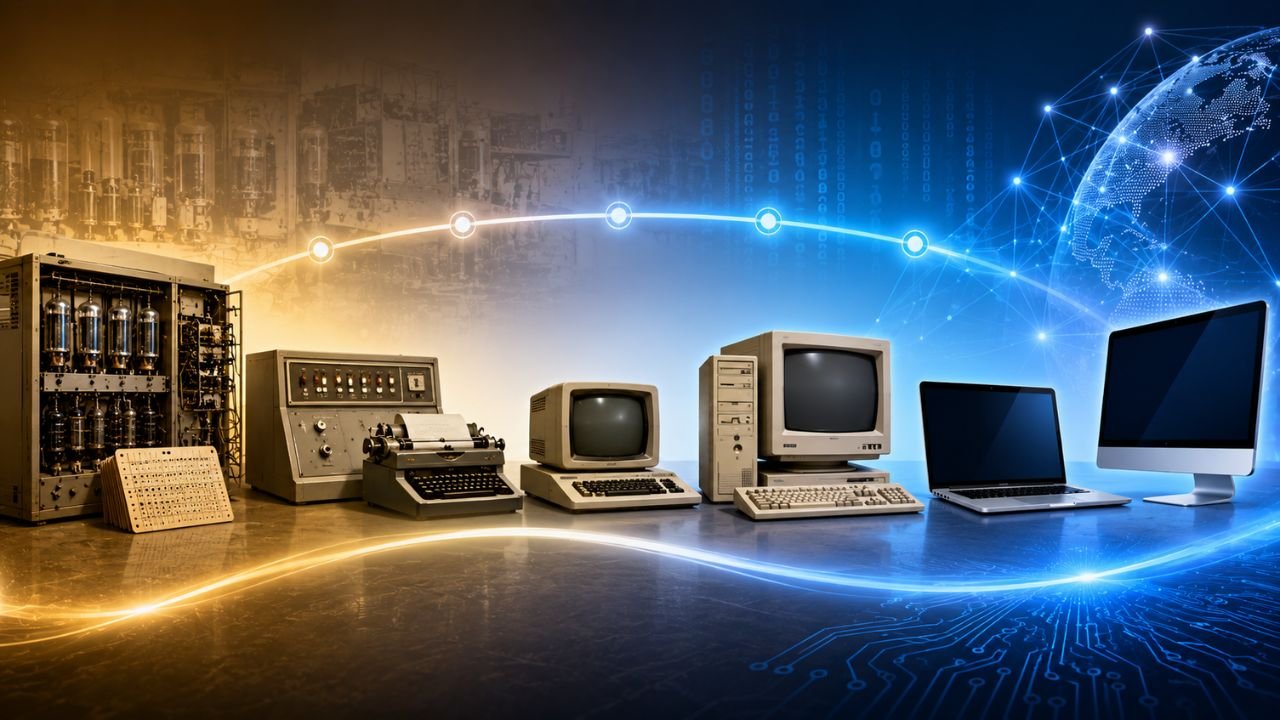
Dear friends, the Generations of Computers is one of the most important topics in Computer Awareness and is frequently asked in SSC, JKSSB, Banking, Railway, Defence, Police, State PSC, and other competitive examinations. Understanding the characteristics, hardware technology, programming languages, speed, operating systems, and examples of each generation helps candidates solve both objective and descriptive questions.
What are the Generations of Computers?
The development of computers is divided into five generations based on the technology used in their construction. Every new generation brought improvements in speed, size, storage, reliability, and processing capability.
First Generation Computers (1940–1956)
The first generation of computers used vacuum tubes as the primary electronic component. These computers were very large, generated a lot of heat, consumed high power, and were mainly used for scientific work.
Features
| Component | Details |
|---|---|
| Generation | First Generation |
| Period | 1940–1956 |
| Hardware | Vacuum Tubes |
| Memory | Magnetic Drums |
| Input | Punch Cards |
| Language | Machine Language (0s and 1s) |
| Speed | Milliseconds |
| Size | Very Large |
| Operating System | No Operating System, Simple Batch Processing |
| Applications | Scientific Purposes |
Examples
- ENIAC
- EDVAC
- UNIVAC
- IBM 650
- IBM 701
Important Computers of the First Generation
ENIAC (Electronic Numerical Integrator and Computer)
- Developed in 1946
- Developed by John Mauchly and J. Presper Eckert
- First general-purpose electronic computer
- Used vacuum tubes
EDVAC (Electronic Discrete Variable Automatic Computer)
- Developed using the stored-program concept
- Invented by John Mauchly, J. Presper Eckert, and John Von Neumann
- Used automatic calculation
EDSAC (Electronic Delay Storage Automatic Calculator)
- Developed in 1949
- Developed by Maurice Wilkes
- First stored-program computer
UNIVAC (Universal Automatic Computer)
- Developed in 1951
- First commercial computer
- Used for business and scientific applications
ABC (Atanasoff–Berry Computer)
- Developed in 1942
- Developed by Vincent Atanasoff and Clifford Berry
- First automatic electronic digital computer
- Used bits for storage
Harvard Mark-I
- First electromechanical automatic calculator
- Developed by Howard Aiken
- Also known as ASCC (Automatic Sequence Controlled Calculator)
Second Generation Computers (1956–1963)
The second generation replaced vacuum tubes with transistors, making computers smaller, cheaper, faster, and more reliable.
Features
| Component | Details |
|---|---|
| Generation | Second Generation |
| Period | 1956–1963 |
| Hardware | Transistors |
| Primary Memory | Magnetic Core Memory |
| Secondary Memory | Magnetic Tapes and Magnetic Disks |
| Programming Languages | Assembly Language, COBOL, FORTRAN |
| Input | Punch Cards |
| Speed | Microseconds |
| Applications | Commercial Purposes |
Examples
- PDP-8
- IBM 1401
- CDC 1604
- UNIVAC 1107
- CDC 3600
- Honeywell 400
Third Generation Computers (1964–1971)
The third generation introduced Integrated Circuits (ICs), making computers faster, smaller, and more efficient.
Features
| Component | Details |
|---|---|
| Generation | Third Generation |
| Period | 1964–1971 |
| Hardware | Integrated Circuits (ICs) |
| IC Developed By | Jack Kilby and Robert Noyce (1958) |
| Languages | High-Level Languages (BASIC, ALGOL) |
| Speed | Nanoseconds |
| Interface | Keyboard and Monitor through Operating System |
Examples
- IBM 360
- IBM 370
- PDP-11
- PDP-8
- Honeywell 6000
- DEC Series
Important Fact
IBM 360 was the first digital computer built with Integrated Circuits (ICs).
Fourth Generation Computers (1971–Present)
The fourth generation introduced microprocessors, which significantly increased computing power while reducing size and cost.
Features
| Component | Details |
|---|---|
| Generation | Fourth Generation |
| Period | 1971–Present |
| Hardware | Microprocessor |
| Technology | LSI and VLSI |
| First Microprocessor | Intel 4004 |
| Developed By | Intel Corporation (1971) |
| Operating Systems | Windows, MS-DOS |
| Interface | GUI (Graphical User Interface) |
| Speed | Picoseconds |
Examples
- DEC 10
- IBM 4341
- Apple II
Fifth Generation Computers (Present–Next)
The fifth generation focuses on Artificial Intelligence (AI) and advanced processing technologies.
Features
| Component | Details |
|---|---|
| Generation | Fifth Generation |
| Technology | Artificial Intelligence |
| Hardware | ULSI |
| Processing | Parallel Processing |
| Speed | Femtoseconds |
Quick Comparison Table
| Generation | Period | Main Technology | Speed |
|---|---|---|---|
| First | 1940–1956 | Vacuum Tubes | Milliseconds |
| Second | 1956–1963 | Transistors | Microseconds |
| Third | 1964–1971 | Integrated Circuits | Nanoseconds |
| Fourth | 1971–Present | Microprocessors | Picoseconds |
| Fifth | Present–Next | Artificial Intelligence & ULSI | Femtoseconds |
Important Facts for Competitive Exams
- First-generation computers used Vacuum Tubes.
- First-generation memory used Magnetic Drums.
- Machine Language (0s and 1s) was used in the First Generation.
- ENIAC was the first general-purpose electronic computer.
- EDSAC was the first stored-program computer.
- UNIVAC was the first commercial computer.
- Second Generation computers used Transistors.
- COBOL and FORTRAN were developed during the Second Generation.
- Third Generation computers introduced Integrated Circuits (ICs).
- ICs were developed by Jack Kilby and Robert Noyce.
- IBM 360 was the first digital computer built with ICs.
- Fourth Generation introduced the Microprocessor.
- Intel 4004 was the first microprocessor.
- Windows and MS-DOS became important operating systems during the Fourth Generation.
- Fifth Generation computers are based on Artificial Intelligence, ULSI, and Parallel Processing.
Conclusion
In Conclusion, Computers have changed a lot over time. In the beginning, they were very big and slow, but today they are small, fast, and very powerful. Each new generation of computers brought better technology and improved performance. Learning the Generations of Computers helps students understand how computers have developed over the years. This topic is very important for SSC, JKSSB, Banking, Railway, Defence, Police, UPSC, State PSC, and other competitive exams, so students should revise it carefully before the exam.
Important MCQ’S on Generations of Computers for all Exams 2026
Q1. Which of the following statements are correct regarding the First Generation of computers?
- They used Vacuum Tubes.
- They used Magnetic Drums as primary memory.
- Machine Language was mainly used.
A) 1 only
B) 1 and 2 only
C) 2 and 3 only
D) 1, 2 and 3
✅ Answer: D
Q2. Which one of the following correctly matches the generation with its technology?
A) First Generation — Transistors
B) Second Generation — Vacuum Tubes
C) Third Generation — Integrated Circuits
D) Fourth Generation — Magnetic Drums
✅ Answer: C
Q3. Arrange the following computer generations in chronological order.
- Fourth Generation
- First Generation
- Third Generation
- Second Generation
A) 2 → 4 → 3 → 1
B) 2 → 3 → 4 → 1
C) 2 → 4 → 1 → 3
D) 4 → 3 → 2 → 1
✅ Answer: A
Q4. Which of the following statements are correct regarding the Second Generation of computers?
- Transistors replaced Vacuum Tubes.
- Magnetic Core Memory was introduced.
- COBOL and FORTRAN were widely used.
A) 1 only
B) 1 and 2 only
C) 2 and 3 only
D) 1, 2 and 3
✅ Answer: D
Q5. Which computer generation introduced Integrated Circuits (ICs)?
A) First Generation
B) Second Generation
C) Third Generation
D) Fourth Generation
✅ Answer: C
Q6. Which of the following statements are correct regarding the Third Generation?
- Integrated Circuits (ICs) were used.
- Computers became smaller and faster.
- BASIC and ALGOL were popular programming languages.
A) 1 only
B) 1 and 2 only
C) 2 and 3 only
D) 1, 2 and 3
✅ Answer: D
Q7. Which one of the following is an example of a First Generation computer?
A) IBM 360
B) Apple II
C) ENIAC
D) PDP-11
✅ Answer: C
Q8. Which of the following statements are correct regarding the Fourth Generation?
- Microprocessors were introduced.
- LSI and VLSI technologies were used.
- GUI-based operating systems became popular.
A) 1 only
B) 1 and 2 only
C) 2 and 3 only
D) 1, 2 and 3
✅ Answer: D
Q9. Intel 4004 is associated with which computer generation?
A) First Generation
B) Second Generation
C) Third Generation
D) Fourth Generation
✅ Answer: D
Q10. Which of the following correctly matches the computer generation with its speed?
A) First Generation — Nanoseconds
B) Second Generation — Picoseconds
C) Third Generation — Nanoseconds
D) Fourth Generation — Microseconds
✅ Answer: C
Q11. Which of the following statements are correct regarding the Fifth Generation?
- Artificial Intelligence is the main technology.
- Parallel Processing is used.
- ULSI technology is associated with this generation.
A) 1 only
B) 1 and 2 only
C) 2 and 3 only
D) 1, 2 and 3
✅ Answer: D
Q12. Match List-I with List-II.
List-I (Generation)
- First Generation
- Second Generation
- Third Generation
- Fourth Generation
List-II (Technology)
a. Microprocessor
b. Integrated Circuit
c. Vacuum Tube
d. Transistor
A) 1-c, 2-d, 3-b, 4-a
B) 1-d, 2-c, 3-a, 4-b
C) 1-c, 2-b, 3-d, 4-a
D) 1-a, 2-d, 3-c, 4-b
✅ Answer: A
Q13. Which one of the following programming languages was commonly used in the Second Generation?
A) BASIC
B) ALGOL
C) COBOL
D) Java
✅ Answer: C
Q14. Which of the following statements are correct?
- UNIVAC was a First Generation computer.
- IBM 360 belonged to the Third Generation.
- Apple II belonged to the Fourth Generation.
A) 1 only
B) 1 and 2 only
C) 2 and 3 only
D) 1, 2 and 3
✅ Answer: D
Q15. Which generation introduced Graphical User Interface (GUI)?
A) First Generation
B) Second Generation
C) Third Generation
D) Fourth Generation
✅ Answer: D
Q16. Arrange the following technologies in the order of their introduction.
- Vacuum Tubes
- Transistors
- Integrated Circuits
- Microprocessors
A) 1 → 2 → 3 → 4
B) 2 → 1 → 3 → 4
C) 1 → 3 → 2 → 4
D) 2 → 3 → 1 → 4
✅ Answer: A
Q17. Which of the following statements are correct regarding computer generations?
- Each new generation improved speed and reliability.
- Computer size became smaller with each generation.
- Processing capability increased in every generation.
A) 1 only
B) 1 and 2 only
C) 2 and 3 only
D) 1, 2 and 3
✅ Answer: D
Q18. Which one of the following is correctly matched?
A) Vacuum Tubes — Fourth Generation
B) Transistors — Second Generation
C) Microprocessor — Third Generation
D) Artificial Intelligence — First Generation
✅ Answer: B
Q19. Which generation is mainly based on Artificial Intelligence?
A) Second Generation
B) Third Generation
C) Fourth Generation
D) Fifth Generation
✅ Answer: D
Q20. Which of the following statements correctly describes the evolution of computer generations?
- Vacuum Tubes were replaced by Transistors.
- Transistors were replaced by Integrated Circuits.
- Integrated Circuits were replaced by Microprocessors.
A) 1 only
B) 1 and 2 only
C) 2 and 3 only
D) 1, 2 and 3
✅ Answer: D