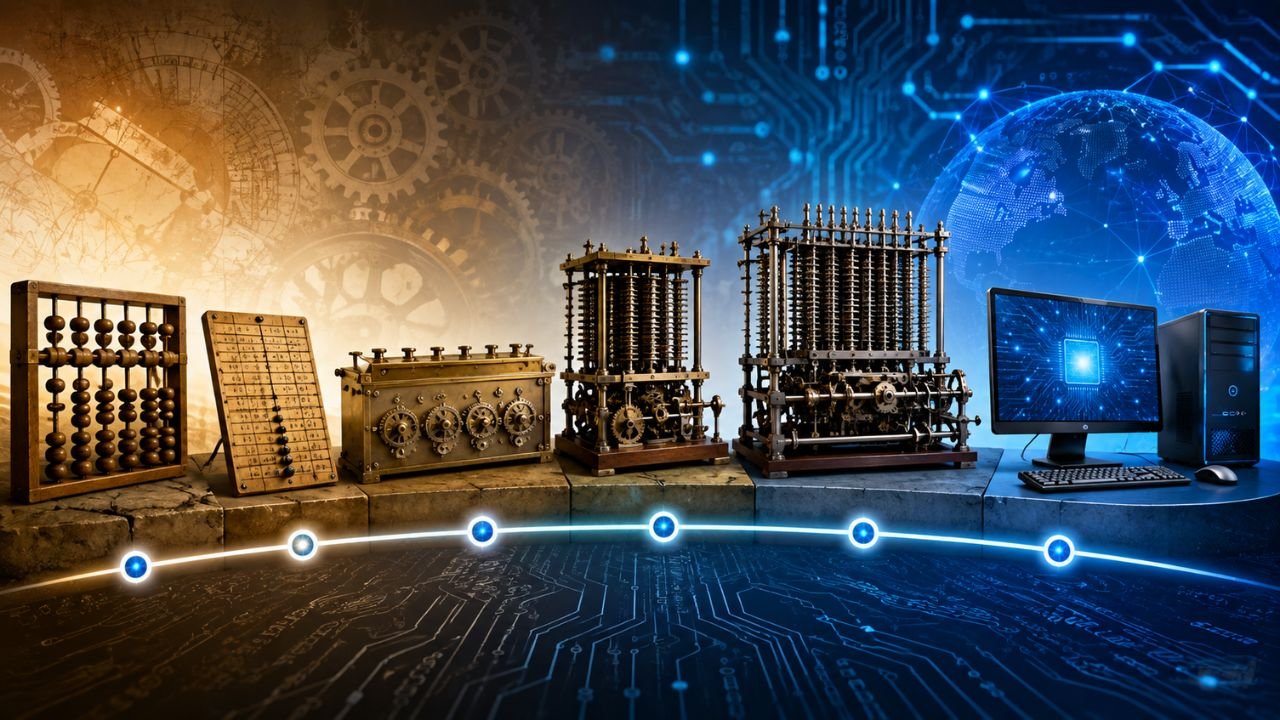
The Evolution of Computer is one of the most important topics in Computer Awareness and is frequently asked in SSC, JKSSB, Banking, Railway, Defence, Police, State PSC, UPSC, and other competitive examinations. Questions are commonly asked about the Abacus, Napier’s Bones, Pascal’s Machine, Analytical Engine, ENIAC, UNIVAC, and other important milestones.
What is the Evolution of Computer?
The Evolution of Computer refers to the gradual development of calculating devices from simple manual tools to modern computers. Early devices were designed to perform arithmetic calculations, while later inventions introduced automatic computation, data storage, and programmable machines.
Timeline of the Evolution of Computer
| Device | Year | Inventor | Importance |
|---|---|---|---|
| Abacus | Around 1600 BC | China | First calculating board |
| Napier’s Bones | 1617 | John Napier | Multiplication device |
| Slide Rule | Developed by William Oughtred | William Oughtred | Basic arithmetic operations |
| Pascal’s Machine | 1642 | Blaise Pascal | First digital adding machine |
| Leibniz Calculator | 1672 | Gottfried Wilhelm Leibniz | Performed all arithmetic operations |
| Punch Card | 1801 | Joseph Marie Jacquard | Controlled machines; later used as computer input |
| Difference Engine | 1822 | Charles Babbage | Mechanical calculating machine |
| Analytical Engine | 1837 | Charles Babbage | First general-purpose mechanical computer |
1. Abacus
The Abacus is regarded as the earliest calculating device.
Important Facts
- Invented around 1600 BC in China
- A calculating board used for counting
- Considered the first mechanical device for counting large numbers
- Tim Cranmer is mentioned in the book as a new creator of the Abacus.
2. Napier’s Bones
Napier’s Bones was an important mathematical calculating device.
Important Facts
- Built in 1617 AD
- Invented by John Napier
- Mainly used for multiplication
- Based on the Rabdology technique
- Rectangular in shape
3. Slide Rule
The Slide Rule became an important calculating instrument before electronic calculators.
Important Facts
- Developed by William Oughtred
- Used for basic arithmetic operations
4. Pascal’s Machine
Pascal’s Machine marked the beginning of automatic mechanical calculation.
Important Facts
- Invented by Blaise Pascal in 1642
- First digital adding machine
- Worked on the principle of a clock and odometer
- Mechanical and automatic calculator
5. Leibniz Calculator
Leibniz improved mechanical computation by introducing more arithmetic operations.
Important Facts
- Invented by Gottfried Wilhelm Leibniz in 1672
- Famous for the Stepped Drum
- Also known as the Reckoning Machine
- Could perform:
- Addition (+)
- Subtraction (−)
- Multiplication (×)
- Division (÷)
6. Punch Card
Punch Cards played an important role in early computer programming.
Important Facts
- Developed by Joseph Marie Jacquard in 1801
- Used to control machines
- Later became an important input method for early computers
7. Difference Engine
The Difference Engine was designed to perform complex mathematical calculations.
Important Facts
- Developed by Charles Babbage in 1822
- Mechanical calculating machine
- Designed to calculate polynomial functions
- Operated using steam with gears and shafts
8. Analytical Engine
The Analytical Engine is regarded as the foundation of the modern computer.
Important Facts
- Developed by Charles Babbage in 1837
- First general-purpose mechanical computer
- Included:
- Input-Output system
- Control Unit
- Memory
- Used punch cards for input
Quick Revision Table
| Device | Inventor | Year | Important Fact |
|---|---|---|---|
| Abacus | China | Around 1600 BC | First calculating board |
| Napier’s Bones | John Napier | 1617 | Multiplication device |
| Slide Rule | William Oughtred | — | Basic arithmetic calculations |
| Pascal’s Machine | Blaise Pascal | 1642 | First digital adding machine |
| Leibniz Calculator | Gottfried Wilhelm Leibniz | 1672 | Performed all arithmetic operations |
| Punch Card | Joseph Marie Jacquard | 1801 | Used to control machines |
| Difference Engine | Charles Babbage | 1822 | Mechanical calculating machine |
| Analytical Engine | Charles Babbage | 1837 | First general-purpose mechanical computer |
Important Facts for Competitive Exams
- The word Computer is derived from the Latin word Computare, meaning to calculate.
- The Abacus was invented around 1600 BC in China.
- John Napier invented Napier’s Bones.
- William Oughtred developed the Slide Rule.
- Blaise Pascal invented Pascal’s Machine in 1642.
- Pascal’s Machine was the first digital adding machine.
- Gottfried Wilhelm Leibniz invented the Leibniz Calculator.
- The Leibniz Calculator is also known as the Reckoning Machine.
- Joseph Marie Jacquard developed the Punch Card.
- Charles Babbage developed the Difference Engine in 1822.
- Charles Babbage developed the Analytical Engine in 1837.
- The Analytical Engine included an Input-Output Unit, Memory, and Control Unit.
- The Analytical Engine used Punch Cards as an input method.
Important MCQs on Evolution of Computer for all Competitive Exams
Q1. Which of the following statements are correct regarding the Abacus?
- It is considered the earliest calculating device.
- It was invented around 1600 BC in China.
- It was mainly used for counting large numbers.
A) 1 only
B) 1 and 2 only
C) 2 and 3 only
D) 1, 2 and 3
✅ Answer: D
Q2. Which one of the following pairs is correctly matched?
A) Napier’s Bones — Blaise Pascal
B) Pascal’s Machine — Charles Babbage
C) Difference Engine — Charles Babbage
D) Punch Card — Alan Turing
✅ Answer: C
Q3. Which of the following statements are correct regarding Napier’s Bones?
- It was invented by John Napier.
- It was developed in 1617.
- It was mainly used for multiplication.
A) 1 only
B) 1 and 2 only
C) 2 and 3 only
D) 1, 2 and 3
✅ Answer: D
Q4. Which one of the following devices was developed by William Oughtred?
A) Abacus
B) Slide Rule
C) Punch Card
D) Difference Engine
✅ Answer: B
Q5. Which of the following statements are correct regarding Pascal’s Machine?
- It was invented by Blaise Pascal.
- It was developed in 1642.
- It is regarded as the first digital adding machine.
A) 1 only
B) 1 and 2 only
C) 2 and 3 only
D) 1, 2 and 3
✅ Answer: D
Q6. Which one of the following statements correctly describes the Leibniz Calculator?
A) It could perform only addition.
B) It is also known as the Reckoning Machine.
C) It was invented by Charles Babbage.
D) It used vacuum tubes.
✅ Answer: B
Q7. Which of the following statements are correct regarding the Leibniz Calculator?
- It was invented in 1672.
- It was invented by Gottfried Wilhelm Leibniz.
- It could perform addition, subtraction, multiplication, and division.
A) 1 only
B) 1 and 2 only
C) 2 and 3 only
D) 1, 2 and 3
✅ Answer: D
Q8. Which one of the following inventions is associated with Joseph Marie Jacquard?
A) Difference Engine
B) Analytical Engine
C) Punch Card
D) Slide Rule
✅ Answer: C
Q9. Which of the following statements are correct regarding the Punch Card?
- It was developed in 1801.
- It was initially used to control weaving machines.
- It later became an important input method in early computers.
A) 1 only
B) 1 and 2 only
C) 2 and 3 only
D) 1, 2 and 3
✅ Answer: D
Q10. Which one of the following statements correctly describes the Difference Engine?
A) It was developed by Alan Turing.
B) It was a mechanical calculating machine designed by Charles Babbage.
C) It was India’s first computer.
D) It was the first electronic computer.
✅ Answer: B
Q11. Which of the following statements are correct regarding the Analytical Engine?
- It was developed in 1837.
- It is regarded as the first general-purpose mechanical computer.
- It used punch cards for input.
A) 1 only
B) 1 and 2 only
C) 2 and 3 only
D) 1, 2 and 3
✅ Answer: D
Q12. Which one of the following components was included in Charles Babbage’s Analytical Engine?
A) Vacuum Tubes
B) Microprocessor
C) Memory
D) Transistors
✅ Answer: C
Q13. Arrange the following inventions in chronological order.
- Pascal’s Machine
- Leibniz Calculator
- Punch Card
- Difference Engine
A) 1 → 2 → 3 → 4
B) 2 → 1 → 3 → 4
C) 1 → 3 → 2 → 4
D) 2 → 3 → 1 → 4
✅ Answer: A
Q14. Which of the following statements are correct?
- Charles Babbage developed both the Difference Engine and the Analytical Engine.
- The Analytical Engine included a Memory Unit and Control Unit.
- The Analytical Engine is regarded as the foundation of modern computers.
A) 1 only
B) 1 and 2 only
C) 2 and 3 only
D) 1, 2 and 3
✅ Answer: D
Q15. Match List I with List II and choose the correct answer.
List I (Device)
- Abacus
- Pascal’s Machine
- Difference Engine
- Analytical Engine
List II (Feature)
a. First digital adding machine
b. First general-purpose mechanical computer
c. Earliest calculating device
d. Mechanical calculating machine
A) 1-c, 2-a, 3-d, 4-b
B) 1-a, 2-c, 3-b, 4-d
C) 1-c, 2-d, 3-a, 4-b
D) 1-d, 2-a, 3-c, 4-b
✅ Answer: A