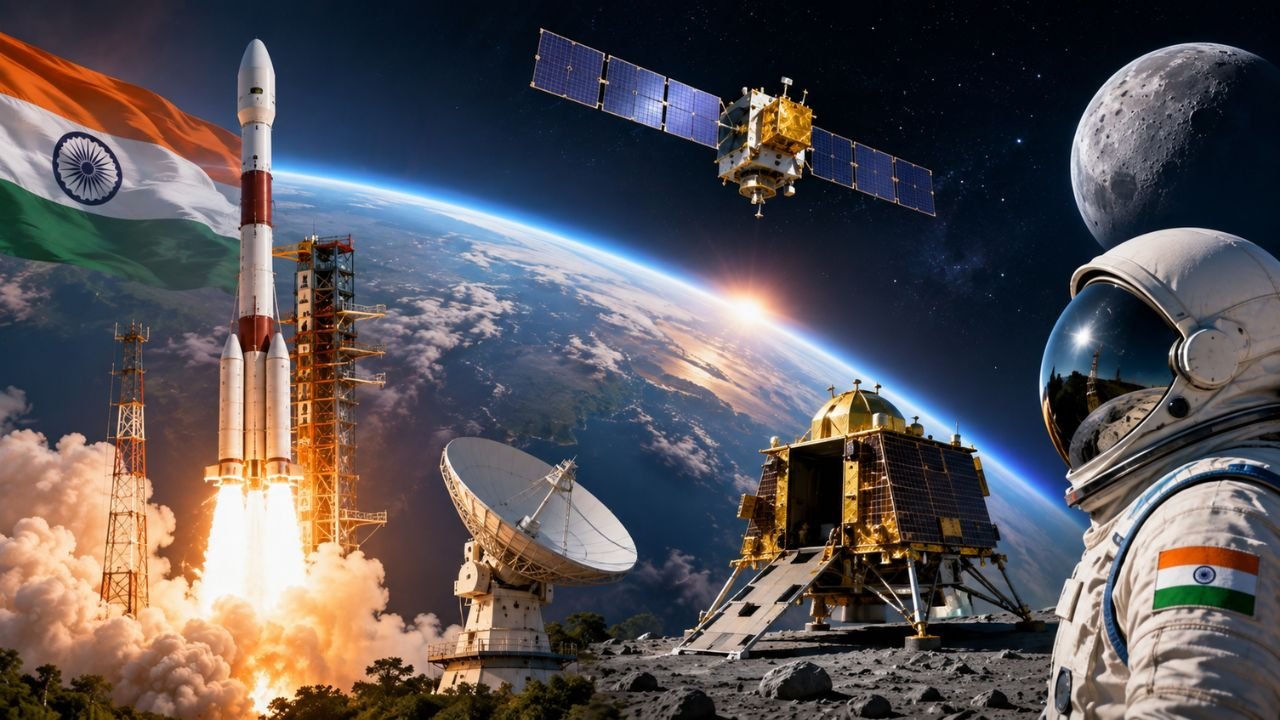
India’s Space Programme is one of the most important topics in Static GK and General Science. Questions related to ISRO, Aryabhata, Chandrayaan, PSLV, GSLV, Aditya-L1, Gaganyaan, and major space milestones are frequently asked in SSC, UPSC, Banking, Railway, Defence, JKSSB, Police, State PSC, and other competitive examinations.
India’s space programme has made remarkable progress since its inception and has achieved several historic milestones in satellite technology, launch vehicles, planetary exploration, and space research.
Overview of India’s Space Programme
| Particular | Details |
|---|---|
| Space Agency | Indian Space Research Organisation (ISRO) |
| Established | 15 August 1969 |
| Headquarters | Bengaluru |
| Parent Department | Department of Space |
| Founder of ISRO | Vikram Sarabhai |
| First Chairman of ISRO | Vikram Sarabhai |
| Current Launch Centre | Satish Dhawan Space Centre |
| First Indian Satellite | Aryabhata |
Father of India’s Space Programme
Dr. Vikram Sarabhai is regarded as the Father of India’s Space Programme. Under his leadership, ISRO was established and India’s space research activities expanded significantly.
Major Milestones of India’s Space Programme
| Year | Event |
|---|---|
| 1962 | INCOSPAR established |
| 1963 | First sounding rocket launched from Thumba |
| 1969 | ISRO established |
| 1975 | Aryabhata satellite launched |
| 1980 | Rohini satellite placed in orbit by SLV-3 |
| 1984 | Rakesh Sharma became the first Indian in space |
| 1994 | First successful PSLV launch |
| 2008 | Chandrayaan-1 |
| 2013 | Mars Orbiter Mission (Mangalyaan) |
| 2017 | Record launch of 104 satellites |
| 2019 | Chandrayaan-2 |
| 2023 | Chandrayaan-3 successful Moon landing |
| 2023 | Aditya-L1 launched |
| 2024 | Aditya-L1 reached Halo Orbit around L1 |
First Indian Satellites
Aryabhata
India’s first satellite marked the country’s entry into the space age.
| Particular | Details |
|---|---|
| Launch Date | 19 April 1975 |
| Launch Country | Soviet Union |
| Named After | Aryabhata (Indian Mathematician) |
| Importance | First Indian Satellite |
Brief Explanation
- Aryabhata marked India’s entry into space.
- It was primarily used for scientific experiments.
Bhaskara-I
Bhaskara-I was one of India’s early Earth observation satellites.
| Particular | Details |
|---|---|
| Launch Year | 1979 |
| Purpose | Earth Observation |
Brief Explanation
- Used for remote sensing.
- Helped in collecting meteorological data.
Rohini
Rohini became a major milestone in India’s launch capability.
| Particular | Details |
|---|---|
| Launch Year | 1980 |
| Launch Vehicle | SLV-3 |
Brief Explanation
- First satellite successfully placed in orbit using an Indian launch vehicle.
Important Facts for Competitive Exams
- ISRO stands for Indian Space Research Organisation.
- ISRO was established on 15 August 1969.
- ISRO headquarters is located in Bengaluru.
- Vikram Sarabhai is the Founder and First Chairman of ISRO.
- Satish Dhawan Space Centre is India’s current launch centre.
- Aryabhata was India’s first satellite.
- Aryabhata was launched on 19 April 1975 from the Soviet Union.
- Bhaskara-I was developed for Earth observation.
- Rohini became the first satellite placed into orbit using an Indian launch vehicle (SLV-3).
- Rakesh Sharma became the first Indian in space in 1984.
- PSLV achieved its first successful launch in 1994.
- Chandrayaan-1 was launched in 2008.
- Mars Orbiter Mission (Mangalyaan) was launched in 2013.
- ISRO successfully launched a record 104 satellites in 2017.
- Chandrayaan-2 was launched in 2019.
- Chandrayaan-3 achieved a successful Moon landing in 2023.
- Aditya-L1 was launched in 2023.
- Aditya-L1 reached the Halo Orbit around L1 in 2024.
Conclusion
India’s Space Programme has transformed the nation into a leading space power through advancements in satellite technology, launch vehicles, lunar exploration, and planetary missions. A clear understanding of ISRO, major milestones, and the first Indian satellites is essential for candidates preparing for SSC, UPSC, Banking, Railway, JKSSB, Defence, State PSC, and other competitive examinations.
Important MCQ’S on India’s Space Programme (2026)
Q1. Which of the following statements are correct?
- ISRO stands for Indian Space Research Organisation.
- ISRO was established on 15 August 1969.
- ISRO functions under the Department of Space.
A) 1 only
B) 1 and 2 only
C) 2 and 3 only
D) 1, 2 and 3
✅ Answer: D
Q2. Which one of the following pairs is correctly matched?
A) Vikram Sarabhai — Founder and First Chairman of ISRO
B) Rakesh Sharma — Founder of ISRO
C) Aryabhata — First Indian Astronaut
D) Rohini — First Sounding Rocket
✅ Answer: A
Q3. Which of the following statements are correct?
- ISRO headquarters is located in Bengaluru.
- Satish Dhawan Space Centre is India’s current launch centre.
- Vikram Sarabhai is regarded as the Father of India’s Space Programme.
A) 1 only
B) 1 and 2 only
C) 2 and 3 only
D) 1, 2 and 3
✅ Answer: D
Q4. Arrange the following milestones in chronological order.
- INCOSPAR established
- First sounding rocket launched from Thumba
- ISRO established
A) 1–2–3
B) 2–1–3
C) 3–2–1
D) 2–3–1
✅ Answer: A
Q5. Which one of the following statements correctly describes Aryabhata?
A) First satellite launched by PSLV
B) First Indian satellite launched from the Soviet Union
C) First satellite launched from Sriharikota
D) First communication satellite of India
✅ Answer: B
Q6. Which of the following statements are correct regarding Aryabhata?
- It was launched on 19 April 1975.
- It was named after the Indian mathematician Aryabhata.
- It was primarily used for scientific experiments.
A) 1 only
B) 1 and 2 only
C) 2 and 3 only
D) 1, 2 and 3
✅ Answer: D
Q7. Bhaskara-I is associated with which of the following?
A) Human Spaceflight
B) Earth Observation
C) Lunar Exploration
D) Mars Exploration
✅ Answer: B
Q8. Which of the following statements are correct regarding Bhaskara-I?
- It was launched in 1979.
- It was developed for Earth observation.
- It was used for remote sensing and meteorological data collection.
A) 1 only
B) 1 and 2 only
C) 2 and 3 only
D) 1, 2 and 3
✅ Answer: D
Q9. Which one of the following pairs is correctly matched?
A) Rohini — SLV-3
B) Aryabhata — PSLV
C) Bhaskara-I — GSLV
D) Chandrayaan-1 — SLV-3
✅ Answer: A
Q10. Which of the following statements are correct regarding Rohini?
- It was launched in 1980.
- It became the first satellite placed into orbit using an Indian launch vehicle.
- It was launched using SLV-3.
A) 1 only
B) 1 and 2 only
C) 2 and 3 only
D) 1, 2 and 3
✅ Answer: D
Q11. Which one of the following milestones occurred in 1984?
A) First successful PSLV launch
B) Chandrayaan-1
C) Rakesh Sharma became the first Indian in space
D) Rohini satellite launched
✅ Answer: C
Q12. Arrange the following events in chronological order.
- Aryabhata launched
- Rohini launched
- Rakesh Sharma became the first Indian in space
A) 1–2–3
B) 2–1–3
C) 1–3–2
D) 3–2–1
✅ Answer: A
Q13. Which of the following statements are correct?
- PSLV achieved its first successful launch in 1994.
- Chandrayaan-1 was launched in 2008.
- Mars Orbiter Mission (Mangalyaan) was launched in 2013.
A) 1 only
B) 1 and 2 only
C) 2 and 3 only
D) 1, 2 and 3
✅ Answer: D
Q14. Which one of the following achievements took place in 2017?
A) Chandrayaan-2 launched
B) Chandrayaan-3 Moon landing
C) Record launch of 104 satellites
D) Aditya-L1 launched
✅ Answer: C
Q15. Which of the following statements are correct?
- Chandrayaan-2 was launched in 2019.
- Chandrayaan-3 achieved a successful Moon landing in 2023.
- Both missions are part of India’s lunar exploration programme.
A) 1 only
B) 1 and 2 only
C) 2 and 3 only
D) 1, 2 and 3
✅ Answer: D
Q16. Which one of the following pairs is incorrectly matched?
A) Chandrayaan-1 — 2008
B) Mangalyaan — 2013
C) Aditya-L1 Launch — 2024
D) Chandrayaan-3 Moon Landing — 2023
✅ Answer: C
Q17. Which of the following statements are correct regarding Aditya-L1?
- It was launched in 2023.
- It reached the Halo Orbit around L1 in 2024.
- It is one of India’s major space missions.
A) 1 only
B) 1 and 2 only
C) 2 and 3 only
D) 1, 2 and 3
✅ Answer: D
Q18. Arrange the following major space missions in chronological order.
- Chandrayaan-1
- Mangalyaan
- Chandrayaan-2
- Chandrayaan-3
A) 1–2–3–4
B) 2–1–3–4
C) 1–3–2–4
D) 3–1–2–4
✅ Answer: A
Q19. Which one of the following events occurred most recently according to the given data?
A) Chandrayaan-3 Moon Landing
B) Aditya-L1 Launch
C) Aditya-L1 reached Halo Orbit around L1
D) Record launch of 104 satellites
✅ Answer: C
Q20. Which of the following statements are correct?
- India’s Space Programme has significantly advanced satellite technology and planetary exploration.
- ISRO, Aryabhata, Rohini, Chandrayaan, and Aditya-L1 are important milestones in India’s space journey.
- These topics are frequently asked in competitive examinations.
A) 1 only
B) 1 and 2 only
C) 2 and 3 only
D) 1, 2 and 3
✅ Answer: D