
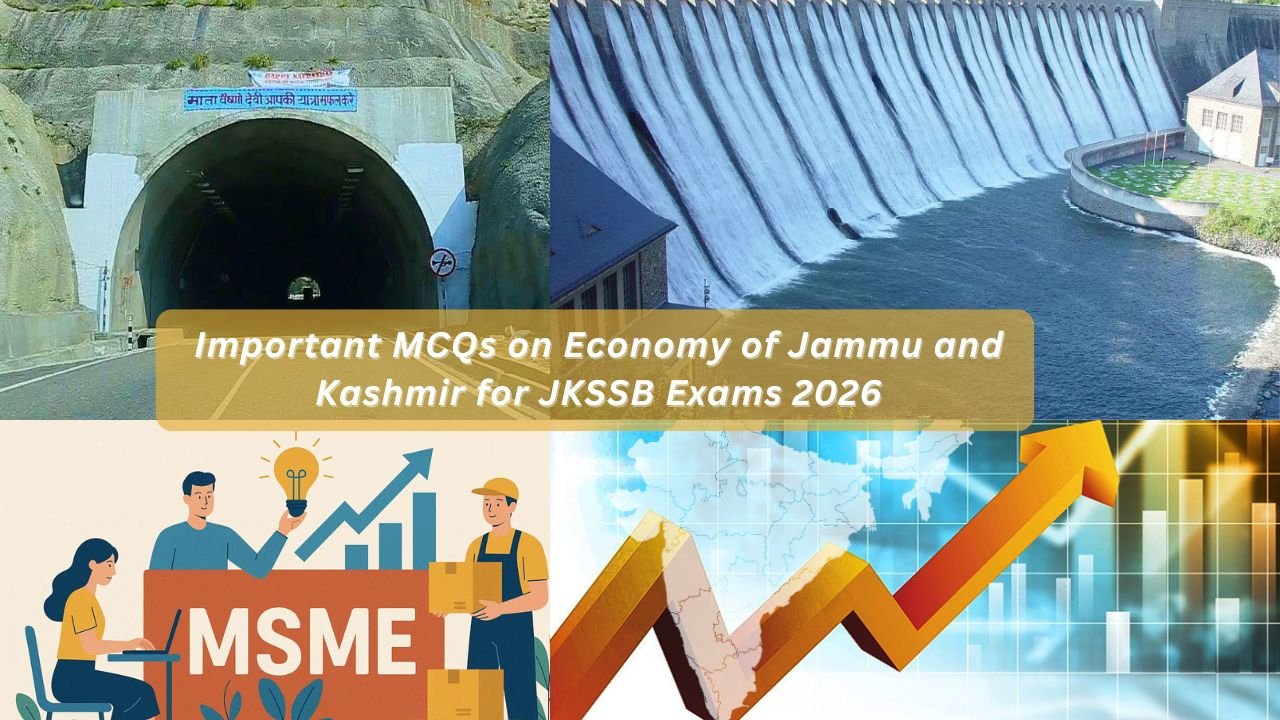
Dear aspirants, In this article, we provide important MCQs on the economy of Jammu and Kashmir for all JKSSB Exams 2026. It covers key topics like industries, power projects, government schemes, transport, and economic facts. These MCQS will help you to understand key topics in the Economy of Jammu and Kashmir.
Q1. Jammu and Kashmir Energy Development Authority was set up in the year?
a) 1967
b) 1993
c) 1989
d) 1991
The right Answer is: c) 1989
Brief Explanation
The Jammu and Kashmir Energy Development Authority was established in 1989. Its main aim is to promote renewable energy sources such as solar, wind etc.
Q2. At which of the following spot is the J&K Govt. going to set up 100 MW geothermal plant?
a) Kathua
b) Reasi
c) Poonch
d) Samba
The right Answer is: b) Reasi
Brief Explanation
Reasi district has geothermal energy potential due to underground heat resources. Because of this natural advantage, Reasi has been identified for setting up a 100 MW geothermal power plant. This project will help in producing clean energy and reducing dependence on fossil fuels.
Q3. Which of the following is responsible for power generation and distribution of electricity in the UT?
a) JKPDCL
b) JKPCL
c) JKPDC
d) JKPD
The right Answer is: a) JKPDCL
Brief Explanation
Jammu and Kashmir Power Development Corporation Limited (JKPDCL) is responsible for power generation and distribution in the Union Territory. It manages electricity supply, power projects, and transmission to ensure the availability of power to households, industries, and government institutions across Jammu and Kashmir.
Q4. Consider the following and choose the correct one?
a) The PDD was set up in 1995
b) J&K has hydro power potential of 20000 MW
c) The PDD is also responsible for Renewable energy
d) None
a) abcd
b) ab
c) bc
d) none
The right Answer is: b) ab
Brief Explanation
The Power Development Department (PDD) was set up in 1995. Jammu and Kashmir has a large hydropower potential of about 20,000 MW. Renewable energy development is mainly handled by JAKEDA, not directly by PDD. Therefore, only statements a and b are correct.
Q5. Cement industry at Wayan was set up in the year?
a) 1897
b) 1982
c) 1962
d) 1952
The right Answer is: c) 1962
Brief Explanation
The cement industry at Wayan was established in the year 1962. It was set up to support construction and infrastructure development in Jammu and Kashmir. The plant helped in meeting local cement demand and reduced dependence on supplies from outside the region.
Q6. Silk factory at Rambagh, Srinagar was set up in the year?
a) 1885
b) 1897
c) 1881
d) 1902
The right Answer is: b) 1897
Brief Explanation
The silk factory at Rambagh was set up in 1897. It played an important role in promoting the silk industry in Kashmir. The factory helped local farmers, improved silk production, and contributed to employment generation and economic development in the region.
Q7.In J&K, MSME was set up in the year?
a) 1958
b) 1961
c) 1967
d) 1963
The right Answer is: a) 1958
Brief Explanation
MSME was set up in the year 1958 to support small and medium industries. It helps entrepreneurs by providing financial assistance, training, and development support. MSME plays an important role in employment generation and economic growth in Jammu and Kashmir.
Q8. Jammu and Kashmir Road Transport Corporation came into existence in the year?
a) 1st September 1967
b) 1st September 1971
c) 1st September 1972
d) 1st September 1976
The right Answer is: d) 1st September 1976
Brief Explanation
The Jammu and Kashmir Road Transport Corporation (JKRTC) was established on 1st September 1976. It was formed to provide organized and affordable road transport services to people across Jammu and Kashmir, especially in remote and hilly areas where private transport was limited.
Q9. Consider the following and choose the correct one?
a) Banihal–Qazigund Tunnel is on NH-44
b) It is 8.45 km long
c) Its construction began in 2011
d) Completed in the year 2021
a) abc
b) abd
c) bcd
d) abcd
The right Answer is: d) abcd
Brief Explanation
The Banihal–Qazigund Tunnel is located on National Highway-44. It is about 8.45 km long. Construction work started in 2011 and the tunnel was completed in 2021. It provides all-weather connectivity between the Kashmir Valley and Jammu region.
Q10. Choose the correct statement about Chenani–Nashri Tunnel?
a) It is also known as the “Atal Bihari Vajpayee Tunnel”
b) Its work started in 2011
c) It is 17 km long
d) Its work was completed in the year 2019
a) abcd
b) bcd
c) c only
d) b only
The right Answer is: d) b only
Brief Explanation
The Chenani–Nashri Tunnel construction work started in 2011. It is officially known as the Dr. Syama Prasad Mookerjee Tunnel, not Atal Bihari Vajpayee Tunnel. Its length is about 9 km, and it was inaugurated earlier than 2019, making only option b correct.
Q11. Consider the following and choose the correct statement?
a) Establishment of J&K Industries Limited — 1963
b) Establishment of KVIB — 1965
c) Establishment of SIDCO — 1967
d) Establishment of SICOP — 1975
a) ab
b) abcd
c) acd
d) cd
The right Answer is: b) abcd
Brief Explanation
Jammu and Kashmir Industries Limited was established in 1963. KVIB was set up in 1965 to promote village industries. SIDCO was established in 1967 to support industrial growth. SICOP was formed in 1975 to help small-scale industries. All the given establishment years are correct.
Q12. Consider the following about the New Industrial Policy 2021 and choose the correct statement?
a) Its slogan is “Tradition, Growth and Transformation”
b) One of the purposes is the development of backward regions
c) ₹28,400 crore funds were allocated
d) Maximum growth opportunities
a) ab
b) acd
c) bcd
d) abcd
The right Answer is: d) abcd
Brief Explanation
The New Industrial Policy 2021–30 aims to promote growth and transformation. Its slogan focuses on tradition, growth, and development. It targets backward regions and provides large financial support of ₹28,400 crore. The policy also focuses on creating maximum growth and employment opportunities in Jammu and Kashmir.
Q13. Which tunnel is also called the Banihal Tunnel?
a) Chenani–Nashri
b) Jawahar Tunnel
c) Nandani
d) Chattergala
The right Answer is: b) Jawahar Tunnel
Brief Explanation
The Banihal Tunnel is also known as the Jawahar Tunnel. It connects Jammu with the Kashmir Valley through the Pir Panjal range. This tunnel was constructed to provide all-weather road connectivity and is an important part of National Highway-44.
Q14. Which tunnel is between Sonamarg and Gagangir?
a) Zoji La Tunnel
b) Z-Morh
c) Chattergala
d) Nandani
The right Answer is: b) Z-Morh
Brief Explanation
The Z-Morh Tunnel is located between Sonamarg and Gagangir. It is being constructed to ensure all-weather connectivity on the Srinagar–Leh highway. This tunnel will reduce travel time and improve transportation, tourism, and defence movement in the region.
Q15. When was the Railway line between Jammu and Pathankot established?
a) 1906
b) 1975
c) 1968
d) 1987
The right Answer is: b) 1975
Brief Explanation
The railway line between Jammu and Pathankot was established in 1975. This railway link improved connectivity between Jammu and the rest of India. It played an important role in trade, passenger movement, and overall economic development of the Jammu region.
Q16. Consider the following and choose the correct one?
a) Chenab Railway Bridge is in Reasi
b) It is between Bakal and Kauri
c) Its height is 395 m
d) It is part of USBRL
a) abc
b) bcd
c) abcd
d) bc
The right Answer is: c) abcd
Brief Explanation
The Chenab Railway Bridge is located in Reasi district. It lies between Bakal and Kauri villages and has a height of about 395 meters, making it the world’s highest railway bridge. It is a part of the Udhampur–Srinagar–Baramulla Rail Link (USBRL) project.
Q17. Consider the following regarding Anji Khad Bridge and choose the correct one?
a) It is in the district of Reasi
b) It is under USBRL
c) It is constructed by Konkan Railway Corporation
d) Its height is 425 m
a) abcd
b) abd
c) bcd
d) abc
The right Answer is: d) abc
Brief Explanation
The Anji Khad Bridge is located in Reasi district of Jammu and Kashmir. It is part of the Udhampur–Srinagar–Baramulla Rail Link (USBRL) project. The bridge is constructed by Konkan Railway Corporation. The height 331m not 425m.
Q18. How many international airports are in J&K?
a) 1
b) 2
c) 3
d) 4
The right Answer is: a) 1
Brief Explanation
Jammu and Kashmir has only one international airport, which is Srinagar International Airport. Jammu Airport is a domestic airport. Therefore, the correct number of international airports in Jammu and Kashmir is one, making option (a) the correct answer.
Q19. Consider the following about Srinagar International Airport?
a) Also known as Sheikh ul Alam Airport
b) It is the 2nd international airport of J&K
c) Inaugurated on 14 Feb 2009
d) It is owned by Indian Army
a) abcd
b) bcd
c) ac
d) cd
The right Answer is: c) ac
Brief Explanation
Srinagar International Airport is also known as Sheikh ul Alam Airport. It was inaugurated on 14 February 2009. Jammu and Kashmir has only one international airport, so statement (b) is incorrect. The airport is operated by the Airports Authority of India, not owned by the Indian Army.
Q20. Jhelum–Chenab–Indus–Ravi have been declared as National Waterways in the year?
a) 2011
b) 2012
c) 2013
d) 2014
The right Answer is: c) 2013
Brief Explanation
The rivers Jhelum, Chenab, Indus, and Ravi were declared National Waterways in the year 2013. This step was taken to promote inland water transport in the region. National Waterway status helps in improving transport, trade, and economic development through river navigation.
Q21. First newspaper of J&K in Urdu was?
a) Gitanjali
b) Ranbir
c) Pratap
d) None
The right Answer is: b) Ranbir – 1924
Brief Explanation
The first Urdu newspaper of Jammu and Kashmir was Ranbir, started in the year 1924. It played an important role in spreading awareness and information among the people. Other options like Gitanjali and Pratap were not Urdu newspapers of J&K.
Q22. Consider the following and choose the correct one?
a) Radio Kashmir was started in the year 1947
b) Doordarshan Kendra setup in 2003
c) First printing press started in 1924
d) The EDI was setup 1997
a) abc
b) bcd
c) a & d
d) a, c & d
The right Answer is: d) a, c & d
Brief Explanation
Radio Kashmir started broadcasting in 1947. The first printing press in Jammu and Kashmir began in 1924. The Entrepreneurship Development Institute (EDI) was set up in 1997. Doordarshan Kendra was t established in not set up in 2003
Q23. According to the Indus Water Treaty, the Eastern Rivers were given to India. Choose the incorrect one.
a Sutlej
b) Ravi
c) Beas
d) Indus
The right Answer is: d) Indus
Brief Explanation
Under the Indus Water Treaty, India was given control over the eastern rivers—Ravi, Beas, and Sutlej. The Indus River is a western river and was given to Pakistan. Therefore, Indus is the incorrect option among the eastern rivers listed.
Q24. Who built the Budshah Bridge?
a) Sheikh Abdullah
b) Bakshi Ghulam Mohammad
c) G.M. Sadiq
d) Farooq Abdullah
The right Answer is: b) Bakshi Ghulam Mohammad
Brief Explanation
The Budshah Bridge in Srinagar was built in 1957 during the tenure of Bakshi Ghulam Mohammad. He played an important role in the development of infrastructure in Jammu and Kashmir. Other leaders listed were not associated with the construction of this bridge.
Q25. Consider the following and choose the correct one?
Power Project River
a) Pakal Dul Marsurdar river
b) Salal Chenab River
c) Chenani Tawi
d) Uri Jehlum
a) BCD
b) ABCD
c) BC
d) ABC
The right Answer is: b) ABCD
Brief Explanation
The Salal Power Project is on the Chenab River, Chenani is linked with the Tawi River, and the Uri Power Project is on the Jhelum River. These power projects are important hydroelectric sources in Jammu and Kashmir, making all given pairs correct.
Q26. Choose the correct one about power projects and districts.
Power Project District
a) Bursar Reasi
b) Kishanganga Ganderbal
c) Kiru Kishtwar
d) Baglihar Ramban
a) abcd
b) bcd
c) ab
d) cd
The right Answer is: a) abcd
Brief Explanation
Bursar Power Project is located in the Reasi district. The Kishanganga Project is in the Ganderbal district. The Kiru Power Project is situated in Kishtwar, while Baglihar Power Project is in Ramban district. All the given pairs of power projects and districts are correctly matched.
Q27. Which one of the power projects is proposed to be built on Marusudar River?
a) Bursar
b) Kiru
c) Ratle
d) Kishanganga
The right Answer is: a) Bursar
Brief Explanation
The Bursar Hydroelectric Power Project is proposed to be built on the Marusudar River, which is a tributary of the Chenab River. This project is one of the largest planned power projects in Jammu and Kashmir and is important for future power generation.
Q28. Consider the following and choose the correct one.
Power Project Capacity
a) Kishanganga 330 MW
b) Bursar 800 MW
c) Ratle 850 MW
d) Baglihar 450 MW
a) abcd
b) bcd
c) ac
d) c only
The right Answer is: a) abcd
Brief Explanation
Kishanganga Hydroelectric Project has a capacity of 330 MW. Bursar Power Project has a planned capacity of 800 MW. Ratle Power Project has a capacity of 850 MW, and Baglihar Hydroelectric Project has a capacity of 450 MW. All the given capacities are correct.
Q29. What is the capacity of Uri-II?
a) 480 MW
b) 240 MW
c) 800 MW
d) 330 MW
The right Answer is: b) 240 MW
Brief Explanation
Uri-II Hydroelectric Project is located on the Jhelum River in the Baramulla district. It has an installed capacity of 240 MW. This project was developed after Uri-I and plays an important role in power generation for Jammu and Kashmir.
Q30. What is the percentage of NHPC in the Chenab Valley Power Project (CVPP) Pvt.?
a) 49%
b) 50%
c) 47.5%
d) 45%
The right Answer is: a) 49%
Brief Explanation
NHPC holds 49% share in Chenab Valley Power Projects Private Limited (CVPP). The remaining share is held by Jammu and Kashmir State Power Development Corporation. This joint venture develops major hydroelectric projects in the Chenab Valley region.
Q31. What is the contribution of India Limited in CVPP Pvt.?
a) 5%
b) 2%
c) 4%
d) 3%
The right Answer is: b) 2%
Brief Explanation
In Chenab Valley Power Projects Pvt. Ltd., Power Finance Corporation (India Limited) contributes 2% equity. NHPC and JKSPDC hold the major shares. This structure helps in funding and smooth implementation of large hydroelectric projects in Jammu and Kashmir.
Q32. Which one of the power projects is correct? Choose the correct.
a) Salal Power Project is in Reasi on Chenab River
b) Dulhasti is in Kishtwar
c) Capacity of Salal is 690 MW
d) Capacity of Dulhasti is 390 MW
a) a b c & d
b) bc & d
c) a & b
d) a & d
The right Answer is: a) abcd
Brief Explanation
Salal Hydroelectric Project is located in Reasi district on the Chenab River and has a planned capacity of 690 MW. Dulhasti Project has a capacity of 390 MW but is located mainly in the Kishtwar district.
Q33. What is the percentage of the horticulture sector in Jammu’s total economy?
a) 8–10%
b) 6–8%
c) 10–12%
d) 12–16%
The right Answer is: a) 8–10%
Brief Explanation
Horticulture is an important part of Jammu’s economy and contributes around 8–10 percent. Crops like apples, walnuts, almonds, and cherries provide employment and income to a large population. This sector plays a key role in rural economic development.
Q34. Consider the following and choose the correct one (One Product – One District)?
Product District
a) Baramulla Apples
b) Pulwama Saffron
c) Kulgam Spices
d) Samba Mushroom
a) a b c & d
b) a b & c
c) b & d
d) c & a
The right Answer is: a) a & b
Brief Explanation
Under the One District One Product scheme, Baramulla is well known for apples and Pulwama is famous for saffron. Spices are mainly associated with Kulgam. Mushroom is associated with samba
Q35. Choose the correct answer about One District – One Product?
Product District
a) Lavender Doda
b) Honey Ramban
c) Picles Udhampur
d) Flowers Srinagar
a) a, b, c & d
b) a & b
c) b & c
d) b & c
The right Answer is: a) a, b, c & d
Brief Explanation
Above all are correctly matched
Q36. What is the aim of the HIMAYAT Programme in J&K
a) Skill development and youth placement
b) Horticulture development
c) Tourism development
d) None
The right Answer is: a) Skill development and youth placement
Brief Explanation
HIMAYAT is a skill development programme in Jammu and Kashmir. Its main aim is to provide training to youth and help them get jobs in different sectors. The programme focuses on improving employability and reducing unemployment among educated and uneducated youth.
Q37. SAKSHAM Scheme main aim is ?
a) Financial assistance to small farmers
b) Promote tourism
c) Sports promotion
d) Women empowerment
The right Answer is: a) Financial assistance to small farmers
Brief Explanation
SAKSHAM Scheme is launched to support small and marginal farmers by providing financial assistance. The scheme helps farmers improve agricultural productivity, adopt modern farming practices, and strengthen their income. It mainly focuses on economic support rather than tourism, sports, or women empowerment.
Q38. UTHA Scheme is related to?
a) Education
b) Poultry
c) Horticulture
d) Women
The right Answer is: c) Horticulture
Brief Explanation
UTHA Scheme is linked with horticulture development in Jammu and Kashmir. It supports farmers engaged in fruit and vegetable cultivation by improving infrastructure, planting material, and market access. The scheme helps boost horticulture production and strengthens the rural economy of the region.
Q39. One of the following is an aromatic crop of J&K?
a) Lavender
b) Cotton
c) Sugarcane
d) Rice
The right Answer is: a) Lavender
Brief Explanation
Lavender is an important aromatic crop grown in Jammu and Kashmir. It is used for producing essential oils and perfumes. Lavender cultivation has increased in recent years and provides a good income to farmers. Cotton, sugarcane, and rice are not aromatic crops.
Q40. What is the main aim of the SKEWPY Scheme?
a) Women entrepreneurship
b) Youth employment
c) Horticulture development
d) None
The right Answer is: b) Youth employment
Brief Explanation
The main aim of the SKEWPY Scheme is to promote youth employment in Jammu and Kashmir. It focuses on providing job opportunities, skill training, and self-employment options for young people. The scheme helps reduce unemployment and encourages youth participation in economic activities.
Q41. Which one of the following organizations is responsible for inter-state power transmission in Jammu and Kashmir?
a) J&K Power Transmission Corporation Limited
b) Jammu Electricity Regulatory Commission
c) Power Grid Corporation of India Limited
d) None
The right Answer is: c) Power Grid Corporation of India Limited
Brief Explanation
Power Grid Corporation of India Limited is responsible for inter-state power transmission across India, including Jammu and Kashmir. It manages high-voltage transmission lines that transfer electricity between states. State bodies handle internal distribution, while Power Grid looks after national-level transmission infrastructure.
Q42. When was J&K SERC established?
a) 2003
b) 2005
c) 2007
d) 2000
The right Answer is: b) 2005
Brief Explanation
The Jammu and Kashmir State Electricity Regulatory Commission (J&K SERC) was established in the year 2005. It regulates electricity tariffs, power distribution, and consumer interests in the region. The commission ensures fair pricing, efficient power supply, and proper regulation of the electricity sector.
Q43. The PIN code series of Jammu starts with?
a) 17
b) 18
c) 19
d) 41
The right Answer is: b) 18
Brief Explanation
The PIN code series for Jammu starts with the number 18. All postal PIN codes of Jammu and Kashmir begin with 18. This helps the postal department identify the region easily and ensures the correct and fast delivery of letters and parcels across the union territory.
Q44. When was the first POST OFFICE established in J&K ?
a) Srinagar 1867
b) Jammu 1870
c) Anantnag 1885
d) Leh 1905
The right Answer is: a) Srinagar – 1867
Brief Explanation
The first POST OFFICE in Jammu and Kashmir was established in Srinagar in the year 1867. It was built during the Dogra rule to manage prisoners and maintain law and order.
Q45. Where is Craft and Development Institute in J&K located?
a) Bemina
b) Rajbagh
c) Hyderpora
d) Batamaloo
The right Answer is: a) Bemina
Brief Explanation
The Craft and Development Institute (CDI) of Jammu and Kashmir is located at Bemina in Srinagar. The institute works to promote traditional handicrafts, provide skill training, support artisans, and preserve the rich cultural heritage of Jammu and Kashmir crafts.
Q46. What is the main aim of Mission YUVA scheme in Jammu and Kashmir?
a) Skill development and youth employment
b) Tourism promotion
c) Road construction
d) Women welfare
The right Answer is: a) Skill development and youth employment
Brief Explanation
Mission YUVA is a flagship scheme of Jammu and Kashmir aimed at empowering youth. The scheme focuses on skill development, entrepreneurship, and providing employment opportunities to young people so they can become self-reliant and financially independent.
Q47. Mission YUVA mainly targets which group of people?
a) Farmers
b) Government employees
c) Youth of Jammu and Kashmir
d) Senior citizens
The right Answer is: c) Youth of Jammu and Kashmir
Brief Explanation
Mission YUVA is specially designed for the youth of Jammu and Kashmir. It supports unemployed and aspiring young people by providing training, financial assistance, and guidance to start businesses and find employment opportunities.
Q48. Mission YUVA promotes which of the following?
a) Government jobs only
b) Entrepreneurship and self-employment
c) Military recruitment
d) Foreign employment
The right Answer is: b) Entrepreneurship and self-employment
Brief Explanation
Mission YUVA encourages youth to start their own businesses. The scheme promotes entrepreneurship, self-employment, and innovation so that young people can create jobs for themselves and others instead of depending only on government jobs.
Q49. Which type of support is provided under Mission YUVA?
a) Free land
b) Financial assistance and training
c) Free housing
d) Pension benefits
The right Answer is: b) Financial assistance and training
Brief Explanation
Under Mission YUVA, youth receive financial support, skill training, and mentoring. This help enables them to start small businesses, improve skills, and generate income, contributing to economic growth in Jammu and Kashmir.
Q50. Mission YUVA scheme mainly helps in reducing which problem?
a) Inflation
b) Unemployment
c) Migration
d) Illiteracy
The right Answer is: b) Unemployment
Brief Explanation
Mission YUVA aims to reduce unemployment by creating job opportunities for youth. Through skill development and entrepreneurship support, the scheme helps young people earn livelihoods and strengthens the economy of Jammu and Kashmir.



Q.43 answer is wrong 18 is correct not 19
Sorry Sir, you are right typing mistake and very thanks for your opinion