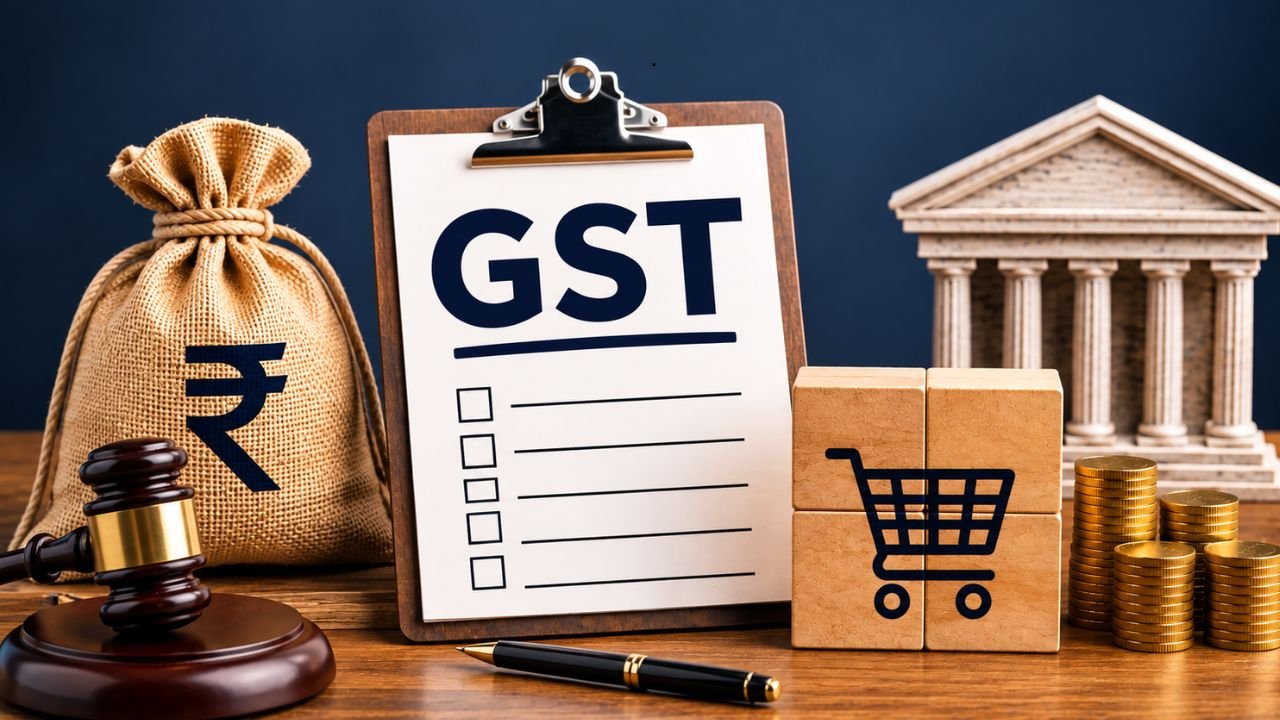
Prepare for Competitive Exams with these important MCQs on Goods and Services Tax (GST), specially prepared by Exam Waves. Practice key questions on GST basics, CGST, SGST, IGST, GST Council, tax slabs, and other important concepts for better exam preparation.
Q1. Consider the following statements regarding the history and introduction of GST in India:
- The Kelkar Task Force on Indirect Tax suggested a comprehensive GST based on the principle of VAT in 2003.
- The concept of “One Nation One Tax” emerged in connection with GST.
- The Constitution (122nd Amendment) Bill was introduced in 2014.
- GST was finally introduced in India on 1st July 2017.
Which of the statements given above are correct?
A) 1 and 2 only
B) 1, 2 and 3 only
C) 2, 3 and 4 only
D) 1, 2, 3 and 4
Answer: D
Q2. Consider the following statements regarding the Constitutional Framework of GST:
- GST required amendments to the Constitution.
- The Constitution (101st Amendment) Act was enacted in 2016.
- Article 246A gives both Parliament and State Legislatures concurrent powers to make laws regarding GST.
- GST was introduced without making any changes to the Constitution.
Which of the statements given above are correct?
A) 1 and 2 only
B) 1, 2 and 3 only
C) 2, 3 and 4 only
D) 1, 2, 3 and 4
Answer: B
Q3. Consider the following statements regarding Articles 269A and 279A:
- Article 269A deals with GST in the case of inter-state trade.
- GST on inter-state trade is levied and collected by the Central Government.
- Tax collected under Article 269A is shared between the Centre and States based on GST Council recommendations.
- Article 279A gives the President the power to constitute the GST Council and define its functions.
Which of the statements given above are correct?
A) 1 and 2 only
B) 1, 2 and 3 only
C) 2, 3 and 4 only
D) 1, 2, 3 and 4
Answer: D
Q4. Consider the following features of GST:
- GST is applicable to the supply of goods and services.
- GST follows a destination-based consumption taxation system.
- Tax is collected by the state where goods or services are consumed.
- Under the Dual GST Model, both Central and State Governments levy tax simultaneously on a common tax base.
Which of the statements given above are correct?
A) 1 and 2 only
B) 1, 2 and 3 only
C) 2, 3 and 4 only
D) 1, 2, 3 and 4
Answer: D
Q5. Consider the following components of GST:
- CGST stands for Central Goods and Services Tax.
- SGST stands for State Goods and Services Tax.
- UTGST stands for Union Territory Goods and Services Tax.
- IGST stands for Integrated Goods and Services Tax.
Which of the statements given above are correct?
A) 1 and 2 only
B) 1, 2 and 3 only
C) 2, 3 and 4 only
D) 1, 2, 3 and 4
Answer: D
Q6. Consider the following statements regarding CGST:
- CGST is levied on intra-state supply.
- It applies when a transaction takes place within the same state.
- CGST is collected by the Central Government.
- It is applicable on every transaction within the state as described in the given material.
Which of the statements given above are correct?
A) 1 and 2 only
B) 1, 2 and 3 only
C) 2, 3 and 4 only
D) 1, 2, 3 and 4
Answer: D
Q7. Consider the following statements regarding SGST:
- SGST is levied on intra-state supply.
- It applies to transactions taking place within the same state.
- SGST is collected by the State Government.
- SGST is applied along with CGST on the same transaction.
Which of the statements given above are correct?
A) 1 and 2 only
B) 1, 2 and 3 only
C) 2, 3 and 4 only
D) 1, 2, 3 and 4
Answer: D
Q8. Consider the following statements regarding UTGST and IGST:
- UTGST is applicable in Union Territories that do not have a legislature.
- UTGST is levied and collected by the Union Territory Government.
- UTGST is applied along with CGST.
- IGST is levied on inter-state supply between two different states.
Which of the statements given above are correct?
A) 1 and 2 only
B) 1, 2 and 3 only
C) 2, 3 and 4 only
D) 1, 2, 3 and 4
Answer: D
Q9. Consider the following statements regarding IGST:
- IGST is levied on inter-state supply.
- It is levied and collected by the Central Government.
- The amount collected is later distributed between the Centre and States.
- IGST is exclusively applicable to transactions occurring within the same state.
Which of the statements given above are correct?
A) 1 and 2 only
B) 1, 2 and 3 only
C) 2, 3 and 4 only
D) 1, 2, 3 and 4
Answer: B
Q10. Consider the following Central Taxes subsumed under GST as given in the material:
- Central Excise Duty
- Additional Excise Duty
- Service Tax
- Central Sales Tax
- Cesses and Surcharges
Which of the above are included?
A) 1, 2 and 3 only
B) 1, 2, 3 and 4 only
C) 2, 3, 4 and 5 only
D) 1, 2, 3, 4 and 5
Answer: D
Q11. Consider the following State Taxes subsumed under GST as given in the material:
- State VAT
- Sales Tax
- Luxury Tax
- Entry Tax/Octroi
- Entertainment Tax
- Taxes on lotteries, betting and gambling
Which of the above are included?
A) 1, 2 and 3 only
B) 1, 2, 3 and 4 only
C) 2, 3, 4, 5 and 6 only
D) 1, 2, 3, 4, 5 and 6
Answer: D
Q12. Consider the following taxes and duties listed as being outside GST:
- Customs Duty
- Stamp Duty
- Motor Vehicle Tax
- Surcharge on Customs Duty
- VAT on Petroleum Products
- VAT on Tobacco Products
- Anti-Dumping Duty
- Toll Tax
Which of the above are listed outside GST in the material?
A) 1, 2, 3 and 4 only
B) 1, 2, 3, 4 and 5 only
C) 2, 3, 4, 5, 6, 7 and 8 only
D) 1, 2, 3, 4, 5, 6, 7 and 8
Answer: D
Q13. Consider the following statements regarding the GST Council:
- Article 279A provides for the constitution of the GST Council.
- The President constitutes the GST Council.
- The Union Finance Minister acts as its Chairman.
- Finance/Tax Ministers of each State or their nominees are members.
Which of the statements given above are correct?
A) 1 and 2 only
B) 1, 2 and 3 only
C) 2, 3 and 4 only
D) 1, 2, 3 and 4
Answer: D
Q14. Consider the following statements regarding the voting structure of the GST Council:
- The Central Government has one-third of the voting power.
- State Governments together have two-thirds of the voting power.
- Decisions require a three-fourths majority.
- The Central Government alone has the power to approve every GST Council decision.
Which of the statements given above are correct?
A) 1 and 2 only
B) 1, 2 and 3 only
C) 2, 3 and 4 only
D) 1, 2, 3 and 4
Answer: B
Q15. Consider the following functions of the GST Council:
- It decides GST rates, exemptions and policies.
- It recommends tax structures.
- It recommends special provisions for states.
- It has no role in matters relating to GST rates or exemptions.
Which of the statements given above are correct?
A) 1 and 2 only
B) 1, 2 and 3 only
C) 2, 3 and 4 only
D) 1, 2, 3 and 4
Answer: B
Q16. Consider the following statements regarding CAG and the National Anti-Profiteering Authority (NAA):
- CAG stands for Comptroller and Auditor General.
- CAG checks financial records and ensures proper use of public funds.
- NAA is described as a statutory body under the GST Act (2017).
- NAA ensures that benefits of reduced tax rates or input tax credit are passed on to consumers.
Which of the statements given above are correct?
A) 1 and 2 only
B) 1, 2 and 3 only
C) 2, 3 and 4 only
D) 1, 2, 3 and 4
Answer: D
Q17. Consider the following GST Tax Slabs listed in the material:
- 0%
- 5%
- 12%
- 18%
- 28%
Which of the above are listed as GST tax slabs?
A) 1, 2 and 3 only
B) 1, 2, 3 and 4 only
C) 2, 3, 4 and 5 only
D) 1, 2, 3, 4 and 5
Answer: D
Q18. Consider the following GST slabs and their corresponding categories as given in the material:
- 0% (Nil Rate) — Milk, fruits, vegetables and fresh food items
- 5% — Essential goods and basic consumption items
- 18% — Electrical goods and many standard products
- 40% — Luxury goods, tobacco products and sin goods
Which of the above are correctly matched according to the image?
A) 1 and 2 only
B) 1, 2 and 3 only
C) 2, 3 and 4 only
D) 1, 2, 3 and 4
Answer: D
Q19. Consider the following statements regarding the Laffer Curve:
- The Laffer Curve was invented by Arthur Laffer.
- It shows the relationship between tax rates and tax revenue collected by the government.
- The curve is shown as an inverted U-shape.
- It indicates that both very low and very high tax rates may generate less revenue, while a moderate rate maximizes revenue.
Which of the statements given above are correct?
A) 1 and 2 only
B) 1, 2 and 3 only
C) 2, 3 and 4 only
D) 1, 2, 3 and 4
Answer: D
Q20. Consider the following statements regarding the overall structure and operation of GST:
- GST is a destination-based tax applicable to the supply of goods and services.
- CGST and SGST are applied to intra-state transactions.
- IGST applies to inter-state supply and is collected by the Central Government.
- The GST Council plays an important role in deciding rates, exemptions and policies.
Which of the statements given above are correct?
A) 1 and 2 only
B) 1, 2 and 3 only
C) 2, 3 and 4 only
D) 1, 2, 3 and 4
Answer: D